
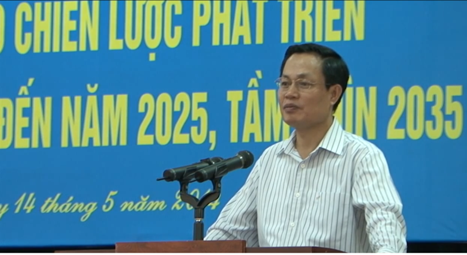
The draft Strategy for the Development of Vietnam National University, Hanoi (VNU) until 2025, with a vision to 2035, clearly states VNU's mission as "training high-quality human resources, nurturing talents, conducting fundamental scientific research and developing integrated multidisciplinary and multi-field technologies, transferring knowledge to serve national development; pioneering innovation in education and training in Vietnam." By 2025, VNU will "become a multidisciplinary and multi-field research university center achieving the basic criteria of an advanced research university in the region and Asia, with some disciplines/fields meeting international standards."
The core values are defined as: "Encouraging and nurturing talent - Pioneering innovation - Responsibility - Unity in diversity". The action slogan is: "Reaching the pinnacle through knowledge".
In its development goals for 2025, the draft outlines specific objectives in the following areas: human resource training - scientific research and development of cutting-edge technology - integration and internationalization.
The draft also presents fundamental solutions related to developing a highly qualified workforce; improving the effectiveness of development cooperation; modernizing infrastructure; reforming university governance; and increasing financial resources.
At the conference, delegates assessed the draft as meticulously and seriously prepared, reflecting the high determination of the VNU leadership to rapidly develop VNU into a leading university in the region and move towards achieving international standards. This was also an opportunity for member units to review their current conditions, define their goals, and outline a roadmap for their development in relation to the development goals of VNU.
In addition, delegates also shared and contributed many opinions on the Draft as well as the future development path of VNU.
Professor Nguyen Van Khanh (Rector of the University of Social Sciences and Humanities) believes that a more accurate assessment of the position, role, and contribution of social sciences and humanities in the development strategy of Vietnam National University, Hanoi is needed. Regarding the application of quantifiable development indicators such as ISI publication index and staff size, attention should be paid to the unique characteristics of social sciences and humanities compared to other scientific fields.
Associate Professor Vu Van Quan (Head of the History Department) emphasized that developing a highly qualified workforce should be considered a key solution for achieving development goals. To do this, a specific survey of the current workforce's age, qualifications, research fields, etc., is needed to identify areas for focused and prioritized investment, rather than spreading investment thinly across the board.
Professor Phung Huu Phu (Head of the Department of Political Science) noted that the development strategy of Vietnam National University, Hanoi (VNU) must be placed within the specific and practical conditions of the country, and must be an integral part of the strategy for building, developing, and protecting the country in the coming period. The goals and tasks of VNU must be closely linked to the requirements and objectives of national development, and must not be separate from the fundamental and comprehensive reform process of Vietnamese education according to Central Committee Resolution No. 8. In addition, VNU needs to clarify its comparative advantages and how to position itself within the network of universities domestically, regionally, and internationally. To become a top-tier university center, VNU also needs to identify itself as a place where talent converges, creating all favorable conditions to maximize individual creativity.
Furthermore, some other opinions suggest that the draft development strategy of Vietnam National University, Hanoi needs to: be more action-oriented; be more unified and synchronized in its mission, goals, and solutions; emphasize academic freedom in the university environment; pay more attention to the physical infrastructure as a foundation for building a modern university; further enhance the autonomy of member units; and include solutions that demonstrate greater concern for and appreciation of the role of teachers in the university….
Author:Thanh Ha
Newer news
Older news

