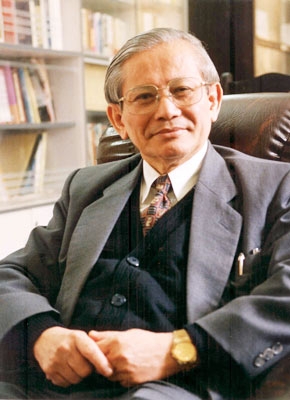
On May 27, 2011, at a meeting of the Academy of Inscriptions and Fine Arts - part of the French Academy, Professor Phan Huy Le was elected a Foreign Corresponding Member. He was the first professor of social sciences in Vietnam to receive this honor.

Professor Phan Huy Le was elected to the position previously held by Abbot Francisco Rico (Spain). The official notification was sent to historian Phan Huy Le on July 5, 2011. The Academy of Inscriptions and Belles-Letters, founded in 1663, is one of five academies of sciences under the French Academy (Institut de France) of the French Republic. It is also one of the oldest and most prestigious academies of the French Academy. The Academy of Inscriptions and Belles-Letters is an academy of humanities, researching archaeology, history, and philology from the ancient and medieval periods to the Classical period, covering a vast historical space from Western Europe to the Far East. Professor and People's Teacher Phan Huy Le was born on February 23, 1934, in Thach Chau commune, Loc Ha district, Ha Tinh province. He was a descendant of Phan Huy Ích, a high-ranking official and diplomat; Phan Huy Chú, a scholar; and Phan Huy Vịnh, a high-ranking official and cultural figure. His father, Phan Huy Tùng (1878-?), was a top scholar and a third-class doctoral graduate in the Quy Sửu year (1913), a renowned and virtuous Lang Trung (official) in the Ministry of Justice during the Nguyễn dynasty, known for his integrity, virtue, kindness, and deep love for his children and grandchildren. His mother belonged to the Cao Xuân family, a family with a rich tradition of scholarship, including prominent figures such as Cao Xuân Dục, Cao Xuân Tiếu, and Cao Xuân Huy. In 1956, after graduating with a Bachelor's degree in History and Geography from Hanoi Pedagogical University, Professor Phan Huy Lê worked as an assistant intern at the History Department of Hanoi University, under the guidance of the famous Professor Đào Duy Anh. Professors Trần Văn Giàu and Đào Duy Anh assigned him to write lectures and undertake the work of a true expert. Just two years later, the young teacher Phan Huy Lê, only 24 years old, was assigned the task of Head of the Department of Ancient and Medieval Vietnamese History and continuously held this important position for decades.

Professor Phan Huy Le was particularly interested in socio-economic history. In the early stages of his research career, his first publications mainly concerned agriculture, rural areas, and farmers. When the US escalated its bombing of North Vietnam, conscious of his responsibility as a citizen to the nation's destiny, Professor Phan Huy Le shifted his research to resistance wars against foreign invaders and major battles in history. His works such as "The Lam Son Uprising," "The Tradition of Nation Building and Defense of the Vietnamese People," "Some Strategic Decisive Battles in National History," and "The Battles of Bach Dang in 938 and 1288"... have become representative works of military history. After the reunification of the country, he continued to summarize the history of resistance against foreign invaders. In the approximately 15 years from 1975, he wrote more than 80 works of this type. The total number of works on the history of resistance against foreign invasion is 120, accounting for 27% of the 445 works he completed. From 1975 to 1999, in addition to researching the history of resistance against foreign invasion, he researched 114 works on socio-economic issues. Notable works in this area include "Land Ownership System and Agricultural Economy during the Early Le Dynasty," works on the Tay Son peasant movement, land registers of Ha Dong, Thai Binh, and Hanoi, a program researching Vietnamese genealogies, and books and monographs on socio-economic formations, socio-economic structures, and Vietnamese villages in the Northern Delta region. From the 1980s onwards, alongside these two topics, Professor Phan Huy Le expanded his research into the field of culture and tradition with approximately 20 works in a five-year period. His total number of works in this field reached 104. Besides that, he also devoted his efforts to many works on local history, especially the history of Thang Long Imperial Citadel and Hanoi. Professor Phan Huy Le also played a particularly important role in summarizing the country's history with 107 works and many representative works such as "History of Vietnam from 1406 to 1858", "History of the Vietnamese Feudal Regime" Volume II (1960) and "History of the Vietnamese Feudal Regime" Volume III (1961). The book "History of Vietnam" Volume I, which he co-authored with Professor Tran Quoc Vuong in 1971, is considered the first comprehensive history of the new regime... In the independent state-level scientific project to build the four-volume "History of Vietnam" series, Professor... Phan Huy Lê was both the editor-in-chief and the main author of Volumes I and II, considered the highest-level summary of the historical period from the origins to the mid-19th century. He followed the country's history in all four major areas, but in each field, Professor Phan Huy Lê reached the pinnacle of expertise with a massive body of work totaling hundreds of publications. In addition, he was the founder of two important and renowned new academic disciplines at the University of Social Sciences and Humanities, Vietnam National University, Hanoi: Oriental Studies and Vietnamese Studies. For generations of students, Professor Phan Huy Lê was a teacher who dedicated much effort to imparting knowledge. He is known as one of the "Four Pillars" of modern Vietnamese historiography, a title bestowed upon him by many generations of students: "Lam – Le – Tan – Vuong" (Professors Dinh Xuan Lam, Phan Huy Le, Ha Van Tan, and Tran Quoc Vuong). From 1988 to the present, Professor Phan Huy Lê... Phan Huy Lê continuously served as the President of the Vietnam Historical Association. He also held key leadership positions or served as a member of many National Councils such as the National Council for the Compilation of the Encyclopedia, the National Council for Science and Technology Policy, the Central Theoretical Council, the Council for Science and Training of Hanoi National University, the State Council for Professor Titles, the National Council for the Ho Chi Minh Prize and the State Prize, the National Council for Cultural Heritage... Professor Phan Huy Lê was awarded the academic title of Professor (1980), Excellent Teacher (1988), People's Teacher (1994); State Prize (2000), Fukuoka Asian Culture International Prize, Japan (1996), and the Order of Academic Palms from the French government (2002).