




Welcome to the online university admissions counseling program of the University of Social Sciences and Humanities (VNU Hanoi).
Today's counseling program is dedicated to the basic science disciplines of the University of Social Sciences and Humanities. These include History, Philosophy, Literature, Classical Chinese and Vietnamese Studies, Political Science, and Anthropology.
The counseling program will end at 11:30 AM today, but all questions from the candidates will be answered the day after the program concludes.
The consultation session today is chaired by Assoc. Prof. Dr. Nguyen Van Kim (Vice Rector, Standing Deputy Secretary of the Party Committee) along with other teachers and lecturers:
1. Lecturer Tran Hinh – Literature Department
2. MSc. Dinh Thanh Hieu – Department of Sino-Vietnamese Studies
3. Assoc. Prof. Dr. Nguyen Van Suu – Anthropology Department
4. Dr. Tran Thi Hanh – Philosophy Department
5. Dr. Tran Thien Thanh – History Department
6. Dr. Luu Minh Van – Political Science Department
7. Mr. Dinh Viet Hai, M.Sc. – Deputy Head of Training Department
Question: I would like to ask about the support for students in basic science programs at the university this year. Are students exempt from tuition fees?
MSc. Dinh Viet Hai:Hello, first of all, let me introduce you to the list of basic science disciplines, which includes:
- Political Science
- Han Nom
- History
- Anthropology
- Philosophy
- Literature
Upon admission to one of the aforementioned majors, students still pay tuition fees as usual, but in addition to academic achievement scholarships and sponsorship scholarships, they will receive financial support for their studies, as in 2012, at 4,200,000 VND/academic year/student.
In addition, students can take (tuition-free) courses on professional skills development, information literacy development, positive thinking and debate, English language learning methods, etc., right in their first year of study.

Mr. Dinh Viet Hai, M.Sc. – Deputy Head of Training Department.
Question: Dear advisors, I would like to ask if it is true that those who study Literature are eligible to receive a journalism degree?
MSc. Dinh Viet Hai:Let me assure you right away that's not true. Students majoring in Literature receive a Bachelor of Literature degree upon graduation. If you want a Bachelor of Journalism degree from the University of Social Sciences and Humanities, you have to pass the entrance exam for the Journalism program, complete the course, and receive a graduation certificate.
However, what you and your classmates should know is that from the next academic year, the University of Social Sciences and Humanities will be opening additional dual degree programs in Journalism, International Studies, and Management Science (currently, the University already offers a dual degree in Tourism and Travel Service Management) for students from all majors in the University who wish to pursue a dual degree in these fields.
Assuming you take the entrance exam and are admitted to the Literature major, by the end of the 2013-2014 academic year (i.e., your first year), if you meet the academic requirements in the training regulations, you will be considered for admission to the Journalism major, a dual degree program (note that admission is based on your first-year Literature studies, not on retaking the university entrance exam). If admitted, you will be a student of both Literature and Journalism, and after a maximum of 6 years, you can have two degrees: a Bachelor of Literature and a Bachelor of Journalism.
I wish you good health and the ability to choose a field of study that suits your career aspirations and abilities!
Question: I would like to find out about the admission quotas for the Political Science major in previous years. Could the professors please advise me?
Dr. Luu Minh Van:In 2008 and 2009, the Political Science program began admitting students for its undergraduate degree. According to regulations for newly introduced programs, the enrollment quota for these two cohorts was limited to 50 students.
Since 2010, in response to the growing demand from applicants, the Political Science major has adjusted its enrollment quota to 70 students. In 2013, the enrollment quota for the major was 68 students.
I hope to meet you as one of the 68 students in the Political Science program.
I wish you success.

Dr. Luu Minh Van (right) and MSc. Dang Anh Dung (Faculty of Political Science).
Question: I'm having trouble choosing a major, especially between Anthropology and some other fields. Could you please tell me about the job opportunities for Anthropology graduates?
Assoc. Prof. Dr. Nguyen Van SuuYou're truly a forward-thinking person because you've already thought about what kind of job you'll do after graduating from university!
Let me briefly explain. The current Anthropology program at the University of Social Sciences and Humanities is a transformation and development of the Ethnology program. Ethnology has been taught in Vietnam and in the Anthropology Department since the 1960s. As of 2011, on average, dozens of students majored in Ethnology each year. Most graduates have found employment.
Individuals with a bachelor's degree in Anthropology continue to work in the aforementioned organizations, but with improved professional skills and capabilities because the Anthropology program equips them with more systematic and comprehensive knowledge of the theory, methodology, and fundamental concepts of the field.
Our survey shows that they have worked and are currently working at the Committee for Ethnic Minorities, the Department of Culture, Sports and Tourism, the Ministry of Education and Training, museums, tourist areas, nature reserves, libraries, and the Ethnic Affairs Committees in the provinces. Some teach at universities, work at research institutes, some work for international organizations operating in Vietnam, and some pursue postgraduate studies in developed countries in America, Europe, Australia, etc.
We have published an article introducing job opportunities for Anthropology students on the Anthropology Department's website at: http://nhanhoc.edu.vn. Please take the time to view it to learn more about Anthropology, the Anthropology Department, and the excellent job opportunities for those with an Anthropology degree.
I wish you success and hope you find a field of study that suits you.

Assoc. Prof. Dr. Nguyen Van Suu (Department of Anthropology).
Question: I would like to know about career opportunities after graduating with a degree in Political Science?
Dr. Luu Minh VanThe labor market's demand for Political Science professionals is increasing, while this field of study has only recently been introduced into the training programs of universities and colleges in Vietnam. Therefore, career opportunities for Political Science graduates are immense. Specifically, Political Science graduates can pursue the following careers:
+ Providing advisory services in agencies responsible for formulating the Party and State's guidelines and policies.
+ Providing advisory services in agencies and organizations within the political system, and in socio-economic organizations.
+ Conduct research at political theory institutions.
+ Work as a reporter, editor, or commentator on current affairs and politics at central and local newspapers and broadcasting stations.
+ Conduct research and teach political science in the Party school system, universities, colleges, and vocational high schools.
In 2012, 31 out of 42 students from the first graduating class of Political Science found employment. In addition to the aforementioned fields of work, some students are working on programs and projects for non-governmental organizations.
Question: In 2012, I took the entrance exam for the Linguistics department but didn't get in. This year I want to apply to the Literature department. However, I'm worried that I haven't prepared well enough, so I would appreciate guidance on how to study for the exam.
GVC Tran HinhRegarding your application to the Literature Department, I'd like to clarify that the Literature Department was the former name of the Literature and Linguistics departments. Now, only the Linguistics and Literature departments exist. Therefore, I think you probably want to apply to the Literature Department this year. Since you took the exam last year, I think you'll have more experience this year, so it shouldn't be difficult. In my opinion, you don't need any intensive courses; you should self-study. You can study each subject individually or all three simultaneously – whichever method suits you best. For Literature, please note that there will soon be a study guide for the Literature exam based on exam scenarios written by Tran Hinh; finding that book is the best option. For History and Geography, you should ask experts from those departments which books are currently the best to use as a guide. There's no better way than self-studying with your limited time. Good luck with your exams!

Lecturer Tran Hinh (Faculty of Literature)
Question: This year, I intend to apply to study History. Could the admissions committee please tell me what subjects are included in the History major? Thank you.
* Job positions students can take on after graduation:
* Types of agencies, organizations, and businesses that offer suitable job opportunities:
- Universities, colleges, and high schools teach history and the subject of the Revolutionary Line of the Communist Party of Vietnam.
- State agencies and organizations that utilize historical knowledge (central agencies of the political system, press agencies, People's Committees at all levels, museums, historical and cultural research centers, historical site management units, publishing houses, specialized history journals, etc.).

Dr. Nguyen Thien Thanh (left) and Assoc. Prof. Dr. Nguyen Van Kim (right)
Thank you for your question! If your goal and passion is to research documents, "read ancient texts," and "ancient cultures," then among the two majors, Sino-Vietnamese Studies and History, at the University of Social Sciences and Humanities, Sino-Vietnamese Studies is closer to your goal. The Sino-Vietnamese Studies program equips students with the necessary knowledge and skills for accessing, processing, and exploiting Sino-Vietnamese texts. It provides a foundation in social sciences and humanities, basic linguistics, and specialized knowledge including: classical Chinese (China, Vietnam), Nôm script, Nôm texts, traditional culture, and specialized theories. It combines internal knowledge of Sino-Vietnamese texts (internal Sino-Vietnamese texts) with external knowledge (external Sino-Vietnamese texts) in historical, cultural, and literary aspects, aiming to exploit the values contained within the Sino-Vietnamese heritage to serve Vietnamese life and connect the national cultural flow from tradition to modernity. Students are also equipped with foreign language skills (modern Chinese) to enable common communication and reading of basic professional documents, computer application skills in the field of Sino-Vietnamese studies, and the necessary skills to access, process, and utilize the rich and diverse Sino-Vietnamese materials in practice.

Lecturer Tran Hinh (left) and Master Dinh Thanh Hieu (right)
Question: Does the literature curriculum at university resemble what I learned in high school? Besides the literary works I studied in high school, what additional knowledge will I acquire at university?
GVC Tran Hinh:
Basically, the knowledge of Literature at university is broader and deeper. In high school, literature knowledge mainly focuses on Vietnamese literary works, with very little foreign literature, and not much expansion beyond that. At university, we will have to study much more. For example, in addition to literature, including both Vietnamese and foreign literature (French, English, German, Chinese, American, East Asian, and Southeast Asian…), we will also study Literary Theory, Classical Chinese and Vietnamese, journalism and media, and especially Art Studies, specifically the three art groups of Film, Theater, and Television. Thanks to the knowledge gained, graduates in Literature will be able to work in many different fields such as literary research, journalism and television, publishing, teaching, and many other media areas. Besides basic knowledge, the Literature department also equips students with professional skills, so I think that if you have the will and ambition, you will certainly have many job opportunities after graduating from the Literature department. And of course, studying literature at university, while not exactly the same as in high school, is not completely unfamiliar either. The department will be responsible for guiding you in your study skills. I wish you success.
Question: Dear Professor/Lecturer, I understand that the Department of History is the only institution in the country that offers a specialization in Archaeology. I am very interested in this field of study. Could you please provide me with specific information about this program and the job opportunities available to graduates? Thank you.
Dr. Tran Thien ThanhThe Department of Archaeology (Faculty of History – University of Social Sciences and Humanities) is the only training institution that has fully developed a training system from undergraduate to postgraduate and doctoral levels in the field of Archaeology. The Department's training program is updated and developed based on experiences from many countries such as France, Russia, and the United States. The Department has also expanded its cooperation with many major universities around the world with highly developed archaeology departments, such as Seoul National University (South Korea), Kanazawa University (Japan), Sun Yat-sen University (China), and the Archaeological Institute of the Federal Republic of Germany. Many large-scale collaborative projects have been implemented, such as the AMS dating project of the Hoa Binh culture with Seoul National University, the Sa Huynh culture research project with the German Archaeological Institute, and the Cultural Heritage Training and Research Project with Kanazawa University. Domestically, the Department's team of experts and scientists has contributed significantly to the discovery and excavation of many archaeological cultures in the country. The recognition of Hoi An, My Son, and Hue Imperial City as World Heritage sites is also largely thanks to the efforts of the Department's faculty members.
Students in the History Department, starting from their third year, can choose to specialize in this field if they meet the academic requirements. For the first three years, students study general history. In their fourth year, they learn specialized knowledge such as the fundamental characteristics of Vietnamese and world archaeology, the latest archaeological achievements, etc.; and receive guidance from lecturers on practical issues in the field. In addition, the Department focuses on training students in excavation skills, fieldwork, work organization, and developing their ability to work independently.
Organizations and institutions in need of students specializing in this field include the Institute of Archaeology (under the Vietnam Academy of Social Sciences), the National Museum (formerly the Vietnam History Museum), and other archaeological management agencies such as local museums and monument management boards. In addition, many tourism-related agencies and companies also require Archaeology graduates. Notably, since 2001, the State has enacted the Law on Cultural Heritage with clear regulations on the standards for personnel working in the field of Archaeology. This further opens up significant job opportunities for students specializing in this field. Archaeology students are also very proactive in seeking professional experience from their second and third years. Many have participated in archaeological excavations on large-scale projects with domestic and international experts. All these advantages help students to be well-prepared for future employment.
Question: Is studying philosophy difficult?
Dr. Tran Thi HanhStudying philosophy isn't difficult if we are passionate and truly want to explore and understand the knowledge of humanity: East and West, ancient and modern...
In the philosophy program, students study social science subjects such as economics, political science, and world civilization history; specialized philosophy subjects such as Chinese, Indian, Vietnamese, Greek, Roman, French, German, Italian, and American philosophy; specialized topics in various specializations such as Marxist-Leninist philosophy, logic, religious studies, aesthetics, ethics, history of philosophy, and scientific socialism; and methodological and professional subjects such as scientific research methods, teaching methods, document drafting skills, and sociological research skills. Practical internships and thesis writing are also included. The philosophy program also emphasizes the development of students' scientific research capabilities. Each year, students can register for scientific research projects, and if they win awards, they may receive credit to replace a specialized subject.
I hope you achieve your goals and succeed!

Dr. Tran Thi Hanh – Deputy Head of the Department of Philosophy
Question: When advising me on choosing a major for university entrance exams, my teacher suggested I apply for Political Science, but I don't understand anything about this field. I hope you can explain it to me.
Dr. Luu Minh Van:
- The homeroom teacher's opinion is very valuable because she has knowledge of the profession and a sense of responsibility towards her students.
Political science is a very young and new field of study at the University of Social Sciences and Humanities, Vietnam National University, Hanoi, in particular, and in Vietnam in general. Previously, everyone thought of politics as power, and political science as the science of gaining and maintaining power, with the fundamental principle that all power belongs to the people. Now, the concept of politics and political science needs to be broadened, not just as a matter of organizing power, but as a science studying the rights of individuals and communities. Studying politics is gradually becoming a common activity, a daily practice for everyone, but to truly understand it, one needs to study it scientifically. Political science research in the world in general and in Vietnam in particular is becoming increasingly rich, vibrant, and relevant. Despite many difficulties and challenges, political science is a promising field that can be pursued throughout one's life.
- Please note one more thing: The University of Social Sciences and Humanities is a pioneering institution among universities and colleges nationwide in the training and research of Political Science. Through several years of training at both undergraduate and postgraduate levels in Political Science, the University of Social Sciences and Humanities has affirmed its position and prestige.
- You can refer to the online training program of the University of Social Sciences and Humanities.ussh.edu.vn) for more information about the field of Political Science.
Question: Is Philosophy a field similar to Civics Education?
Dr. Tran Thi Hanh:
Philosophy is not the same as Civic Education.
Philosophy, nearly as old as mathematics, is one of the fundamental branches of social science. It provides a sound worldview and methodology for human cognition and practical activity in the process of conquering and transforming the world to serve human existence and development. It would be impossible to achieve a high level of abstract thinking and universal reasoning without being equipped with philosophical knowledge.
In our country's current development, the most significant shortcoming and weakness, as we all see, is the lack of strategic theoretical thinking for development in each sector as well as for society as a whole. To elevate this theoretical thinking, philosophical science is the core.
Civics education in secondary schools only introduces the simplest issues in the fields of politics, society, culture, and ideology.
University graduates with a philosophy degree can teach civics in high schools.
Graduates of the Civic Education program at teacher training universities can pursue further studies in philosophy and complete a Master's program in Philosophy. This will enable them to teach at vocational high schools, colleges, universities, and academies. Job opportunities are always abundant for them.
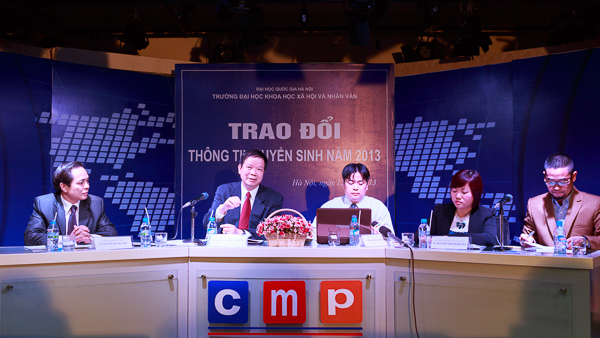
The press conference to exchange information on the 2013 admissions of the University of Social Sciences and Humanities was held this morning, March 12, 2013.
Question: I heard that studying Sino-Vietnamese studies requires learning Chinese, but I studied English in high school. Will I be able to learn Chinese from the beginning when I enter university? How long will it take to be able to understand Chinese texts? Also, how does Vietnamese Nôm script differ from Chinese characters?
MSc. Dinh Thanh HieuYour question is quite broad, so I'll answer it briefly as follows:
In the Sino-Vietnamese Studies program, the mandatory foreign language is Chinese. Upon entering the program, students will learn Chinese from scratch. After graduation, students will be equipped with basic conversational Chinese language skills and the ability to read specialized documents. It's difficult to say "how long it takes to be proficient in understanding classical Chinese texts" because the ocean of knowledge is vast, and learning is a lifelong process. However, after graduating from the 4-year Sino-Vietnamese Studies program, students will be equipped with the necessary knowledge and skills to access, process, and utilize Sino-Vietnamese texts, such as collecting, evaluating, and translating common Sino-Vietnamese texts, and beginning to explore the inherent values in Sino-Vietnamese heritage. Sino-Vietnamese script is a writing system created by the Vietnamese people using Chinese characters to record the Vietnamese language. Therefore, to learn Sino-Vietnamese script, one must have a certain level of proficiency in Chinese characters. The specialized knowledge of the field of Sino-Vietnamese studies includes Nôm characters and Nôm texts, encompassing theory of Nôm script, practice in reading Nôm texts, Nôm transcription, and analysis of Nôm texts…
Question: Dear Professor, since high school, I have studied and read many interesting history books by authors such as Phan Huy Le, Dinh Xuan Lam, Vu Duong Ninh, Le Mau Han, Vu Quang Hien, etc. After registering and being admitted to the History major, will I have the opportunity to study and listen to lectures from the aforementioned professors?
Dr. Tran Thien Thanh:Due to outstanding achievements in training and scientific research, many generations of faculty members of the Department of History have received numerous prestigious awards and titles domestically and internationally in science and technology, and in education and training: Ho Chi Minh Award: Professor Tran Van Giau, Professor Dao Duy Anh, Professor Ha Van Tan, Professor Tran Quoc Vuong;
State Awards: Professor Phan Huy Le, Professor Phan Dai Doan, Professor Phan Huu Dat, Associate Professor Nguyen Thua Hy. International Awards: Professor Phan Huy Le: Fukuoka Asian Culture International Award, Japan (1996), Order of the Academic Palm Branch of the French Government (2002), Corresponding Member of the French Academy of Inscriptions and Fine Arts (2011). People's Teacher: Professor Dinh Xuan Lam, Phan Huy Le, Ha Van Tan, Phan Huu Dat, Le Mau Han, Vu Duong Ninh, Hoang Van Khoan, Nguyen Van Hong, Trinh Nhu, Nguyen Quoc Hung, Han Van Khan.
Distinguished Teachers: Tran Quoc Vuong, Pham Thi Tam, Nguyen Thua Hy, Phung Huu Phu, Vu Minh Giang, Nguyen Quang Ngoc, Nguyen Van Khanh, Pham Xanh, Hoang Luong, Ngo Dang Tri, Nguyen Hai Ke.
Upon being admitted to the History major, I had the opportunity to attend specialized lectures (at various levels, especially at the master's and doctoral levels), read the latest works of many professors stored in the History Department's archives or other sources introduced by faculty and staff of the Department, and receive feedback from professors on my personal research direction. In addition, I and other students admitted to the History major received lectures and feedback on our personal research direction from highly reputable professors with expertise from the generations following the professors mentioned above, whom I'm sure you know, such as Assoc. Prof. Dr. Nguyen Hai Ke, Assoc. Prof. Dr. Nguyen Dinh Le, Assoc. Prof. Dr. Vu Van Quan, Assoc. Prof. Dr. Nguyen Van Kim, Assoc. Prof. Dr. Lam My Dung…
Question: I would like to ask the professors to explain what Anthropology is and what knowledge students studying Anthropology will acquire.
Assoc. Prof. Dr. Nguyen Van Suu – Deputy Head of the Department of Anthropology:
Thank you for your interest in Anthropology! Originating in the 19th century, Anthropology holds a particularly important academic position, possesses profound practical significance, and is highly international in scope. It is currently taught at many universities in the region and around the world.
With human beings as its subject of study, Anthropology has many academic and applied research fields, some of which include:
Socio-cultural anthropology studies the internal dynamics of societies through ethnographic descriptions. It is an important field of study examining the worldview of people in different cultures and countries, exploring the lives of diverse ethnic communities, their cultural and social characteristics, such as communities in mountainous regions, farmers, fishermen, traders, artisans, etc., in plains and riverine areas, and urban dwellers in cities. Socio-cultural anthropology also studies religious life, language, social systems and organization, livelihoods, exchange, technology, political systems, ecology, psychology, art, etc., with the aim of deciphering the similarities and differences between various communities and ethnic groups.
- Physical anthropology explores the biological origins of humankind, evolutionary development, and genetic diversity.
- Linguistic anthropology seeks to explain the nature of language and human language use.
- Medical anthropology seeks a more complete understanding of the factors that influence human health and well-being.
- Forensic anthropology seeks to identify skulls or decipher the remains of the human body.
- Business anthropology helps businesses gain a better understanding of their operations and customers.
- Visual anthropology collects images of daily life through film.
- Environmental anthropology believes that human prosperity is inseparable from the harmony and well-being of the environment.
- Museum anthropology introduces and explains to the public the significance of ethnographic and archaeological collections.
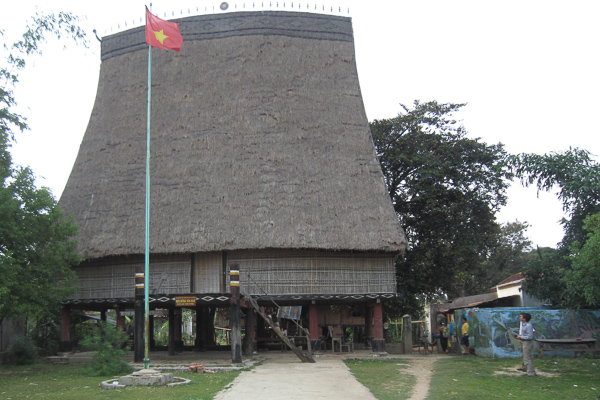
Lecturers from the Department of Anthropology conducted a survey on the communal houses of the Ba Na people in Kon Tum province, Central Highlands.
In anthropological research, research methods and theories play a crucial role. Throughout its development, anthropology has developed a system of ethnographic field research methods such as participatory observation, semi-structured interviews, and interdisciplinary research techniques to collect ethnographic data in specific research areas. Alongside this, anthropology has produced many different theoretical schools to explain culture, society, and the nature of human beings.
The undergraduate program in Anthropology provides knowledge in all the aforementioned fields. Students also participate in ethnographic field trips and research practice to hone and enhance their skills, enabling them to seize job opportunities upon graduation. You should also visit the website nhanhoc.edu.vn for more information about undergraduate and postgraduate programs in Anthropology.
Question: My friend is inviting me to apply to study Political Science, but she's outgoing, actively involved in many social activities, and has leadership potential, while I'm the opposite. So, according to the professors, should I apply to study Political Science?
Dr. Luu Minh Van:Hi Tuan, that's a great question!
First of all, I think you tend to be overconfident in your abilities.
Don't think that studying Political Science only leads to leadership positions. Many people also work in research, analysis, political commentary, consulting, and advisory roles – jobs that require the same perseverance and quiet composure you possess.
I also believe that during your studies and future career, you will discover your own strengths and achieve success.
After the entrance exam, I really hope to see you at the Department of Political Science, and please tell me where you asked this question.
Assoc. Prof. Dr. Nguyen Van Kim – Permanent Deputy Secretary, Vice Rector of the UniversityThe online admissions counseling program of the University of Social Sciences and Humanities on March 12, 2012 has concluded. Thank you to all parents, students, and readers who participated. Due to time constraints, it was not possible to answer all questions immediately, so the counseling team will continue to answer after this session.