Dear Principal, ladies and gentlemen!
There are honors bestowed with the satisfaction of having fulfilled a noble duty. Today's honors are just such, for while the Order of the Academic Palms celebrates individuals, through them we are also celebrating something greater: a shared work, an intellectual friendship, and a shared belief that knowledge knows no boundaries.
First of all, I would like to say that I stand here today with genuine pride and emotion. Because what we are celebrating is not merely a ceremony, but a living testament to the best aspects of Franco-Vietnamese cooperation.
It is no coincidence that in the nomination dossiers for these two professors, we included a rare and valuable note: "These two candidate dossiers are inseparable." This is not a flowery statement, but a description of a fact.
For many years, Professor Hoang Anh Tuan and Professor Nguyen Tuan Cuong have been two pillars of the same "sanctuary": the Vietnamica European program. Implemented in Vietnam under the patronage of France, this is one of the most ambitious Franco-Vietnamese scientific cooperation projects currently underway.
For those unfamiliar, Vietnamica is a European-scale digital epigraphic project. The project aims to catalog, map, and preserve ancient Vietnamese epigraphic texts – the stone or wood inscriptions and texts that form the profound memory of a nation.
Imagine thousands of stone inscriptions scattered throughout Vietnam, in village temples, temple courtyards, or in the dusty archives of provincial libraries. The characters are fading, the stones are eroding... and with them, a priceless part of Vietnam's memory is silently disappearing. This is what Vietnamica is striving to prevent: not only to digitize the stones, but also to save the voices, to bring back to life the men and women who etched their eras into the material.
Funded by the European Research Council, since 2019, the program has brought together researchers from the Institute for Advanced Studies (EPHE), the University of Social Sciences and Humanities, Vietnam National University, Hanoi (USSH), and the Institute of Han Nom Studies to focus on a data archive spanning five centuries of Vietnamese history. This is a project that Professor Hoang Anh Tuan and Professor Nguyen Tuan Cuong have diligently preserved with the seriousness and passion that inspires admiration.
Allow me to introduce you two in the order of protocol, but with equal respect.
Dear Principal Hoang Anh Tuan!
He was born in 1976 in Thanh Hoa. He could have been perfectly content with a brilliant history career within the framework of USSH. But he has achieved much more: he was trained at Leiden (Netherlands), was a visiting professor at Montana (USA), and served as a science ambassador for the Alexander von Humboldt Foundation at the University of Frankfurt (Germany)... his journey is that of a historian who rejects all boundaries, both literally and figuratively.
His works on Southeast Asian trade relations in the 17th and 18th centuries, and on the archives of the Dutch and British East India Companies in Tonkin, have renewed and deepened our understanding of a Vietnam we thought we knew intimately. He revealed a maritime Vietnam, connected and steadfastly oriented towards the world long before the concept of "globalization" emerged. His first work, *Silk for Silver: Dutch – Vietnamese Relations, 1637-1700*, published by Brill (Leiden-Boston, 2007), immediately established his name on the international stage.
Six books, four translations, 79 articles: a monumental and far-reaching career, much like the commercial networks he dedicated his life to researching. But beyond a researcher, he was also a builder. As Chairman of the Interdisciplinary Council for Historical Sciences at NAFOSTED, a member of the ASEAN SEAMEO-SPAFA Executive Board, and head of the national project on Vietnamese History for many years, he was one of the silent but essential architects of the humanities research sector in Vietnam.
As the Rector of USSH, he transformed his institution into a natural "cradle" for Franco-Vietnamese cooperation in this field. He not only embraced Vietnamica, but he was also the soul of the project from the Vietnamese side; without him, the Vietnamica program would have lacked a "home" to rely on. And that is precisely what France wishes to honor him for: not only as an outstanding researcher, but also as a man who dedicated his reputation and institution to serving a collective project. France is sincerely grateful to him!
Dear Professor Nguyen Tuan Cuong!
He once led the Institute of Han Nom Studies, one of Vietnam's most valuable institutions, preserving all the documents left behind by the French School of Oriental Studies (EFEO) in 1956. It can be said that he was the guardian of a shared heritage of both France and Vietnam. His role far exceeded that of a typical institute director. It was a tremendous responsibility that he shouldered with a widely recognized scientific reputation extending beyond Vietnam's borders.
A philologist, Confucian expert, and a highly multilingual individual, he is the author of 20 books and has published works in Vietnamese, French, English, Japanese, Chinese, and Korean. Educated in Vietnam, he spent two years at Harvard and lectured at universities in Taipei, Beijing, Tokyo, Columbia, and Berlin.
And last autumn, an honor came, perhaps the clearest expression of the world's academic appreciation for him: he was elected Foreign Correspondent of the Academy of Literature and Epigraphy. This is one of the five academies of the French National Institute, founded in 1663, bringing together the greatest names in world philology and history. As far as I know, he is one of the very few Vietnamese scholars to receive this honor. France, on that day, sent him a message; and today, we reaffirm it once again.
In the Vietnamica project, he is "a man of texts": a decipherer of what time has obscured, a restorer of meaning and context to epigraphic texts. It is a meticulous task, like that of a jeweler, requiring perseverance and rigor; but it is also an act of love for a civilization that he is determined not to let fade away.
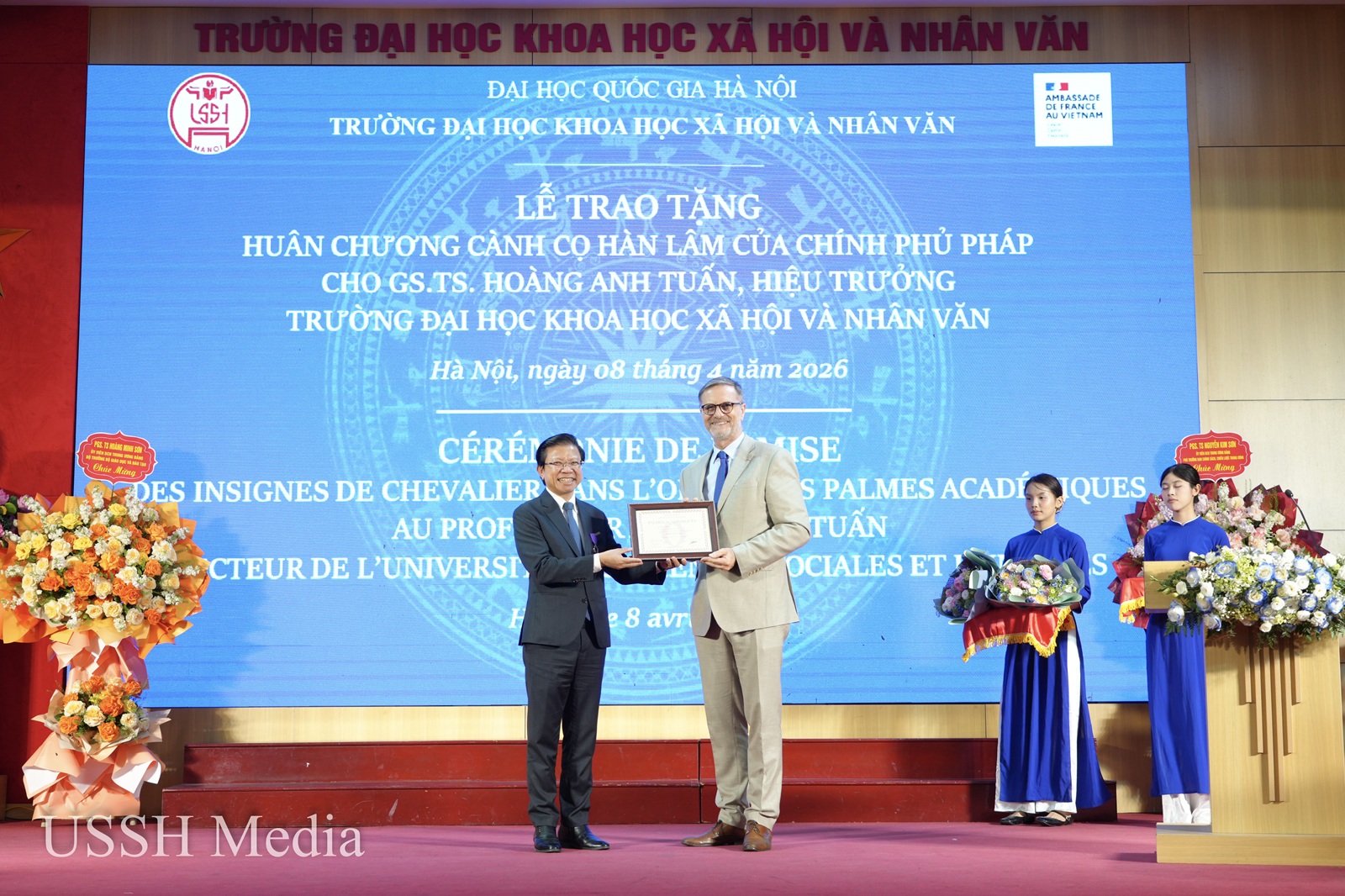
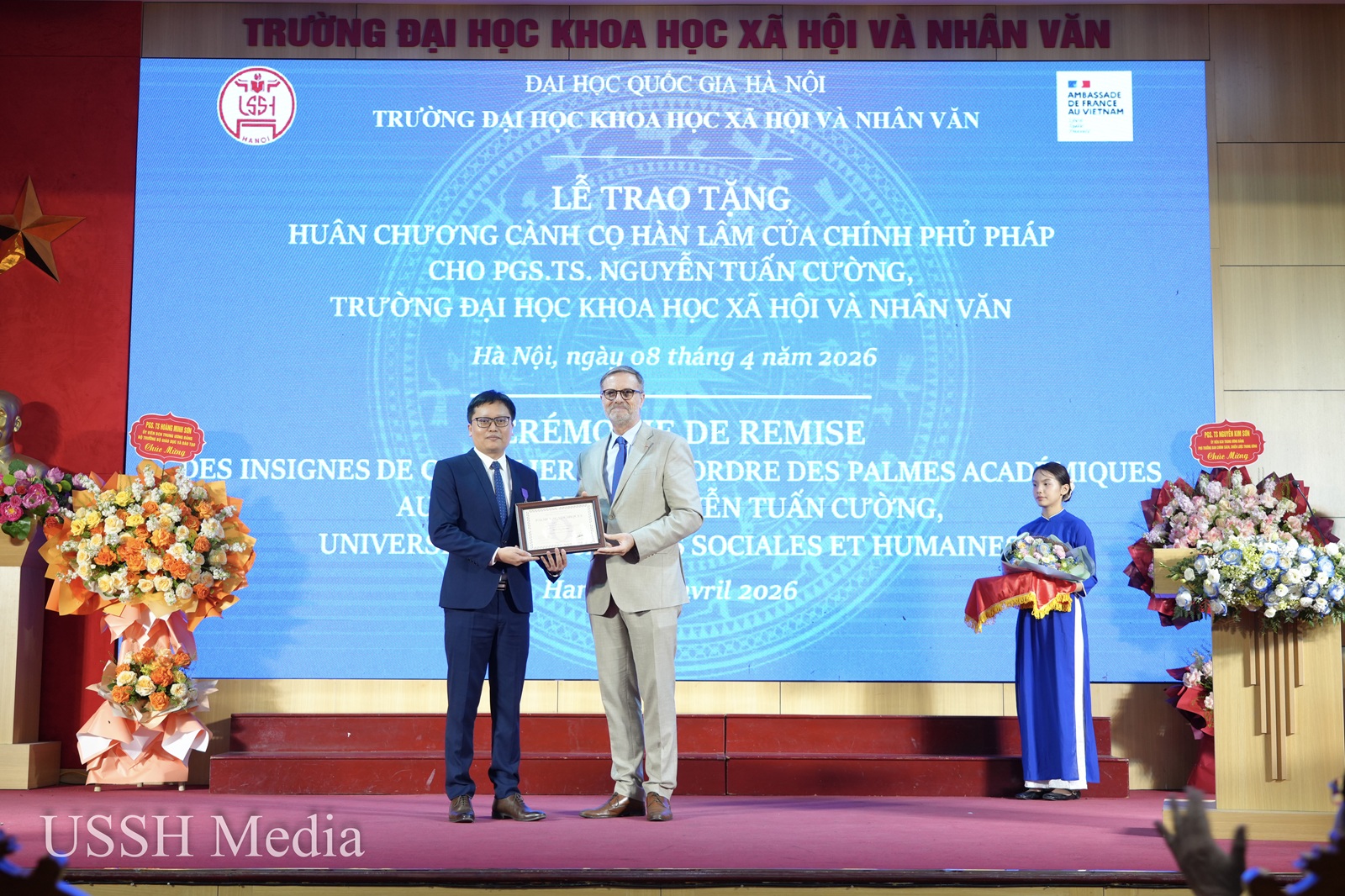
Professors, you both represent the best aspects of Franco-Vietnamese cultural and scientific cooperation: not a one-way collaboration from giver to receiver, but a collaboration between equals, between scholars who respect and understand each other and together build something unprecedented.
Before presenting the medal, I would like to share something personal: in this profession, we meet many wise people. But rarely do we meet people who are willing to dedicate that wisdom to serving something greater than themselves. These two gentlemen are such people. What they have built together now belongs to Vietnam, to humanity, to all those, in a hundred years or a thousand years from now, who wish to hear the voices they have rescued from silence.
France today honors the individual excellence of each of these men, but above all, it honors this fundamental act: the voluntary choice to unite their strengths. They transformed intellectual friendship into a working method, and turned Franco-Vietnamese cooperation from a mere formality into a sacred calling.
Professors, on behalf of the French Republic, I present to you both the Order of Academic Palms, Knight class (Chevalier dans l'Ordre des Palmes Académiques).
Congratulations to both of you, and may the Vietnamica project endure!
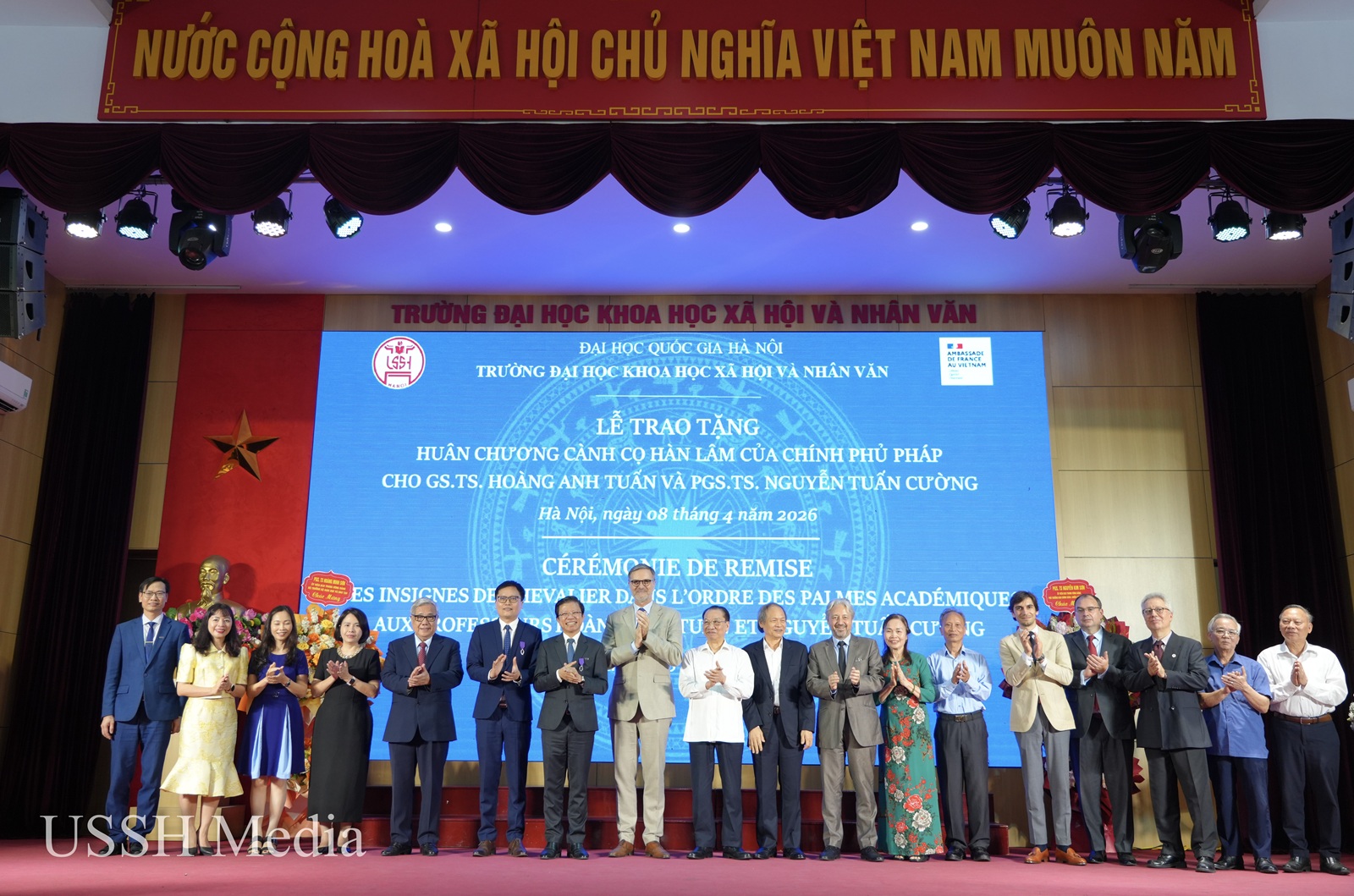
Leaders of the French Embassy in Vietnam, organizations, and school leaders congratulated the two scientists on being awarded the Order of the Academic Palms.
Newer news
Older news

