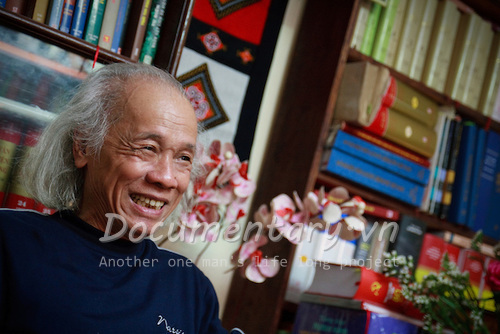
According to his work records, he was born on October 1, 1935, but he himself stated that he was born in the year of the Water Monkey (Nhâm Thân), 1932. He doesn't remember his exact lunar birth date, as it's been a long time. This discrepancy in his birth year is due to the process of compiling and transferring his records when he left his beloved hometown of Bình-Trị-Thiên to study in the North in 1953. If based on the year of the Water Monkey, his element would be Metal - Sword-Edge Metal (Kiếm Phong Kim), but perhaps his personality didn't match his element, as he was always a commanding sword, a sharp point in the field of modern and contemporary Vietnamese political history. That is why, even now, despite his advanced age and declining health, he remains a sharp sword, a guiding light for generations of his students on their long journey of research and teaching in Historical Sciences in general, and the History of the Communist Party of Vietnam and Ho Chi Minh Thought in particular.
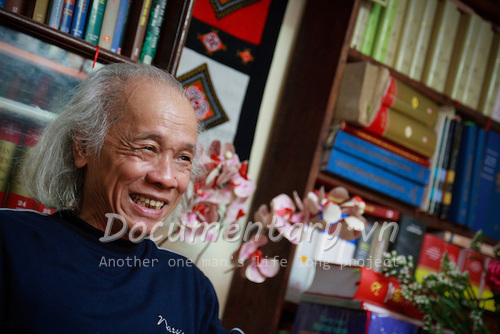
Associate Professor, People's Teacher Le Mau Han - Head of the History Department (Hanoi University) (1976 - 1990)/Photo: Thanh Long
In 1953, after completing his lower secondary education, he left Quang Tri for the North to study, and perhaps this event, this fortunate circumstance, marked a turning point in his life, not only in his scientific career but also in his personal life. In 1956, after finishing high school, he enrolled in the first cohort of the History Department at Hanoi University. In August 1959, after a period of tireless study, like Professor Phan Dai Doan, Professor Vu Duong Ninh, Associate Professor Vu Van Ban, etc., he was one of 17 students in the first cohort of Hanoi University who were retained to supplement the teaching staff in the History department. And perhaps, it was from this point that his connection with historical science truly intertwined with his Metal element (Kiem Phong Kim) destiny. Under the guidance of scholars Tran Van Giau, Dao Duy Anh, and Tran Duc Thao, and with the enthusiastic support of senior colleagues, through a process of arduous training filled with hardships and difficulties, he became an educator, a historian, and an expert on the history of the Communist Party of Vietnam, modern Vietnamese history, and especially on Ho Chi Minh Thought.
Although he graduated with a Bachelor's degree in History, specializing in Modern and Contemporary Vietnamese History, Associate Professor Lê Mậu Hãn was determined to join the Department of Party History early on. He joined Professor Kiều Xuân Bá (former Deputy Head of the Department of History), Associate Professor Hồ Sỹ Khoách, and others to establish the Department of the History of the Communist Party of Vietnam in the 1960s, and in 1974, the specialization in the History of the Communist Party of Vietnam was officially established under the Department of History.
In 1975, Associate Professor and People's Teacher Lê Mậu Hãn was appointed Head of the History Department and undertook a crucial area of expertise: clarifying strategic issues in the history of the Communist Party of Vietnam, in political platforms, in military and diplomatic policies, and in Party building. His writing style possessed both Party principles and scientific rigor, and especially a very high fighting spirit.
As a researcher and lecturer in the History of the Communist Party of Vietnam, he devoted all his energy and intellect to scientific research. For him, only thorough research and accurate understanding of the history of the specialized field could effectively convey the specialized science to students, trainees, and researchers. As a researcher, he understood Lenin's guidance very well: "In historical science, as in other sciences, accurate facts are the atmosphere of the scientist, the foundation from which to build the theory of the research problem" (according to Assoc. Prof. Dr. Trinh Mieu in the book...).The journey to historical truth(National Political Publishing House, Hanoi, 2005). Having sufficient necessary documents and materials, grasping the "essence" of historical events, and placing them in relation to each other within the specific historical context when considering and reasoning—this was a working principle of his and a requirement he placed on his students and colleagues. Therefore, when reading his research works on the History of the Communist Party, one does not feel bored or dry, but finds in them a broad perspective, a fascinating and captivating guide to historical truth. Respecting historical truth and correctly assessing historical truth has made his works and articles, brimming with historical data, truly become a handbook for generations of his students and colleagues to use in approaching and researching the science of the History of the Communist Party of Vietnam. It can be said that his works and articles such as:The revolutionary programs of the Communist Party of Vietnam, History of the Communist Party of Vietnam (volumes I and II),Party Congresses and Central Committee meetings on the History of the Government, the History of the Vietnamese National Assembly, the History of the Communist Party of Vietnam… have made a significant contribution to the development of the Specialization in the History of the Communist Party of Vietnam at the Faculty of History, University of Social Sciences and Humanities.
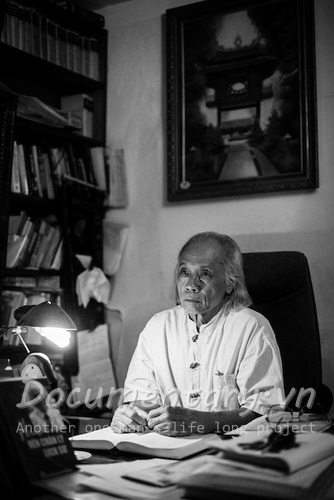
Associate Professor Lê Mậu Hãn, a People's Teacher, was one of the scientists who contributed to the establishment of the Department of History of the Communist Party of Vietnam (from the 1960s) and the Specialization in History of the Communist Party of Vietnam (in 1974) at the Faculty of History. / Photo: Thành Long
Not only did he contribute to the founding and development of the Department of Communist Party History, the Faculty of History in particular, and the field of Party History in Vietnam in general, but in the field of Ho Chi Minh Studies, when mentioning research on Ho Chi Minh Thought, one cannot fail to mention him as a leading expert in this nascent field. Together with his students and colleagues, he organized research courses on understanding Ho Chi Minh Thought. For this new field of science, he seemed to possess an ability and capacity to attract not only leading scholars in Ho Chi Minh Studies inside and outside the university, but also younger generations of staff to join forces in building and promoting the development of this scientific discipline. Reading the articles and books he wrote about Ho Chi Minh, one can sense not only Ho Chi Minh's thoughts and philosophies about the Vietnamese revolution, but also the warm, sincere, humane feelings he had for his fellow Vietnamese people and for all of humanity. Therefore, the works that Associate Professor and People's Teacher Le Mau Han wrote about Ho Chi Minh are not merely purely scientific works, but also stories and literary works with artistic merit. For example, rereading the article "Ho Chi Minh with the banner of national independence in the Party's first Manifesto."He wrote and published in the Party History Journal No. 5(53) in 1990. One can see in it his new, bold historical thinking to position and adjust historical issues and events with abundant cited data, but resolved in a gentle way, with his profound interpretations of the truth of Ho Chi Minh's "Independence, freedom - national liberation" expressed in the Party's first Political Platform in 1930. He was also the one who correctly assessed the formula for the birth of the Communist Party of Vietnam, that it was the combination of Marxism-Leninism, Ho Chi Minh Thought with the workers' movement and the patriotic movement in Vietnam.
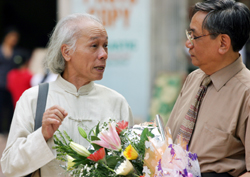
Associate Professor Lê Mậu Hãn and Professor Vũ Dương Ninh - two leading historians and mentors to many generations of students and trainees at the University of Social Sciences and Humanities.
It can be said that, as a scientist and a teacher, he was always a guiding light, a beacon of light, leading generations of his students. However, in his 15 years as Head of the History Department and Party Secretary, he also left a profound impression on his colleagues and students. To this day, in many meetings and gatherings of former faculty and staff, when discussing him and his role in personnel planning, former lecturers and researchers, now associate professors, doctors, and even retired ones, often fondly recount: Professor Le Mau Han was the first to advocate for the "Associate Doctorate" system, and he directly participated in guiding and assisting many colleagues, both within and outside the Department and University, to successfully defend their associate doctorate dissertations in history. He often told his students and colleagues that while a degree might not fully reflect a person's abilities, it serves as a necessary condition to motivate individuals to strive for excellence commensurate with their responsibilities. For teachers, this is also a way to set an example and encourage young people and students to train and strive to become scientists. The practice of graduates training other graduates must end – a temporary solution only permissible during wartime or when the country lacks the conditions to standardize its teaching staff. This is a philosophy of scientific development, a valuable practical experience that he learned during his time leading the Department of History and left behind for the Department as a guide for its development.
Throughout his life, he has dedicated himself to historical science in general and the specialized fields of the History of the Communist Party of Vietnam and Ho Chi Minh Studies in particular. He has been working in accordance with the Party's requirements for renewing theoretical thinking: speaking the truth and clearly stating the truth. His approach, from his Marxist methodology and specialized scientific methods to his dedication, rigor, and contributions, serves as a great example for many generations of students.
Having lived in the capital city for nearly 60 years, Associate Professor and People's Teacher Le Mau Han is an embodiment of the harmonious blend of "Trang An style" and the spirit of the people of Quang region in Central Vietnam. We, his students, know that he is still continuing his new scientific work, anticipating the changing times.
|
Associate Professor, People's Teacher Le Mau Han
+ Workplace: Department of History. Department of Political Science. + Management position: Head of the Department of History (Hanoi University) (1976 - 1990). Head of the Department of Party History, Faculty of History (Hanoi University) (1991-1997). Head of the Ho Chi Minh Studies Group (Faculty of Political Science).
History of the Vietnamese National AssemblyVolumes 1, 2, and 3, National Political Publishing House, Hanoi. History of the Vietnamese Government; Volume 1, National Political Publishing House, Hanoi. Vietnam, a heroic country, co-authored, Truth Publishing House, Hanoi, 1975. 40 years of the Socialist Republic of Vietnam, co-authored, Truth Publishing House, Hanoi, 1985. History of the Communist Party of Vietnam, Volumes I and II, editor-in-chief, University and Professional Education Publishing House, Hanoi, 1988. Contributing to understanding President Ho Chi Minh's ideology of independence and freedom., co-authored, National Political Publishing House, Hanoi, 1994. History of the Vietnamese National Assembly 1946-1960, editor, co-author, National Political Publishing House, Hanoi, 1994. Victory in the resistance war against the US and twenty years of national reconstruction after the war., co-author, Social Sciences Publishing House, Hanoi, 1995. The August Revolution - Some Historical Issues, co-authored, Social Sciences Publishing House, Hanoi, 1995. History of the Hanoi City Party Committee (1954-1975), editor, co-author, Hanoi, 1995. Vietnamese EncyclopediaVolumes 1, 2, 3, and 4, compiling entries on politics and Party history, published by the Encyclopedia Publishing House. Communist Party of Vietnam - Congresses and Central Committee Meetings, editor, co-author, National Political Publishing House, Hanoi, 1995. General Overview of Vietnamese History, Volume III (1945 onwards), editor, co-author, Hanoi, 1997. The revolutionary programs of the Communist Party of Vietnam, National Political Publishing House, Hanoi, 2000. |
Author:MSc. Pham Minh The

