Tran Van Giau is undoubtedly one of Vietnam's greatest contemporary writers. He began his research and writing career very early. In the early 1930s, while still studying at the Lenin University of the East in Moscow, he participated in drafting and writing several important documents of the Communist International related to the leadership of the Indochinese Communist Party. From 1935 to 1941, for nearly seven years in imperialist prisons—at the Saigon Central Prison, Con Dao Island, and the Ta Lai concentration camp—Tran Van Giau often worked shirtless on the cement floor of his cell, diligently and secretly compiling dozens of propaganda and training documents. Overcoming the surveillance and terror tactics of secret police, the "Red Professor" eagerly participated in teaching Party training classes in prison, contributing to equipping many cadres and Party members with the most essential theoretical knowledge and propaganda and organizational skills. Many "students" of that "University of Revolution" later became high-ranking Party officials, such as Ton Duc Thang, Pham Van Dong, Phan Dinh Khai (Le Duc Tho), etc. During the frantic race against time to prepare forces to seize power in Saigon and Southern Vietnam on the eve of the August Revolution, the Party Secretary Tran Van Giau personally compiled many small books as training and propaganda materials for workers and especially for intellectuals and high-ranking officials, using theory and enthusiasm to persuade and attract them to the revolutionary side. Sadly, to this day, the majority of his works – which are undeniably of exceptional value – remain lost, with very few having been recovered.
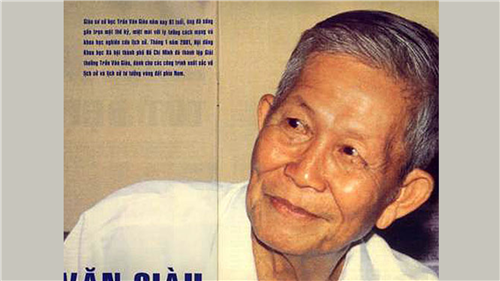
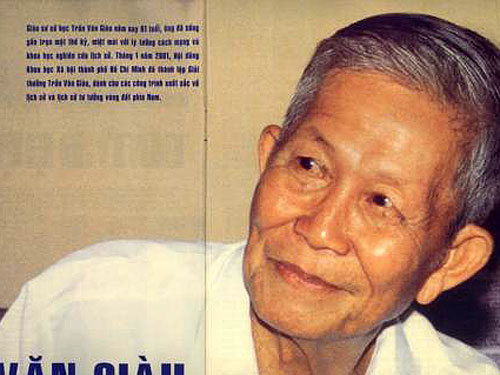
Professor, People's Teacher, Labor Hero Tran Van Giau (1911-2010)
Former Head of the History Department (Hanoi University), Secretary of the Party Committee of Hanoi University (1956).
Following the successful August Revolution and the establishment of the Democratic Republic of Vietnam on September 2, 1945, the French colonialists, under the guise of the British, returned to wage war to re-establish colonial rule in Vietnam. The people of Southern Vietnam were the courageous pioneers in confronting the French invaders. Tran Van Giau stood at the forefront of this vanguard. In 1949, he was unexpectedly called to the Viet Bac war zone and assigned various tasks. From 1951 to 1954, he served as Director and a professor directly teaching at the University Preparatory School in the Thanh-Nghe-Tinh liberated zone. During this period, he continued to write, primarily theoretical and propaganda materials for political training.
In November 1954, the Faculty of Literature and the Faculty of Science of the University of Education were established. Tran Van Giau was the first Party Secretary of the university's Party Committee, teaching Political Science, Philosophy, World History, and Vietnamese History. In the 1955-1956 academic year, he was awarded the title of Professor by the State in the first round of appointments. In mid-1956, Hanoi University was established, and he was appointed Party Secretary of the university, becoming one of the pioneering masters of modern history and philosophy in Vietnam.
During those difficult years, Professor Tran Van Giau and Professors Dao Duy Anh, Tran Duc Thao, and Cao Xuan Huy laid the foundation for the fields of history and philosophy. There was a shortage of teachers, books, and especially reference materials and textbooks. Without delay, Tran Van Giau and his students and colleagues had to "roll up their sleeves" and immediately compile the first textbooks. Surprisingly, despite these conditions, the textbook he edited on Modern Vietnamese History, even after many decades, can still be considered the most fundamental, profound, and influential textbook. In addition, he had to urgently compile other books such as...General Philosophy,History of resistance against invasionAlreadyThe South held firm as an impregnable fortress.vv. was used both as a reference document in schools and as a propaganda material, like a trumpet call urging compatriots and comrades to rush south to participate in the resistance war against the US to save the country.
Having overcome that period, by the early 1960s, Professor Tran Van Giau began undertaking meticulous and thorough research on Vietnamese history. His first book was the series "Vietnamese working class(3 volumes). This is the first comprehensive and systematic research work on the history of the Vietnamese workers' movement. After more than four decades, it can be seen that here and there the book needs supplementation and correction of historical data, but the most important contribution is Professor Tran Van Giau's methodological expertise. With this book, for the first time, Vietnamese history is no longer just the history of leaders, political parties, or religions, but truly the history of the masses, created by the people.
Next, Professor Tran Van Giau undertook an extremely difficult task, one that no one had been capable of before: compiling a comprehensive history of Vietnamese thought. He himself recognized this as a very difficult undertaking, but he could not refuse it. This is what he himself stated when Volume I of the book was published:Entering the field of intellectual history alone, at least in the initial stages, is truly worrying and frightening; there were times when I hesitated. (...) Here, the problem is very fascinating, the work is very difficult, everything is quite new, only one thing is familiar: methodology, but how are the principles of methodology correctly applied to the history of Vietnamese thought? It will certainly take a long time to find out."
Following this method, after many years of diligent research, the three-volume book was finally completed."The development of Vietnamese thought has come to fruition."Commenting on this monumental work, David G. Marr, one of the world's most renowned historians and a leading expert on Vietnam, wrote:"Among all the works published in every language in the world, this is the best history of Vietnamese thought."[1]I believe that the above comment from a prominent Western historian like David G. Marr is sufficient to highlight the true value of the work that Tran Van Giau "painfully" spent over 20 years completing; no further comment is needed. For these two works, Professor Tran Van Giau was awarded the first Ho Chi Minh Prize by the Vietnamese government in 1996.
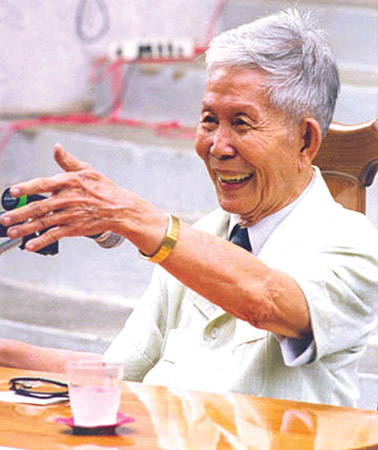
Professor Tran Van Giau was the teacher of many generations of Vietnamese historians.
After the liberation of South Vietnam and the reunification of the country, he returned to live in Ho Chi Minh City. Despite his advanced age and declining health, he continued to diligently research, contemplate, and refine his previously conceived works, as well as publish new ones. Generations of students, from those he mentored who have now become renowned scholars, to the new generation of students just starting their careers, who read his books and consider themselves his indirect disciples, still flock to meet him to hear him speak, see him smile, and receive his guidance. Foreign scholars, regardless of nationality or political views, who study modern and contemporary Vietnam without having met him – to interview him, to discuss his work, and to engage in debate – still consider themselves to have not yet attained enlightenment…
The works selected and published in volumes I and II of the book series are “The work was awarded the Ho Chi Minh Prize.These are, of course, his most representative works. Although the two volumes are very substantial (with a total of 3,558 pages), they only represent a fraction of his achievements.a small partThe academic contributions that Tran Van Giau dedicated to the Revolution, the Nation, and the Vietnamese social sciences and humanities.
As mentioned above, Tran Van Giau began his writing career very early in the field of political theory. Besides propaganda and training materials, he also compiled quite a few books on philosophy, political economy, and literary essays. However...History is the field in which he most clearly demonstrated his immense contributions and overarching academic prestige.
Tran Van Giau's influence and prestige in the field of modern and contemporary Vietnamese history research are affirmed not primarily by the enormous number of works he has published, but rather by...approachandprofessional seriousnessHe demonstrated consistency in all those works. There is no doubt that Tran Van Giau was a Marxist historian. The Marxist spirit – to quote one of his students, Professor Tran Quoc Vuong – was ingrained in his very being.
What needs to be clarified here is that the Marxist worldview was expressed in a very unique way in the method that Tran Van Giau used to approach and study history. He certainly belonged to the first generation of Western-educated intellectuals.voluntaryWe have embraced Marxist thinking in a completely rational and scientific manner, and treated Marxist-Leninist theory scientifically—as Marx himself demanded. Thanks to this, when applying Marxist methodology to the study of national history,He minimized the flaws caused by dogmatism and rigid adherence to rules.This has been a rather chronic ailment among Marxist historians, not only in Vietnam but also in many former socialist countries. Indeed, he pondered extensively on applying the theory of socio-economic formations and the doctrine of class struggle to the periodization of Vietnamese history, and he himself soon realized that it was impossible to rigidly "force" one period or another of the nation's history into one socio-economic formation or another.
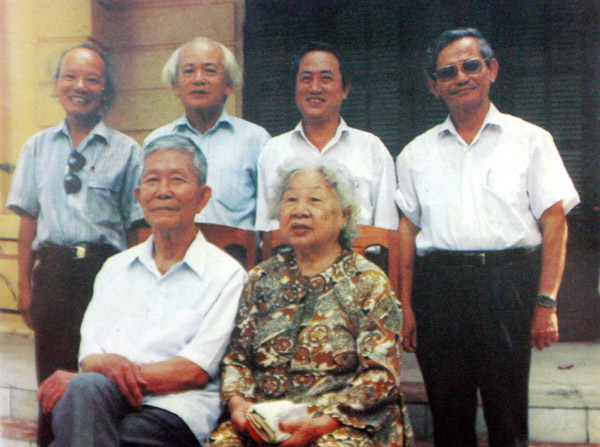
Professor Tran Van Giau and his wife, along with their students: Professor Tran Quoc Vuong, Meritorious Teacher; Professor Dinh Xuan Lam, People's Teacher.
Professor Ha Van Tan, People's Teacher; Professor Phan Huy Le
The most important principlein Tran Van Giau's understanding and presentation of historyrespecting the truthThat's the way he wrote history, which he called "having dates and names for the events." The books he wrote, fromResistance against invasion,Vietnamese working class(two sets) toThe South held firm as an impregnable fortress.andThe development of thought in VietnamHis works are overflowing with material, drawn from many sources and perspectives. He is also very meticulous in collecting and using historical sources, always critically evaluating, comparing, and clearly determining their reliability. The materials he uses are always clearly cited. For any unclear or doubtful parts, he clarifies them so that readers can carefully verify them themselves. Despite the abundance of material, his works are never boring to read; on the contrary, readers are strongly captivated by his eloquent and coherent explanations. Therefore, not only history students and researchers in Vietnam but also foreign scholars are eager to read his books.He is the most frequently cited contemporary Vietnamese scholar in works by foreigners on modern Vietnamese history.Looking through the bibliography at the end of research papers by renowned foreign scholars such as David G. Marr, William J. Duiker, Jayne S. Werner, Huynh Kim Khanh, Alexander B. Woodside, Stein Tonnesson, Daniel Hemery, Pierre Brocheux, Martin Murray, Bernard B. Fall, Shawn F. McHale, Furuta Motoo, Wilfred Lulei, etc., you will always find several references to Tran Van Giau. It's not that these scholars all agree with his arguments when consulting his books. Even if their opinions differ or are completely opposite to his – which is normal in science – they all show him great respect. Many praise him just as much as his students do back home.
Two setsHis book is about the history of the Vietnamese labor movement.These are the most frequently referenced and cited works both domestically and internationally. People refer to these two books primarily because they are vibrant and rich in material, as mentioned above. But what makes these books so highly regarded and widely referenced is the methodology and approach that Tran Van Giau demonstrates in these research works. Abroad, and especially in Vietnam, many people have tried to present and explain the processes and events of modern and contemporary Vietnamese history in different ways. However, in most of these works published in various languages in many countries, there is a common perspective and presentation that reduces history to merely the history of political parties, leaders, religions, and groups.eliteAll kinds.It is only in the aforementioned works of Tran Van Giau that history is truly presented as "the undertaking of the masses."In this work, the appearance, physical form, thoughts, aspirations, and activities of the masses were vividly and concretely recreated. Tran Van Giau's style of historical writing clearly had a strong influence on the epistemology and approaches of many scholars both domestically and internationally. In Vietnam, following his work, several other valuable studies on workers, farmers, women, etc., were conducted using this approach. Abroad, it wasn't until the mid-1990s that a few studies following this direction appeared.love up", which includes David G. Marr's monumental book on the August RevolutionVietnam 1945: the Quest for PowerIt is the most representative work.
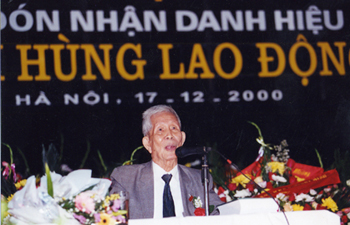
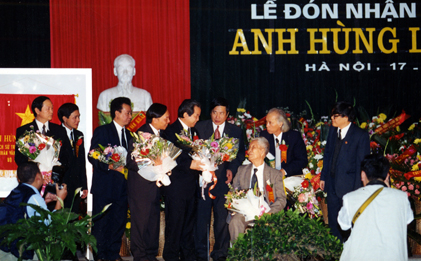
Professor Tran Van Giau delivered a speech at the ceremony to receive the title of Hero of Labor for the Department of History (University of Social Sciences and Humanities) in 2000.
Today, the application of anthropological, sociological, and approaches is becoming increasingly common.folkloreLearn, research, and present history in a "love upThis viewpoint is becoming increasingly popular among historians in many countries, and has begun to show signs of becoming an extreme trend, "seeing the trees but not the forest." It is in this context that the book series...Vietnamese working classTran Van Giau's work further affirms its methodological value. While writing history, even though he took mass movements as his main subject, Tran Van Giau did not fall into any kind of "populism." He maintained a multifaceted, multidimensional perspective, neither extremist nor biased. His research on workers, which revealed the clear yet fragile political-social boundary between two classes—one of whom were "teachers," the other "workers"—and highlighted the interaction between the political system, mass organizations, and the working class, is something only Tran Van Giau accomplished in Vietnam. Abroad, Joseph Buttinger and Martin Murray only offered a few ideas.
Another book by Tran Van Giau that is very famous both domestically and internationally is his three-volume work.The development of thought in Vietnam from the 19th century to the August Revolution.which he published between 1973 and 1993. This is the complete body of work that he published.Diligence, dedication, and intelligenceThere was more to be accomplished. Having specialized in writing textbooks, conducting research, and reconstructing the history of mass movements, when Trần Văn Giàu began to venture into the field of Vietnamese intellectual history, he knew very well that he was undertaking a very difficult and complex task.
Finally, to understand Tran Van Giau's scientific works, it's perhaps also worth knowing that he was a man who endured great suffering.Life is full of worries and troubles when one becomes self-aware."—That's what Uc Trai said—and it came true for Uc Trai and for Tran Van Giau. The stormy, arduous path of his life, from a Western-educated intellectual, the son of a wealthy family, to a professional revolutionary, prisoner, leader, and finally a scholar and historian, is the path of..."many human sorrowsHis father died while he was away from home. Years later, he returned quietly to pay his respects at his father's grave in a deserted field at night, while he was still wandering far and wide. Then his mother also quietly passed away while he was still away.He fought on the battlefields. His virtuous wife wasted her youth waiting for him, at times even having to enter a monastery to escape the malicious slander of public opinion… But those were only “small sorrows.” Greater sadness and pain haunted him for many years. Only by understanding the depths of his heart can one truly appreciate his extraordinary resilience, and understand that he was not only a staunch revolutionary soldier, a scholar, and a great teacher, but also a truly GREAT PERSONALITY.
|
PROFESSOR, PEOPLE'S TEACHERTRAN VAN GIAU
+ Affiliation: Department of History. + Management position: Former Head of the History Department (Hanoi University). Secretary of the Party Committee of Hanoi University (1956).
History of resistance against invading forces(3 volumes, 1956-1957). History of the Vietnamese working class (4 volumes, 1,500 pages). Modern history of Vietnam. The South held firm as an impregnable fortress.. The development of Vietnamese thought from the 19th century to the August Revolution.. Cultural Geography of Ho Chi Minh City. Traditional spiritual values of the Vietnamese people.
+ Ho Chi Minh Prize for Science and Technology for the workHistory of VietnamComprising 5 sets, 18 volumes (1956-1978) in 1996. |
Author:Professor Dinh Xuan Lam; Professor Pham Hong Tung

