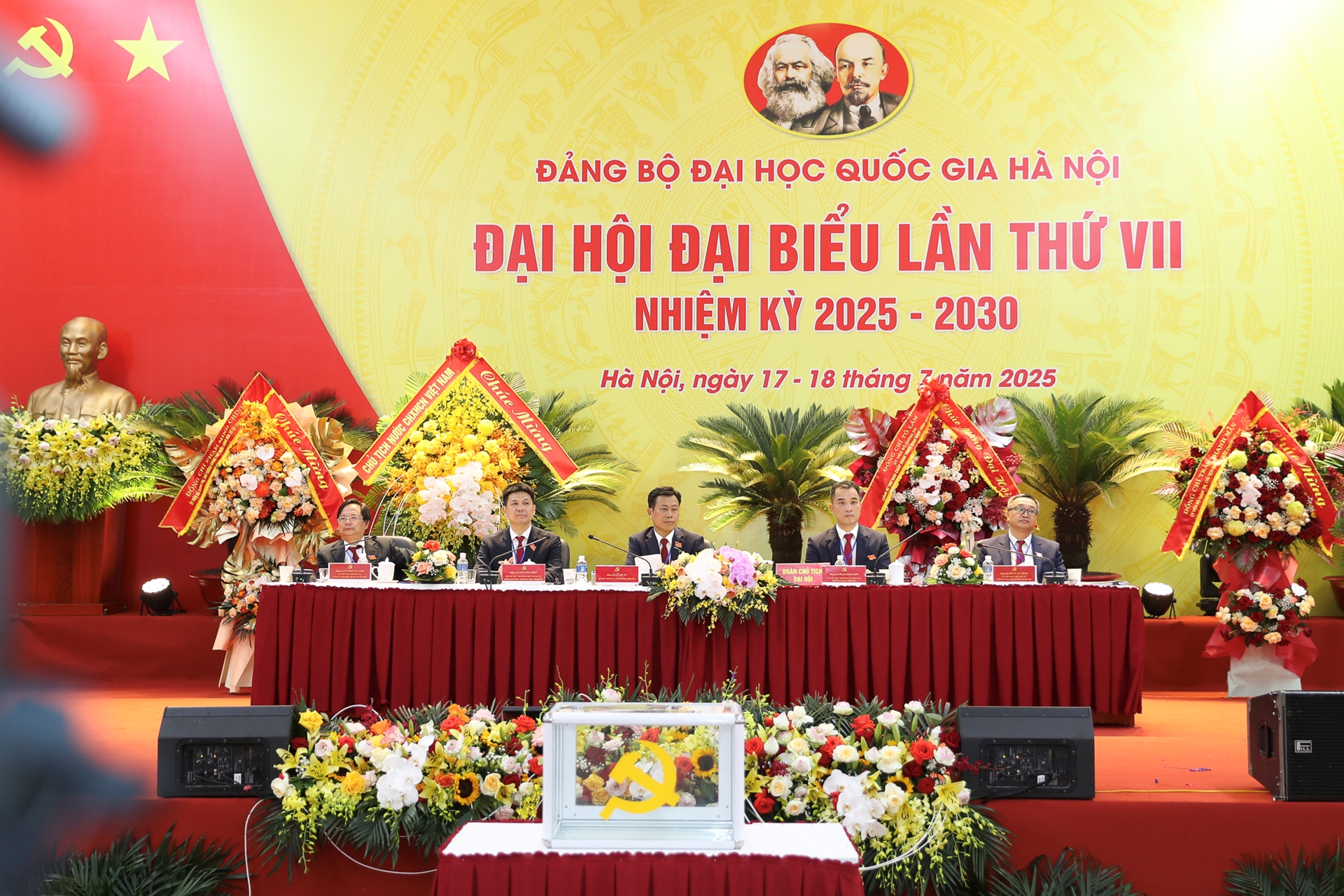
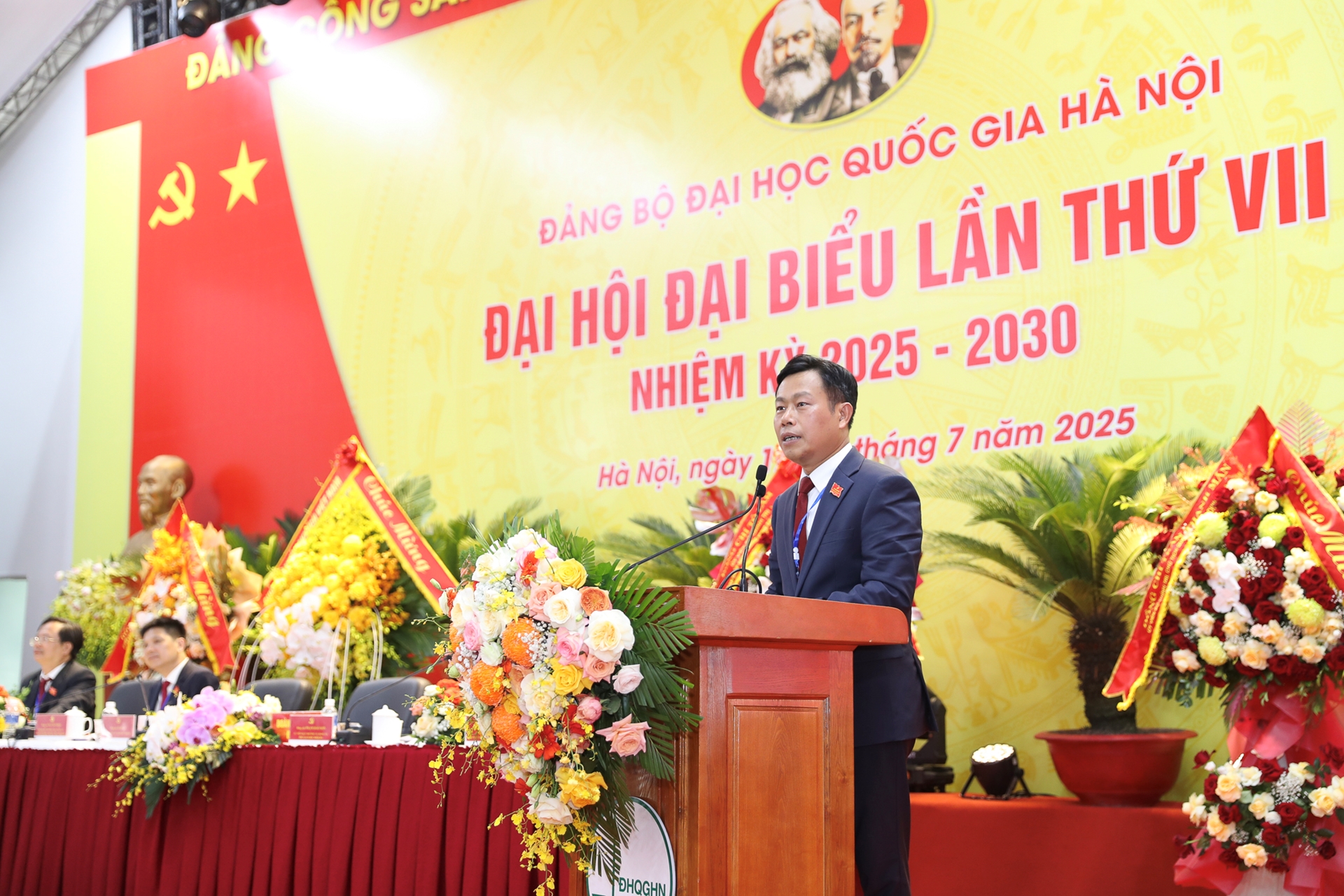
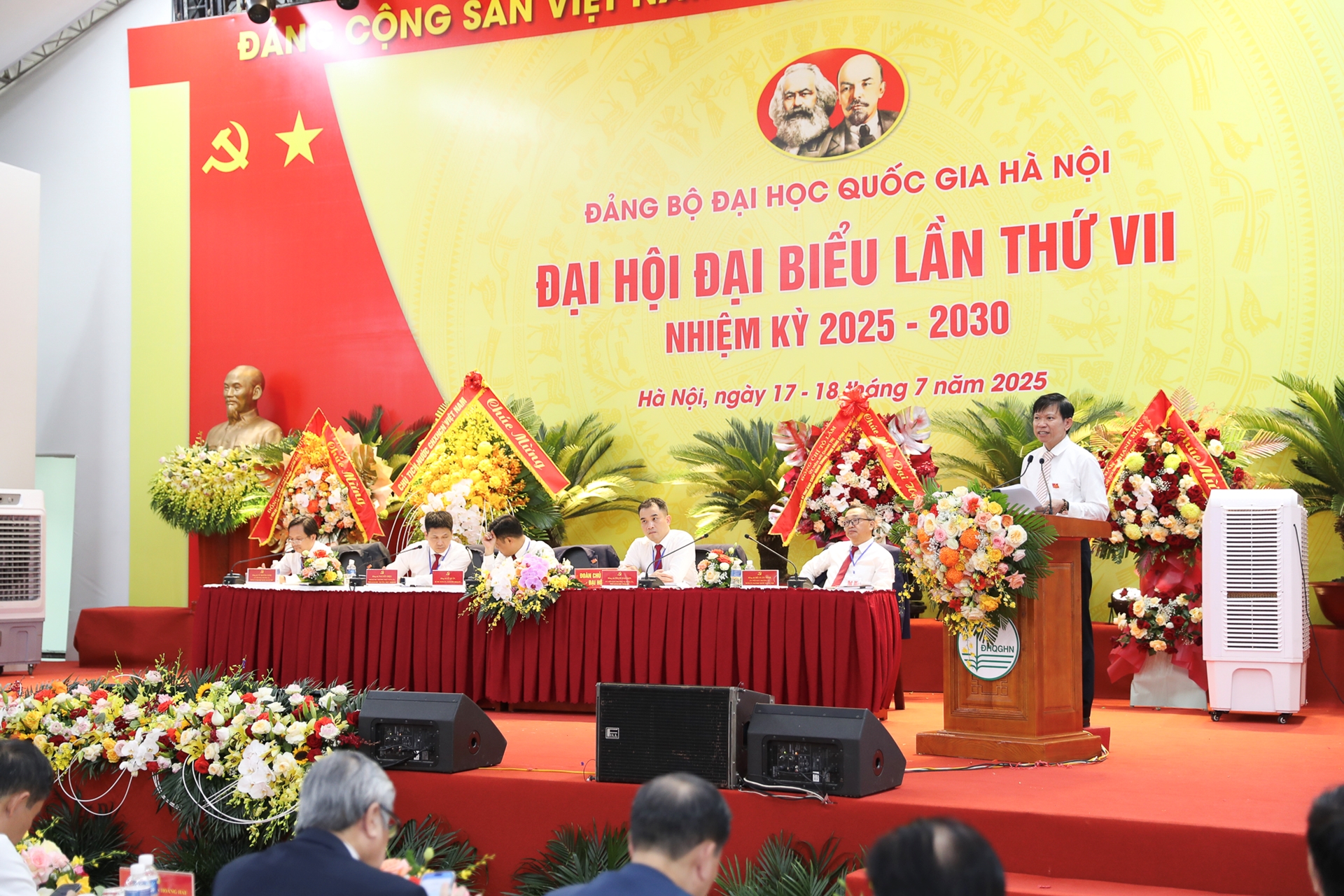
In his opening speech, the Party Secretary and Director of Vietnam National University, Hanoi, Le Quan, stated that the 7th Congress of the Party Committee of Vietnam National University, Hanoi, is taking place at a time when the entire nation is undergoing a strong transformation to strive for development. In this context, all cadres, Party members, and students of Vietnam National University, Hanoi, express their profound faith in the leadership of the Party; and are determined to compete and strive to build and develop Vietnam National University, Hanoi, into a leading innovative university in the world.
The Congress respectfully and highly appreciates the valuable contributions to the Political Report of the 7th Congress of Delegates - a product of the wisdom and solidarity of the entire Party Committee of VNU.
The 7th Congress of Delegates has the task of comprehensively and objectively reviewing the implementation of the Resolution of the 6th Congress and the leadership and guidance of the Party Committee; analyzing and evaluating the 5-year reform process; drawing necessary lessons to decide on the direction, goals, and tasks for the development of VNU in the 2025-2030 period; electing the delegation to attend the 18th Congress of the Hanoi City Party Committee; and especially electing the 7th term of the VNU Party Committee, which is truly exemplary in political qualities, possesses sufficient intellect, courage, and capacity to lead VNU in the new era.
Comrade Le Quan emphasized that the 7th Congress of the Party Committee of Vietnam National University, Hanoi (VNU) upholds the spirit of innovation, national responsibility, and breakthrough development. The entire Party Committee will strive its utmost, leveraging the strength of the system to seize opportunities, overcome challenges, and create a breakthrough in development to make VNU a leading innovative university, contributing effectively and directly to national development, and successfully fulfilling the glorious mission entrusted by the Party and State: training high-quality, highly skilled human resources, nurturing talent, and playing a pivotal and leading role in innovation within the Vietnamese higher education system.
A milestone in our development journey.The political report presented to the Congress clearly stated that, over the past five years, under the close leadership and guidance of the Party Committee and the Standing Committee of the Party Committee, along with the efforts of the entire system, Vietnam National University, Hanoi (VNU) has achieved many important accomplishments, creating a foundation for breakthrough development in the coming period. VNU's position continues to be enhanced both domestically and internationally; connectivity and linkages within the system are increasingly strengthened; and its pivotal and leading role in the comprehensive and fundamental reform of education and training has been affirmed.
One of the hallmarks of the past term of the Party Committee of Vietnam National University, Hanoi is the unity and cohesion, the building of a democratic and cooperative working environment, creating a foundation for sustainable development, and maximizing the leadership role of Party committees at all levels.
Modern university governance methods are thoroughly implemented at Vietnam National University, Hanoi (VNU). Decentralization and delegation of authority are carried out synchronously. VNU grants high levels of autonomy, coupled with accountability, to its units. VNU focuses on strategic and quality management; strengthens inspection, supervision, coordination, and linkages among units; and directly implements major tasks that are interdisciplinary, cross-sectoral, and have a profound impact. Member units and affiliated units are autonomous in their organization and operation to leverage their specific expertise while ensuring interconnectedness, collaboration, and the use of VNU's shared resources for development.
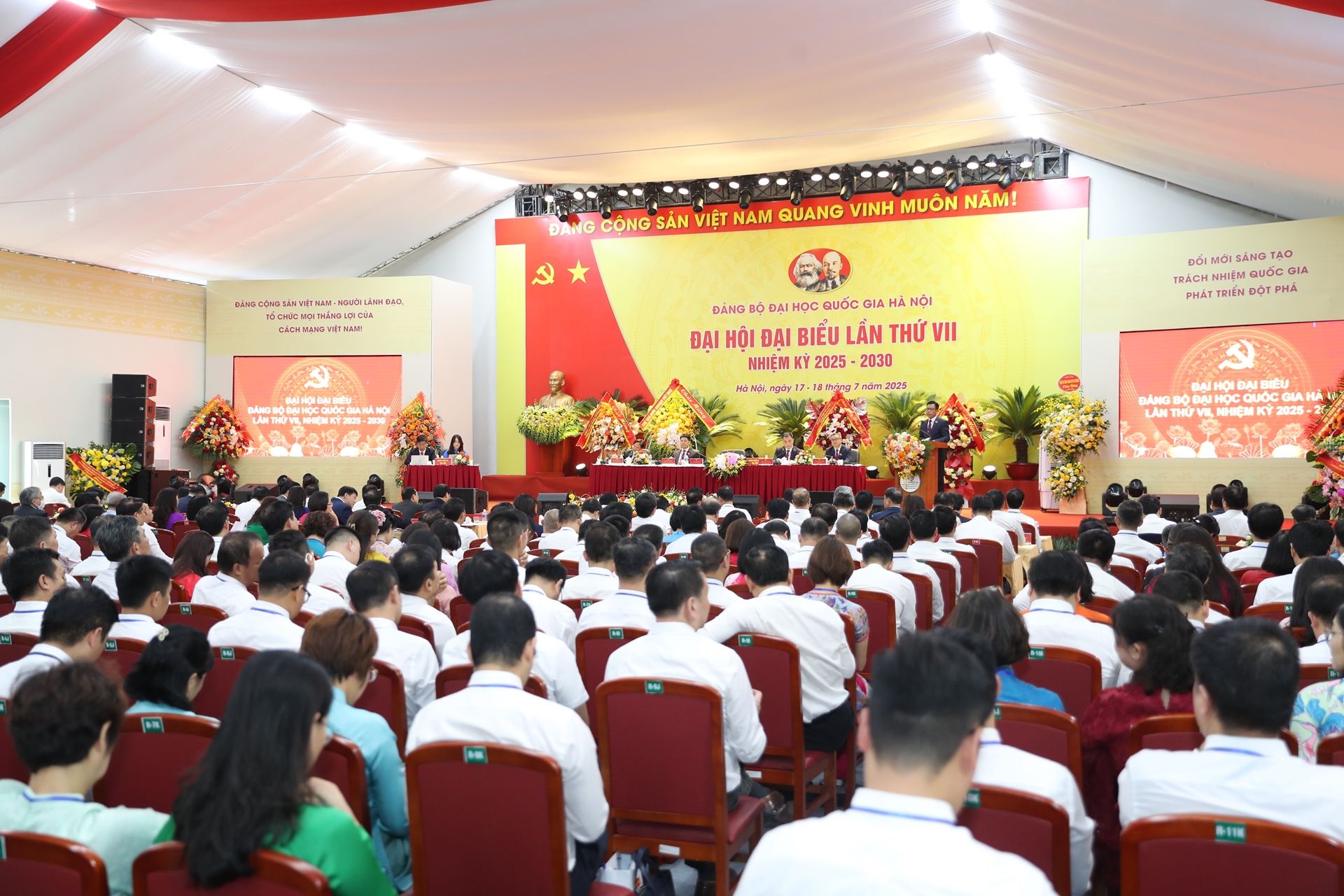
Digital transformation and the application of digital technology, coupled with advanced university governance innovation, have shown significant progress compared to previous periods. Information technology infrastructure, databases, and management software in various operational areas are being standardized, upgraded, modernized, synchronized, and seamlessly connected between the inner city area and the Hoa Lac campus.
Internationalization is a strategic pillar in training, and Vietnam National University, Hanoi (VNU) is comprehensively restructuring its programs, teaching methods, and organizational models according to international standards. One of the key highlights is shortening the undergraduate training time in key science fields to 3 years, applying a 3-semester/year system, helping students proactively plan their career paths and enter the labor market sooner.
The scientific and technological activities of Vietnam National University, Hanoi (VNU) have achieved remarkable results, initially applying computerization processes, building and operating software systems for managing scientific and technological activities, and significantly shortening administrative procedures. Financial resources invested and planned for the next term in the field of science and technology have increased dramatically, estimated at over 3,520 billion VND.
The construction of the Vietnam National University, Hanoi (VNU) urban area in Hoa Lac and the official relocation of the VNU headquarters to Hoa Lac is a major task and has been identified as a breakthrough for the VNU Party Committee in the past term. To date, the VNU headquarters and most of its member units and affiliated units have officially moved their offices and are now present in Hoa Lac. According to the plan, by the end of 2025, the VNU urban area will reach over 480,000 m2 of built-up area, with nearly 20,000 full-time students studying regularly and about 2,000 students attending periodic national defense and security education, marking a transformation of VNU towards a new development space in terms of infrastructure, academic life, and university administration.
Term 2025-2030: Breakthrough development, steadily advancing with the country into a new era.The country is preparing the mindset, resources, and necessary conditions to enter an era of progress. The accelerated implementation of resolutions of the Central Committee and the Politburo, especially Resolution No. 57-NQ/TW, is both a requirement and a driving force and opportunity for the development of Vietnam National University, Hanoi.
The Vietnam National University, Hanoi (VNU) has set a strategic goal of building a strong and comprehensive Party Committee within VNU, serving as a pioneering nucleus to lead VNU's development into an innovative university, ranking among the world's leading universities, and making significant contributions to national development in the new era.
Vietnam National University, Hanoi (VNU) has identified five overarching development perspectives, including:
Firstly, continue to refine the multi-disciplinary, multi-sectoral model. Consistently build a strong Party Committee at Vietnam National University, Hanoi (VNU) with the motto "One VNU"; promote decentralization (academic, training management, personnel organization, development cooperation, finance, infrastructure); leverage the strength of the system (brand management; VNU urban area in Hoa Lac; science and technology infrastructure and digital transformation); ensure interconnectedness (human resources, A+B training model). VNU focuses on strategic management, quality control, resource development, and promoting innovation indicators.
Secondly, focus on building a team of outstanding lecturers and scientists. Strengthen policies for utilizing, training, attracting, and rewarding talent; create a good working environment to foster innovation; and cultivate and develop the next generation of staff.
Thirdly, strongly promote the internationalization of VNU's activities, focusing on internationalizing and improving the quality of training; implement fundamental reforms in education and training linked to international integration.
Fourth, focus on building VNU into a center for basic science research and innovation; a leading unit in implementing Resolution No. 57-NQ/TW.
Fifth, promote digital transformation in all activities of VNU towards a digital university.
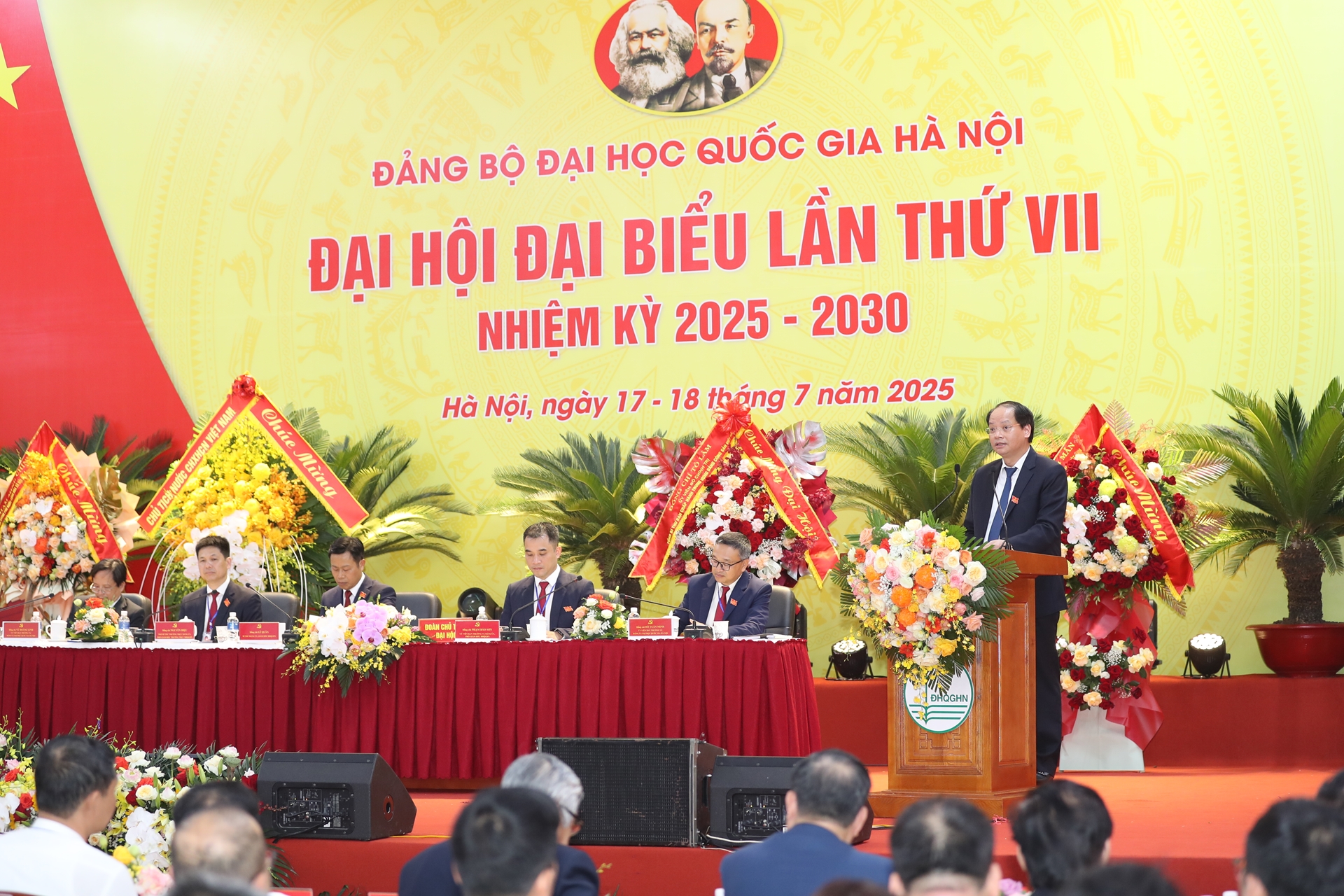
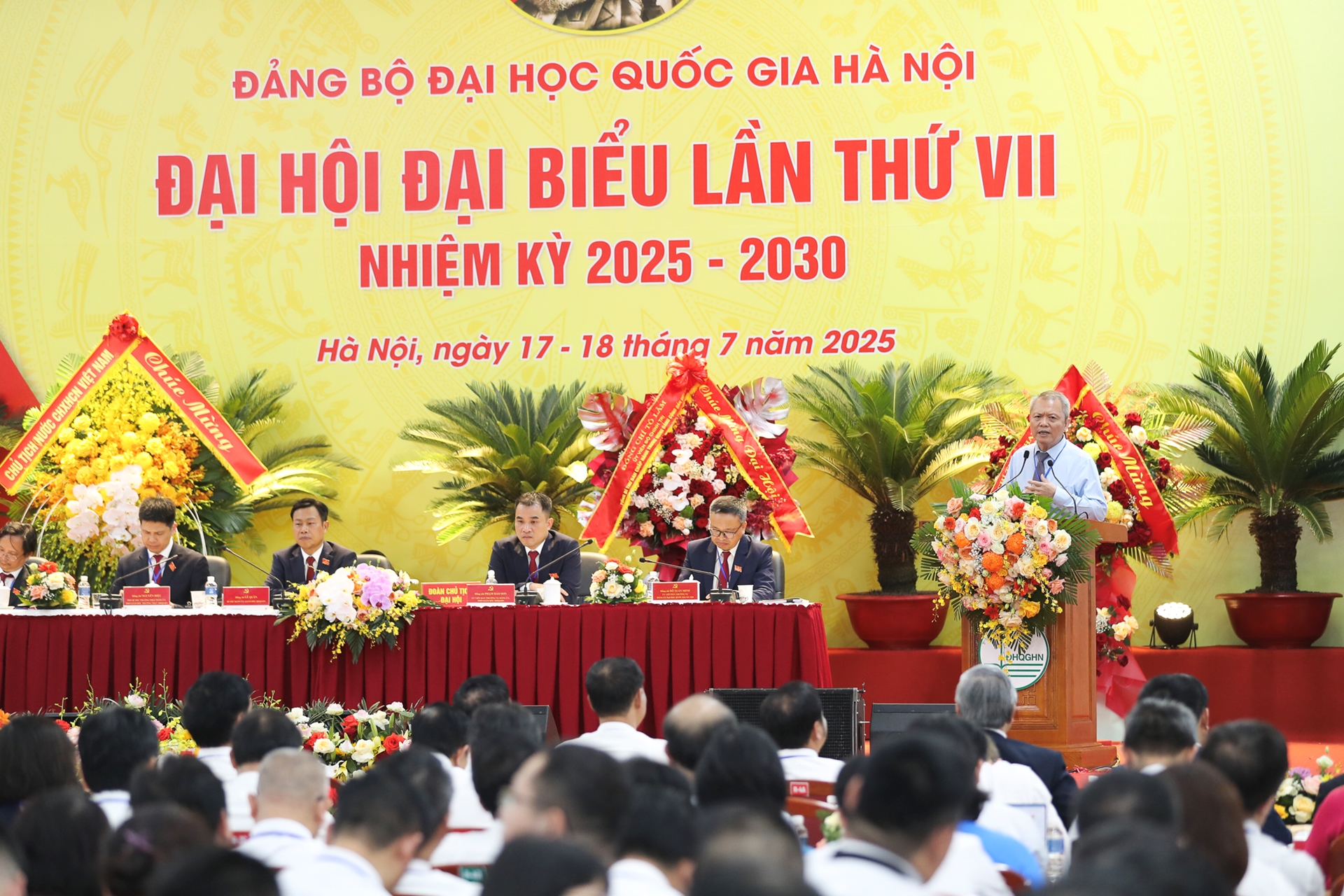
Comrade Nguyen Doan Toan, Member of the Standing Committee and Head of the Propaganda and Mass Mobilization Department of the Hanoi City Party Committee, delivered a speech at the Congress.
Speaking at the Congress, Comrade Nguyen Doan Toan stated that the City Party Committee highly appreciates the innovative, multi-disciplinary, multi-field university model with autonomous mechanisms and modern university governance methods of Vietnam National University, Hanoi (VNU), in which the VNU Party Committee is the leading core, uniting and leveraging collective strength; impressed by the remarkable development of many important indicators in the fields of science and technology, training, and domestic and international cooperation; and acknowledges the role and important contributions of VNU's scientists in research, policy consulting, and accompanying ministries, sectors, and localities in planning development and training and fostering cadres at all levels. The City Party Committee commends VNU's pioneering spirit of innovation through many effective and meaningful pilot policies and programs in the past term; and especially appreciates the vision, courage, and determination of the entire Party Committee in transforming and successfully building the VNU urban area in Hoa Lac.
In the coming term, the country and Hanoi will enter a new phase of development, the "Era of National Advancement," with very high demands on the quality of human resources, the development of science and technology, and digital transformation. As the leading institution of the higher education system, and a trusted address of the Central Committee and the City Party Committee, the comrade suggested that the Party Committee of Vietnam National University, Hanoi pay attention to and focus on implementing the following key tasks:
The first,Continue to enhance the leadership capacity and fighting strength of the Party Committee, focusing on building a truly clean and strong Party Committee in terms of politics, ideology, organization, and ethics. Promote the study and emulation of Ho Chi Minh's thought, morality, and style; strengthen unity, promote democracy within the Party, and enhance the exemplary role of cadres and Party members, especially leaders, in conjunction with implementing the Central Committee's resolutions on Party building and rectification and the political system.
MondayPromoting the political core role in leading the implementation of professional tasks. Proactively and strongly innovating the university governance model; promoting university autonomy associated with sustainable development. Focusing on improving the quality of training, especially training high-level human resources, human resources for key industries, high-tech industries, digital economy, green economy, circular economy… in line with the country's development orientation. Continuing to develop high-quality training programs, international collaborations, meeting the requirements of global integration and competition.
Tuesday,Focus on comprehensive digital transformation, especially in university governance and training management. Vietnam National University, Hanoi (VNU) must be a pioneering and exemplary institution in autonomy, innovation, and digital transformation in higher education in Vietnam, affirming its leading role in innovation and effectively implementing key tasks in Resolution No. 57-NQ/TW, developing VNU into a leading center of science, technology, and innovation in the region.
Wednesday,Promote scientific research and innovation; prioritize research in basic sciences, interdisciplinary sciences, and cutting-edge science and technology. Strengthen the transfer of research results into practical production and business, serving the socio-economic development of the Capital and the country; develop a startup ecosystem within universities, closely connecting with businesses and localities, especially Hanoi, contributing to the formation of a new growth pole in the western part of the Capital.
Thursday,We are committed to building a team of scientists and lecturers with strong political integrity, in-depth professional expertise, and sufficient capacity to participate in regional and global scientific and educational activities. This is a key factor in fulfilling the mission of building VNU into a leading research university in the region.
During the implementation of Directive No. 45 of the Politburo (13th term) and Plan No. 329 of the Hanoi City Party Committee on organizing Party congresses at all levels, the Executive Committee of the Party Committee of Vietnam National University, Hanoi, has always received profound attention and guidance from the Standing Committee, the Office, the Inspection Committee, and the Party Committees of the Hanoi City Party Committee, as well as special attention from a large number of cadres and Party members who contributed to the drafting of the Congress documents.
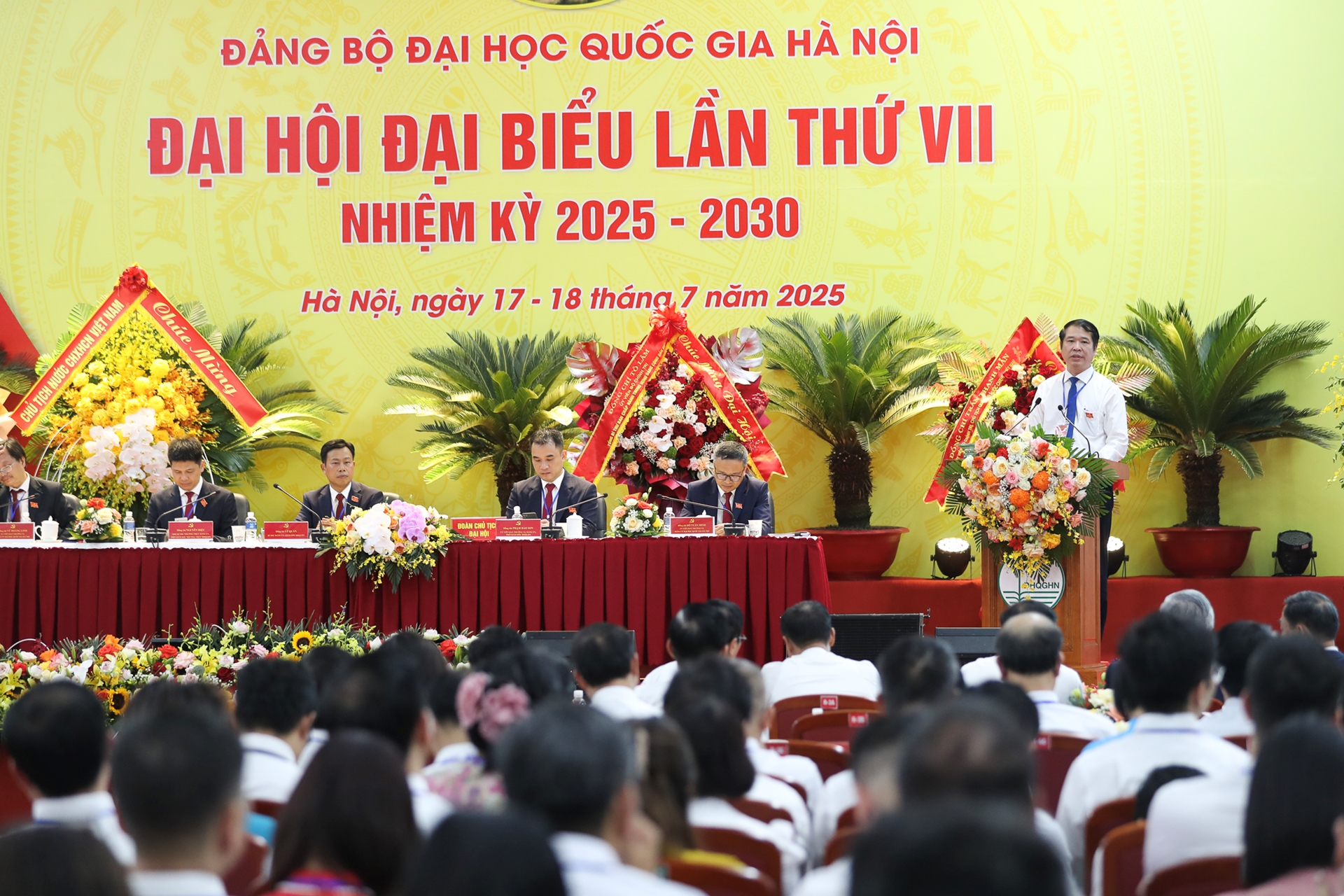
With a spirit of democracy and high responsibility, at the Congress, delegates presented their opinions and contributions to the documents of the Congress at all levels: Comrade Le Thanh Son - Rector of the University of Natural Sciences, presented a paper on the topic: "Developing basic science and training talents in the context of university autonomy"; Comrade Le Ngoc Thanh, Rector of the University of Medicine and Pharmacy, presented a paper on the topic: "Affirming the position of VNU in the field of health sciences: breakthrough achievements and strategic orientation"; Comrade Chu Duc Trinh, Rector of the University of Technology, presented a paper on the topic: "University autonomy and digital university governance in the era of national development"; Comrade Nguyen Truc Le, Secretary of the Party Committee and Chairman of the Council of the University of Economics, presented a paper on the topic: "Strengthening the policy advisory role of VNU in the socio-economic development of the nation and localities"; Comrade Hoang Anh Tuan, Rector of the University of Social Sciences and Humanities, presented a paper entitled: “From humanistic thinking to digital citizenship: a strategic direction for higher education in the context of digital transformation”; Comrade Nguyen Dinh Duc, former Chairman of the University Council of the University of Technology, presented a paper entitled “Experiences in building strong research groups at VNU”; Comrade Nghiem Xuan Huy, Director of the Institute of Digital Training and Testing, presented a paper entitled: “Digital transformation in training at VNU”.
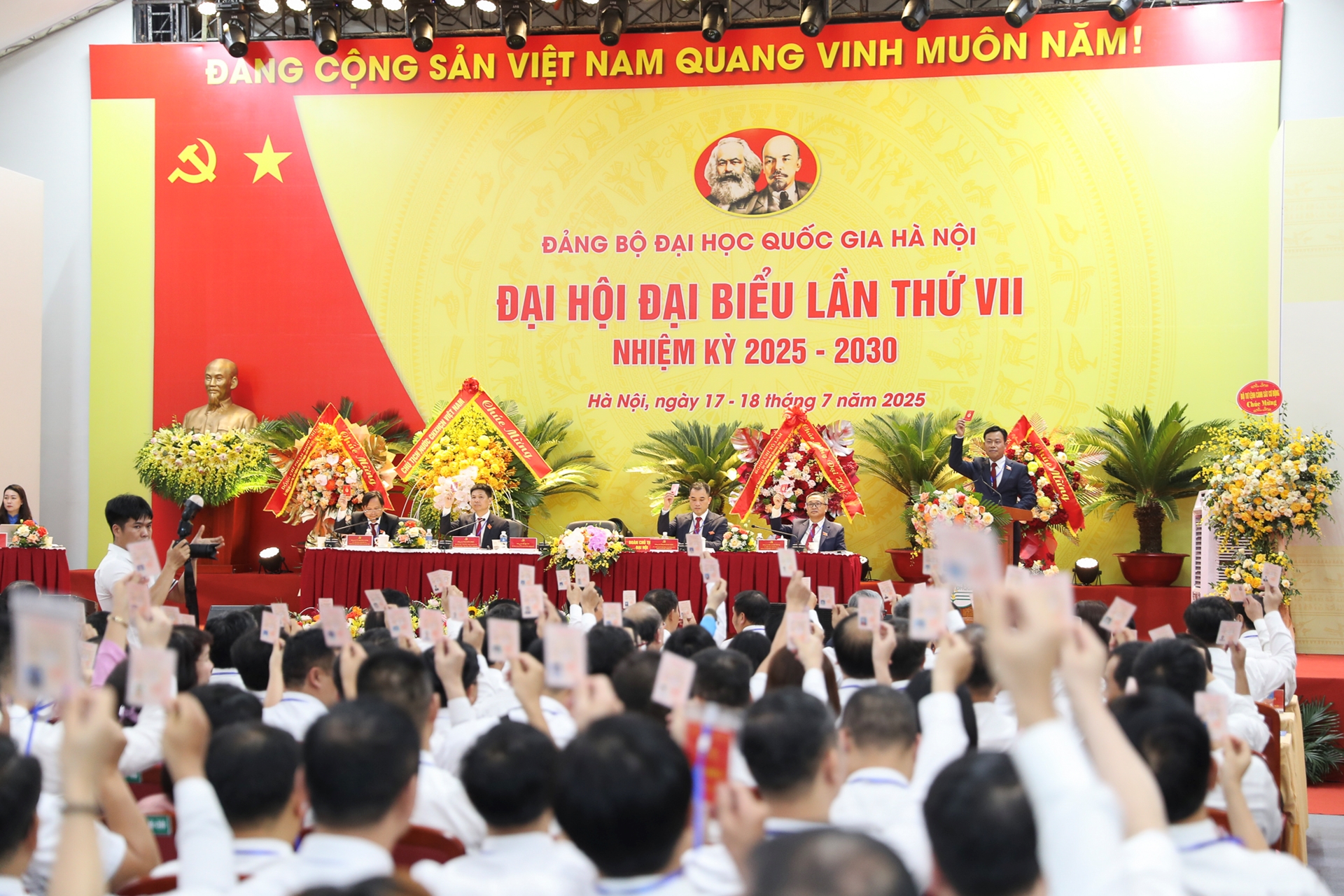
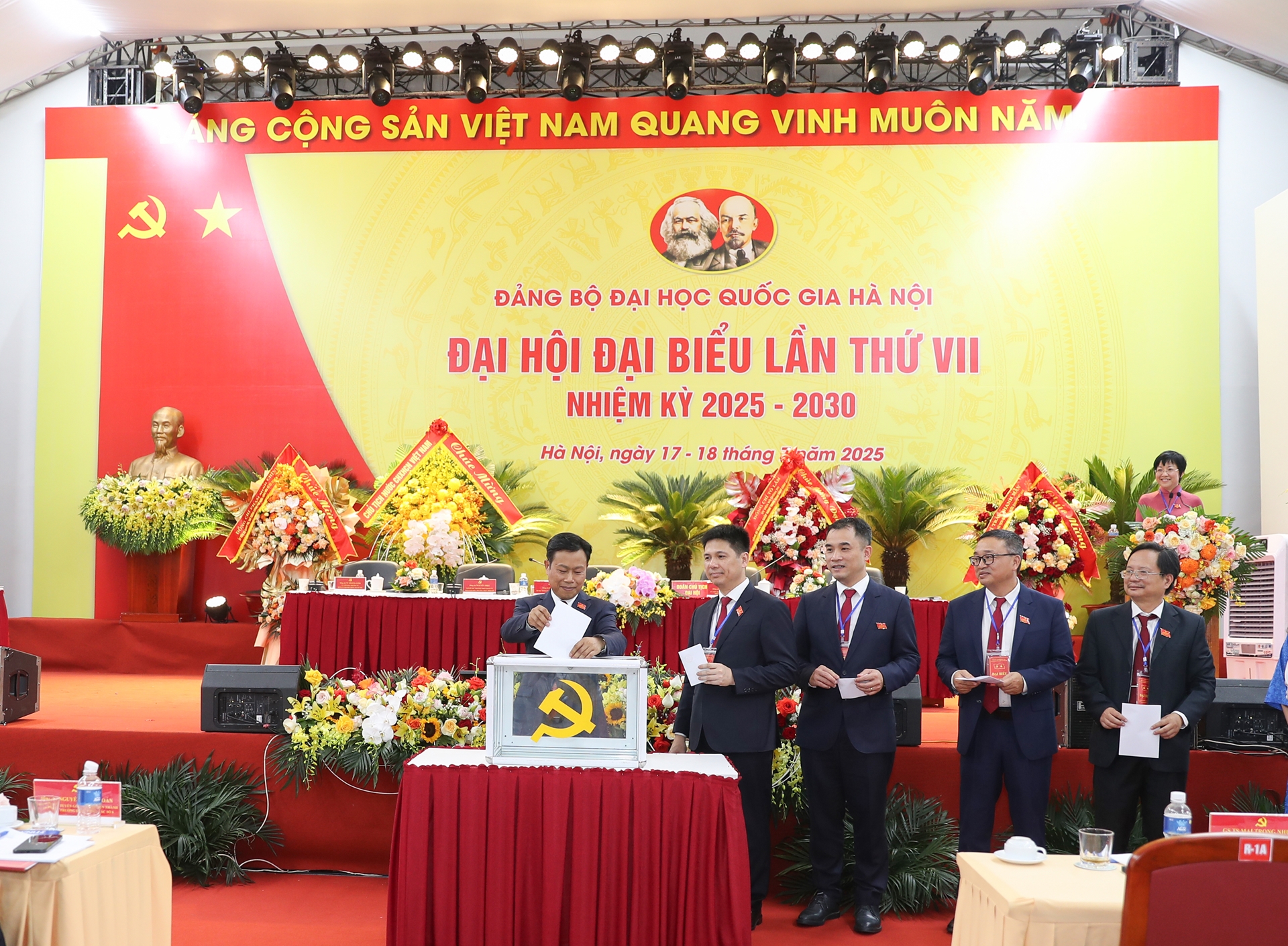
The Congress elected the Executive Committee of the Party Committee of Vietnam National University, Hanoi, for the 7th term, 2025-2030, consisting of 24 members who possess the necessary moral qualities, leadership skills, and capabilities to shoulder the responsibility of leading the development of Vietnam National University, Hanoi over the next five years. Comrade Le Quan was re-elected as Secretary of the Party Committee of Vietnam National University, Hanoi for the 2025-2030 term.
The Congress elected a delegation representing all Party members of the Party Committee to attend the 18th Congress of the Hanoi City Party Committee, consisting of 5 official delegates and 1 alternate delegate. The Congress also voted with 100% of delegates in favor of approving the important targets and the Congress Resolution.
On behalf of the new Executive Committee, the Secretary of the Party Committee of Vietnam National University, Hanoi, Le Quan, affirmed that the 7th Congress of Delegates of Vietnam National University, Hanoi, had been a great success. The success of the Congress will create momentum throughout the Party Committee, helping cadres, Party members, and students of Vietnam National University, Hanoi, to be confident, creative, and steadfast on the new path of development. After the Congress, grassroots Party organizations must proactively plan to put the Congress's Resolution into practice through specific action programs. The Congress calls on all cadres, Party members, and students of Vietnam National University, Hanoi, to unite and strive to successfully implement the Resolution of the 7th Congress of Delegates, bringing Vietnam National University, Hanoi, to a new level and making a worthy contribution to the development of the Capital and the country.
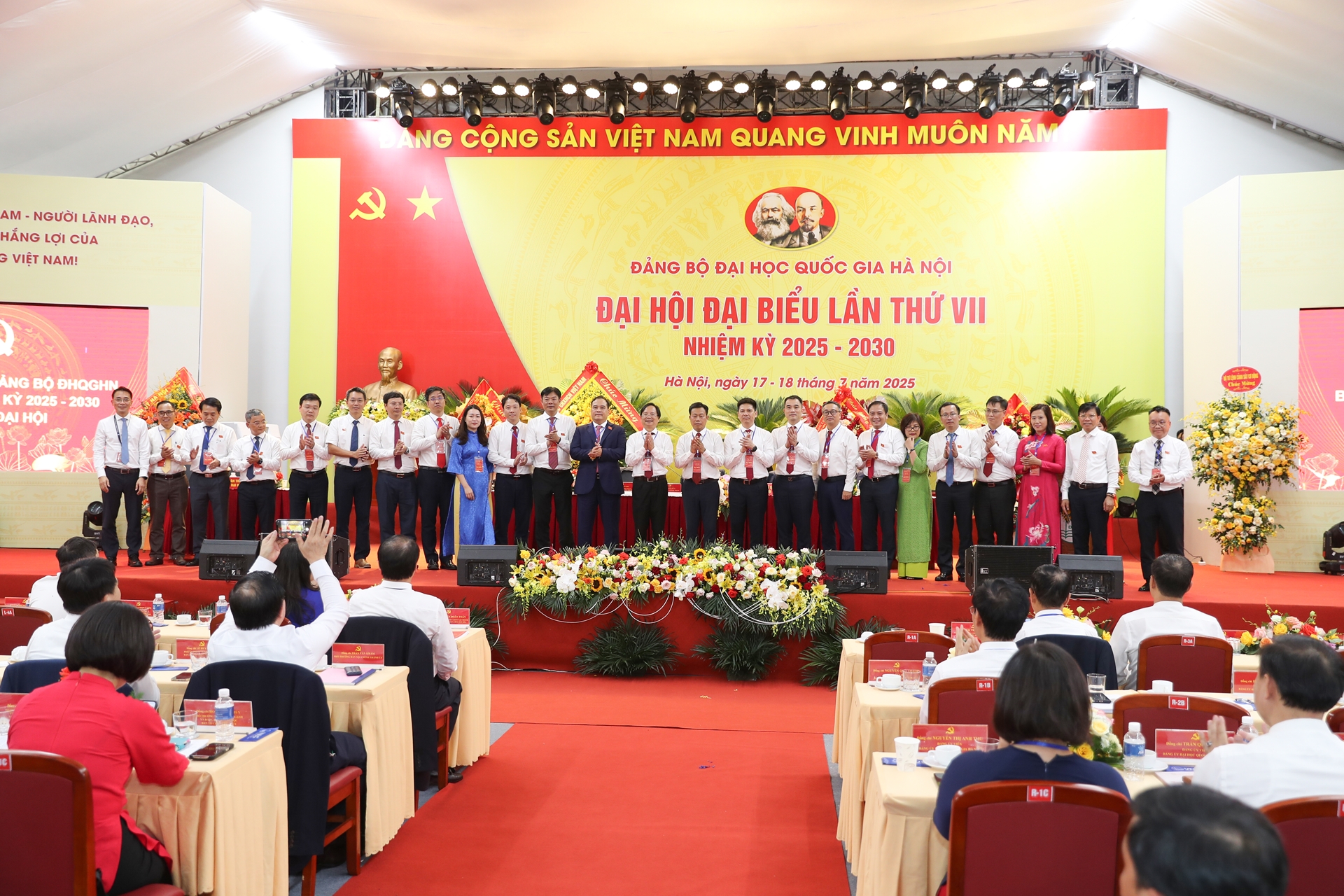
The Executive Committee of the Party Committee of Vietnam National University, Hanoi, term VII, 2025-2030, has been introduced.
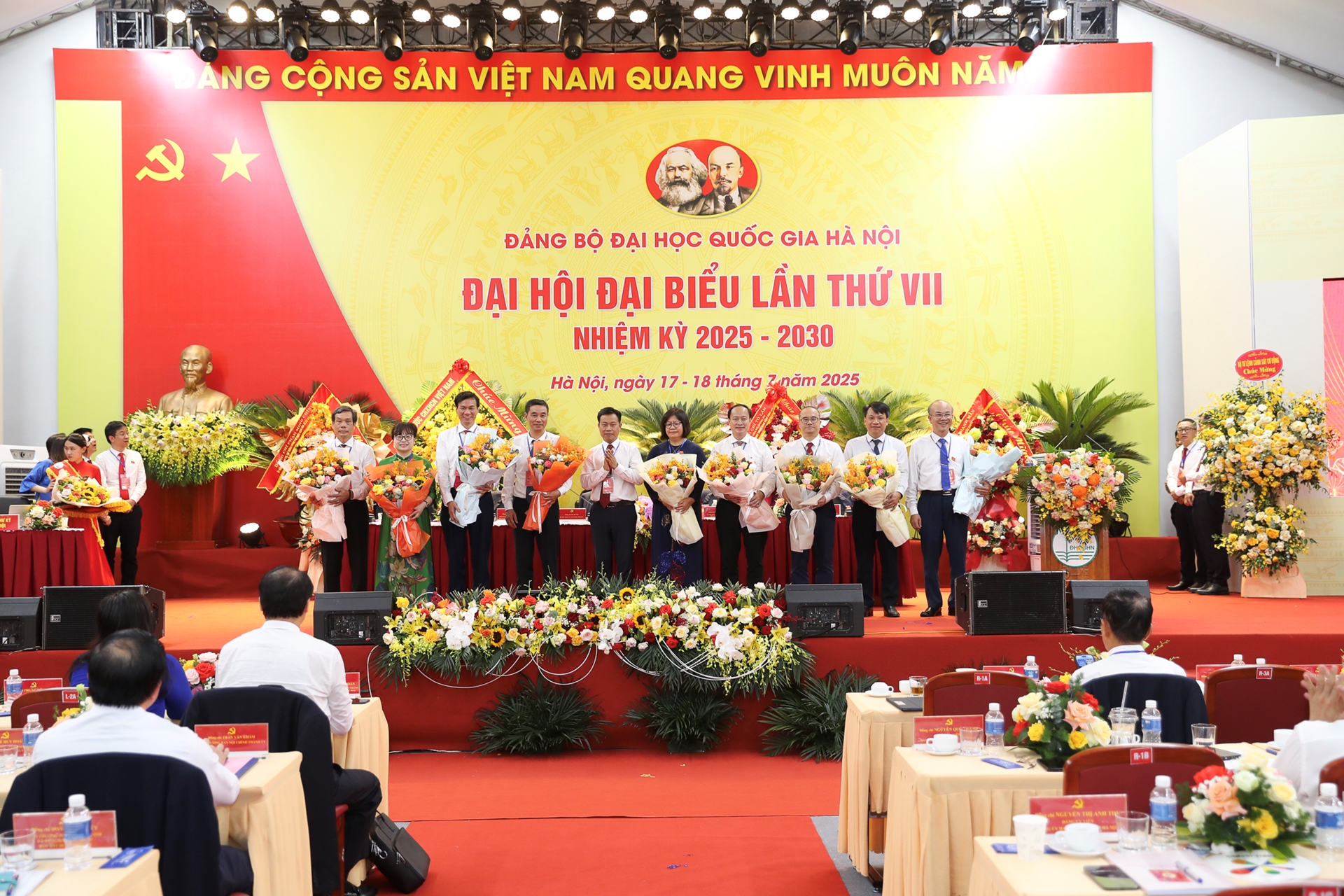
Comrade Le Quan, on behalf of the Executive Committee of the Party Committee of Vietnam National University, Hanoi, term VII, 2025-2030, presented flowers to express gratitude to the members of the Executive Committee of the Party Committee of Vietnam National University, Hanoi, term VI.
Delegates presented their papers at the Congress.
During the 2020-2025 term, the work of building, consolidating, and improving the quality of grassroots Party organizations and Party members was emphasized, resulting in increasingly substantive evaluations and classifications, with an average annual rate of over 97% of Party branches achieving "Good Performance" and 98% of Party members achieving "Good Performance" or higher. As of June 2025, the entire Party Committee of Vietnam National University, Hanoi had 1,156 newly admitted Party members, including 674 student Party members and 20 high school student Party members, exceeding the target set by the 6th Party Congress by more than double.
In the context of implementing Resolution No. 18-NQ/TW of the Central Committee, Vietnam National University, Hanoi (VNU) reorganized its structure towards a streamlined, efficient, effective, and effective model, reducing the number of departments from 36 to 25, achieving high consensus and maintaining unity within the entire Party Committee. Simultaneously, it promoted autonomy mechanisms and restructured its apparatus towards a more streamlined model, coupled with upgrading and developing several units according to a roadmap to perfect a multi-disciplinary, multi-field structure, with particular emphasis on developing innovation capacity.
The data sharing, integration, and warehousing system is standardized and synchronized throughout VNU, adhering to the Digital University Architecture. By the end of 2024, 95% of learning materials will be digitized; 100% of staff and student data will be digitized; and 20% of courses in each program will adopt online teaching, fulfilling the targets set by the 6th Congress.
The current scale of undergraduate training at Vietnam National University, Hanoi (VNU) is over 60,000 students, exceeding the target by 26.5%. Training programs are flexibly adjusted to meet the requirements for supplying high-quality human resources for socio-economic development. Specifically, the structure of majors and fields is being adjusted towards increasing the number of engineering and technology, health sciences, and digital creative arts (reaching 30% of the total training scale). This is projected to reach 40% in the 2024-2025 academic year, and from 2026 onwards, the goal is to reach 65%.
The scientific staff continues to grow, with 2,878 scientific staff members out of a total of 5,291; the percentage of lecturers with doctoral degrees reached 67.3%; and the percentage of lecturers holding professor or associate professor titles reached 21%. During the 2020-2025 term, the total number of scientific articles published in the ISI/SCOPUS system was 9,751, 2.7 times more than the previous term. The percentage of scientific publications in the Q1 and Q2 groups reached 64%, exceeding the target set by the 6th Congress by 14%; the number of applications for utility solutions and inventions accepted is estimated at 357.
The science, technology, and innovation network of Vietnam National University, Hanoi (VNU) has been restructured with 15 research programs; 8 priority technology fields (Semiconductor Chip Technology, Artificial Intelligence and Digital Technology, Biotechnology - Medicine and Agriculture, Environment, Robotics and Automation, Advanced Energy and Materials, Quantum Technology); 46 strong research groups; a modernized and invested laboratory system, including 9 key laboratories and 1 national key laboratory. The High-Tech and Innovation Park is linked to the development of applied research and technology transfer units (reorganization of member research institutes, establishment of the Semiconductor and Advanced Materials Institute, the Institute for Applied Artificial Intelligence in Sustainable Development, the Quantum Technology Institute, VNU Investment and Development Joint Stock Company, the Science and Technology Business Incubator, and science and technology development funds...).
Vietnam National University, Hanoi (VNU) continues to affirm and promote its role and academic prestige in fulfilling national tasks: participating in summarizing practical experiences and conducting theoretical research, especially on resolutions of the Central Committee and the Politburo, with many research works providing scientific basis and arguments for policy advice to the Party and the State; deeply involved in advising, reviewing, and contributing to the National Master Plan, the Capital City Plan, and local plans for the period 2021-2030, with a vision to 2050. Strengthening applied research, with a high academic reputation and strong scientific and technological potential, VNU continues to be entrusted with leading the implementation of many large-scale national scientific tasks, with dozens of scientific and technological products put into practical application.
The advantages of its organizational model and its role as a leading university in Vietnam have allowed Vietnam National University, Hanoi (VNU) to collaborate with major universities around the world. Along with maintaining hundreds of traditional international partners, VNU has recently expanded its cooperation agreements with leading universities worldwide such as: Tsinghua University, Peking University, Seoul National University, National University of Singapore, Nanyang Technological University, University of Tokyo, Paris-Saclay University, RMIT University, University College Dublin, and many leading universities in Russia, France, South Korea, etc. Through international cooperation, VNU has pioneered the promotion of international student and faculty exchange programs. VNU is always a destination for renowned universities, educational and scientific organizations, scholars, politicians, and social activists from around the world.
The university rankings of Vietnam National University, Hanoi (VNU) are constantly improving. According to the QS rankings, VNU is currently ranked 761-770 among the world's best higher education institutions, continuously increasing by more than 100 places per year in the last three years; In the Times Higher Education Impact Rankings, which uses the 17 United Nations Sustainable Development Goals, VNU ranks 70th in the world for the Quality Education criterion; In the QS World University Rankings for Sustainable Development 2025, VNU ranks 325th in the world, 51st in Asia and number 1 in Vietnam; many important indicators and fields/disciplines are among the top 500 universities in the world.
Most recently, the Government issued Decree No. 201/2025/ND-CP dated July 11, 2025, stipulating the functions, tasks, and powers of national universities (VNUs), replacing Decree No. 186/2013/ND-CP dated November 17, 2013. This is a historic turning point, affirming that VNUs are not only the core of Vietnam's higher education system but also create a new mechanism to fully utilize their potential to fulfill the new missions of the era of progress. With the attention of the Party and State leaders, the support and creation of ministries and sectors, and the strong internal strength of its lecturers, scientists, and students, VNU is on a journey of breakthrough development to become a symbol of innovation, making practical contributions to the sustainable development of the country.
Related articles:
Preparatory session for the 7th Congress of the Party Committee of Vietnam National University, Hanoi, term 2025-2030