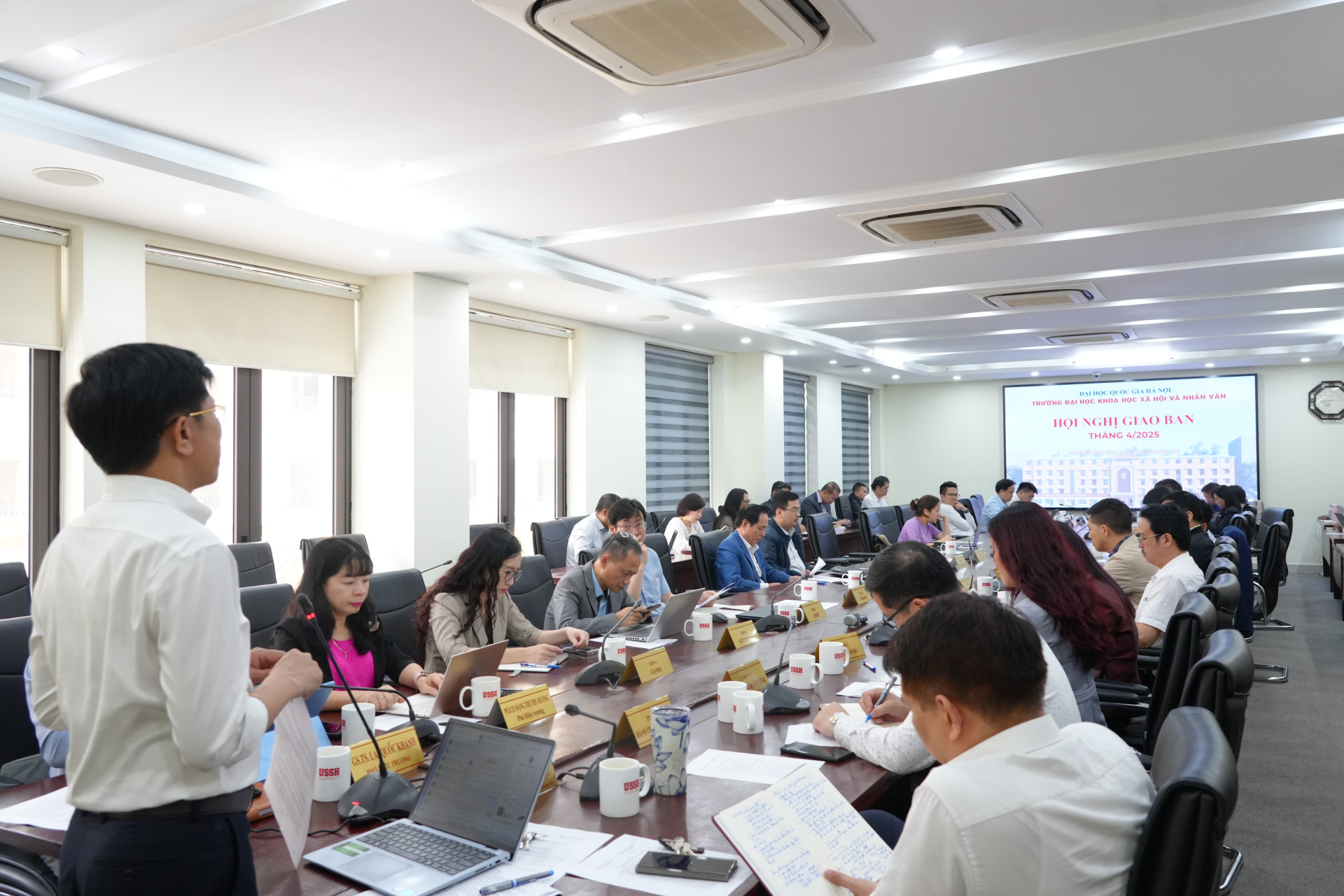
Overview of the Conference
After listening to the opinions and discussions of the Vice Principals and delegates attending the Conference, Principal Hoang Anh Tuan concluded:
1. Party work:The subcommittees serving the Congress are requested to hold meetings and urgently finalize preparations to ensure the successful organization of the Party Congress of the University of Social Sciences and Humanities, creating a solid foundation for breakthroughs in the next term.
2. Organizational and personnel matters:- Prepare a plan to implement some tasks that were temporarily suspended due to the implementation of Resolution 18 (Phase 1); Continue the spirit of restructuring and streamlining, ensuring effectiveness and efficiency. In cases where it is truly necessary to carry out key tasks and breakthroughs, the School will consider opening/establishing new units.
- Closely follow the implementation roadmap of the VNU Hanoi Job Position Scheme to proactively develop the school's plan.
3. Admissions process:The Admissions Department is requested to focus intensely and proactively adhere to current regulations, integrating the School's educational philosophy and viewpoints into the admissions plans. If necessary, the Admissions Department should propose the establishment of support committees to assist in the admissions process.
- Admission to the Specialized High School for Social Sciences and Humanities: The admissions council reviews and calculates all stages and processes, such as exam question setting, grading, and selection, ensuring a focus on in-depth training with a humanistic character, creating a pool of candidates for university admissions.
- Regular university admissions: Ensure that all enrollment targets are met, maintaining a balanced and harmonious approach across different subject combinations and admission methods to improve the quality of incoming students and facilitate the training process. The admissions department will act as the central point of contact, with training units coordinating by providing information and sending it to the communications department for promotion and advertising of training programs (to be completed before April 20, 2025).
- Postgraduate admissions: Continuing to improve the admissions process and application submission…
- Recruitment for part-time, double degree, second degree, and short-term programs: Research and propose innovative approaches that are flexible and open-minded, with the goal of improving both the quantity and quality of students.
4. Training organization:- Continue to promote improvements in all training processes towards professionalism and efficiency, enhance service quality, and ensure a learner-centered approach.
- Urgently complete and standardize the postgraduate training management process in Q2/2025; Continue to improve towards professionalism in the stages of thesis defense, graduation, degree awarding, and alumni affairs.
5. Technological advancements in education:Monitor progress and ensure completion before August 30, 2025, for subjects implementing video lectures (at least 6 subjects as planned); Identify and implement compulsory modules and those taught in foreign languages in Q2/2025.
6. Adjusting the undergraduate curriculum:The adjustments should be substantive and effective, as demonstrated by the following points:
- Specialization orientation: With the philosophy of prioritizing expertise, specialization does not necessarily have to be tied to a specific subject area, the time allocated to specializations is flexible and not uniform, and units balance the quotas of their respective fields to open new/adjust training programs.
- Structure of Block M: Based on references from other higher education institutions (domestic and international), calculate the number of courses taught in M2 and M3, and propose that units organize discussions, exchanges, and reach a consensus on suitable majors and specializations that reflect contemporary educational trends, meet high societal needs, and still ensure the core elements of the majors/specializations.
- Enhance the training of digital skills, foreign language proficiency, and entrepreneurial spirit for students:
+ Compulsory credits for foreign languages in the social sciences and humanities: Clearly define the compulsory foreign language courses; regulations on exemption conditions for studying, testing, and taking exams; regulations on converting international certificates with certificates as prescribed by the Ministry of Education and Training and Vietnam National University, Hanoi. The communication department should widely disseminate this information to students.
+ Mandatory credits for soft skills, digital competence, and entrepreneurial spirit: Evaluate and continue implementation, and urgently develop video lectures.
7. Quality assurance work:The Quality Assurance Department proactively monitors and updates information from state agencies and the Ministry of Education and Training to promptly advise leaders on quality assurance plans and strategies for the future.
- Accreditation of the Specialized High School for Social Sciences and Humanities: Deputy Principal Dang Thi Thu Huong is assigned to oversee and direct the High School as the focal point, with the Department of Education and Training coordinating to complete the self-assessment report in May 2025, ensuring high quality and approval by the Hanoi Department of Education and Training; Continue the roadmap for developing the autonomy plan for the Specialized High School for Social Sciences and Humanities, striving to complete it in 2025 and begin implementing autonomy from 2026.
8. Scientific and foreign affairs work:- Scientific work: Firmly adhering to the viewpoint of developing science in a balanced and harmonious way between academic and applied fields, international, national, and local levels, in the coming time, scientific activities need to expand the search for external resources, especially with localities (Ninh Binh, Quang Ninh, Nam Dinh, Cao Bang) to increase financial resources and affirm the position of the Humanities.
- Currently, some fields/sectors have been performing well and effectively, but many specialized clusters have not yet exploited and utilized their strengths, nor have they connected and developed to the extent commensurate with the available resources. We request that the leadership of each unit demonstrate a sense of responsibility and proactively connect with and support leading scientists/industries in carrying out administrative procedures (if needed).
- Strengthen the linkages between science and development cooperation to increase collaboration in science and training.
- Foreign affairs: It is necessary to readjust the understanding and approach to foreign affairs towards a focused, substantive, and effective approach. The focus of foreign affairs in the coming period should be on closely linking it with education and science in attracting experts and promoting international student recruitment.
9. University Administration:- Accelerate the modernization and application of technology in office work, document management, and archiving.
- Continue developing the project proposal for implementing university management software at the School, and submit it to the Board of Directors for review and approval.
- Facilities: Continue to renovate facilities in 2025, aiming for uniformity and optimization of the school's space and area, ensuring smooth operation for the next 15 years.
10. Financial matters:- Officials and employees complete the personal income tax settlement according to regulations; the Finance and Planning Department will provide guidance and support (if needed).
- Revise internal spending regulations: Due to many new issues arising, flexibility is needed for the departments that have agreed on the adjustments.
- Review and adjust expenditure items, clearly identifying tasks that must be performed according to regulations and tasks that require overtime or extra hours, ensuring fairness and increasing revenue.
- Complete the vocational training programs according to the roadmap. The communications department will closely follow the roadmap to promptly inform and disseminate positive information to students, paying particular attention to communicating about the new tuition fee collection method to be implemented from the 2024-2025 academic year.