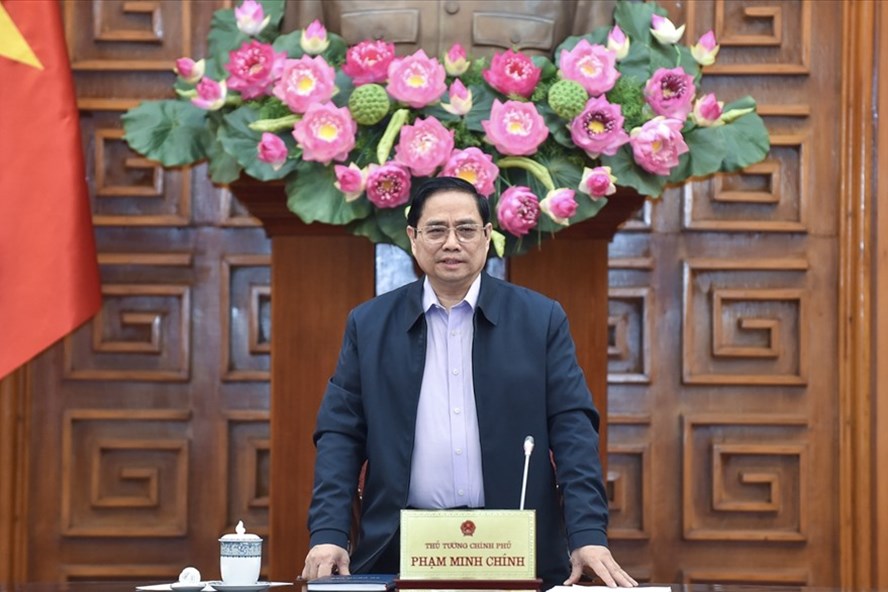
On the morning of November 28th, Prime Minister Pham Minh Chinh held a working session with the Vietnam National University, Hanoi (VNU) to discuss its operational situation, the implementation of its functions, tasks, and powers in the past period, and major orientations for the future, addressing difficulties and obstacles, and identifying breakthrough tasks to ensure VNU develops to its full potential.
Also attending the working session were Deputy Prime Minister Vu Duc Dam, Minister and Head of the Government Office Tran Van Son, and Professor Le Quan, Director of Vietnam National University, Hanoi.
The outstanding efforts and endeavors affirm the correctness of the policy.
According to the report of Vietnam National University, Hanoi (VNU) and the opinions expressed at the meeting, after 28 years of promoting high levels of autonomy and self-responsibility, VNU has achieved many important accomplishments. In particular, the period from 2001 to 2013 was a period of remarkable development. From not being listed in any rankings, in 2013, VNU was among the top 3% of universities in the world and the top 250 universities in Asia, with some fields ranking in the top 100 in Asia.
From 2014 to the present, Vietnam National University, Hanoi (VNU) has made significant progress, affirming its outstanding academic prestige both domestically and internationally. The number of international publications in the ISOSCOPUS system in 2020 was 1,100, a 2.8-fold increase compared to 2013 (200 publications); internationalization indicators in 2020 increased by 2 to 5 times compared to 2013. VNU's university ranking has improved significantly on international rankings, consistently ranking in the 801-1000 group globally for three consecutive years (2019-2021). International rankings in several fields have also increased considerably, with some fields ranking in the top 500 globally.
“In the context of limited investment resources, which are very low compared to the requirements for building a university of regional and international stature, the fact that Vietnam National University, Hanoi (VNU) has consistently ranked highly in regional and international university rankings is a remarkable achievement. This demonstrates that the establishment of national universities is a strategic and consistent policy of the Party and the State, in line with the development trends of higher education worldwide.”
"The distinctiveness and effectiveness of the VNU organizational model have brought about outstanding achievements in pioneering innovation, unique training products, science and technology that only multidisciplinary universities can achieve," affirmed Professor Le Quan, Director of VNU.
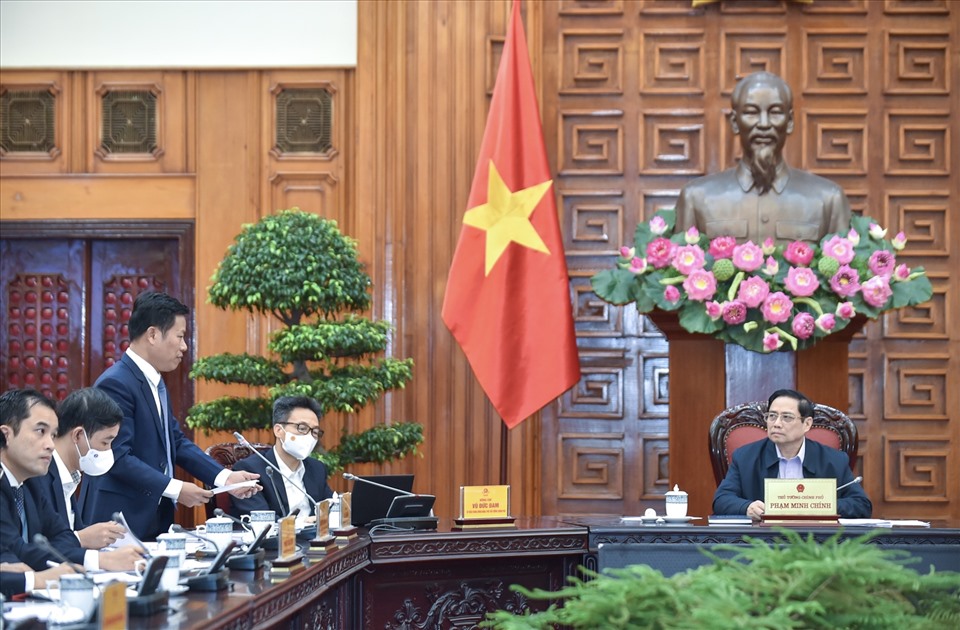
According to the Director of Vietnam National University, Hanoi, Le Quan, the core "keyword" in the university's future development orientation is "high quality". Photo: VGP/Nhat Bac
According to the Director of Vietnam National University, Hanoi (VNU), Le Quan, the core "keyword" in VNU's future development orientation is "high quality". Accordingly, in terms of training, VNU will prioritize strong investment in traditional basic science training programs to train and develop human resources in science and technology, and innovate talent training programs with new formats and methods…
Regarding scientific and technological research, we will promote research in the fields of social sciences and humanities and educational sciences; participate in summarizing practical experiences and conducting theoretical research; and provide policy advice to the Party and the State. We will strengthen research activities in some natural science fields where VNU has advantages through basic research programs.
Conduct research and develop scientific arguments to understand natural laws and conditions, contributing to solving key immediate and long-term problems of the country. Promote the implementation of new scientific research and technological development directions, prioritizing technologies with high application potential, in which Vietnam National University, Hanoi has advantages…
Furthermore, actively participate in the global innovation network. Strengthen cooperation with partners, especially large domestic and foreign enterprises, prioritizing Japanese partners to develop large-scale, transnational international research projects and programs; cooperate in research implementation, transfer, and commercialization of scientific and technological products.
Besides the advantages, the process of implementing the mission and goals assigned to Vietnam National University, Hanoi (VNU) by the Party and the State still faces some difficulties and obstacles. VNU proposes that the Government soon issue a Decree on national universities and regulations on the organization and operation of national universities in the direction of granting greater autonomy. VNU also proposes several specific contents related to its legal status, training, research, finance, organization, personnel, investment… and the project to build VNU in Hoa Lac.
Maximizing human resources
After listening to the opinions and concluding the meeting, Prime Minister Pham Minh Chinh highly appreciated and basically agreed with the reports, opinions, and proposals presented at the meeting, and emphasized a few additional points.
The Prime Minister highlighted several impressive results and achievements that the Vietnam National University, Hanoi (VNU) needs to further promote in the coming time. Based on inheritance, stability, innovation, and development, VNU has a team of staff and scientists with great potential; a glorious and proud historical tradition, with many leaders of the Party, State, and agencies within the political system having studied and trained there.
Vietnam National University, Hanoi (VNU) has also received the affection, trust, and admiration of the people; recognition in international rankings and evaluations; and attention from the Party and the State, such as the allocation of over 1,000 hectares of land for the construction of VNU in Hoa Lac.
Furthermore, the activities of Vietnam National University, Hanoi (VNU) still have limitations and shortcomings, such as a lack of renowned scientists at the regional and international levels. Applied research for management, production, business, serving important tasks of the Party, State, and people, and policy consulting activities are still limited. Infrastructure remains inadequate, and the investment and construction of the VNU project in Hoa Lac is still facing obstacles and has not been completed definitively.
Pointing out the causes of these shortcomings, the Prime Minister stated that leadership and guidance must be more decisive, thorough, and forceful, with a focus on key areas, innovative thinking, and a strategic vision. Obstacle regulations and some inappropriate policies and mechanisms are slow to be amended while reality is evolving rapidly. Investment in infrastructure has not kept pace with the advancement in expertise. The general requirement for the operation of Vietnam National University, Hanoi is to be more decisive and forceful, worthy of being the leading institution in the university system.
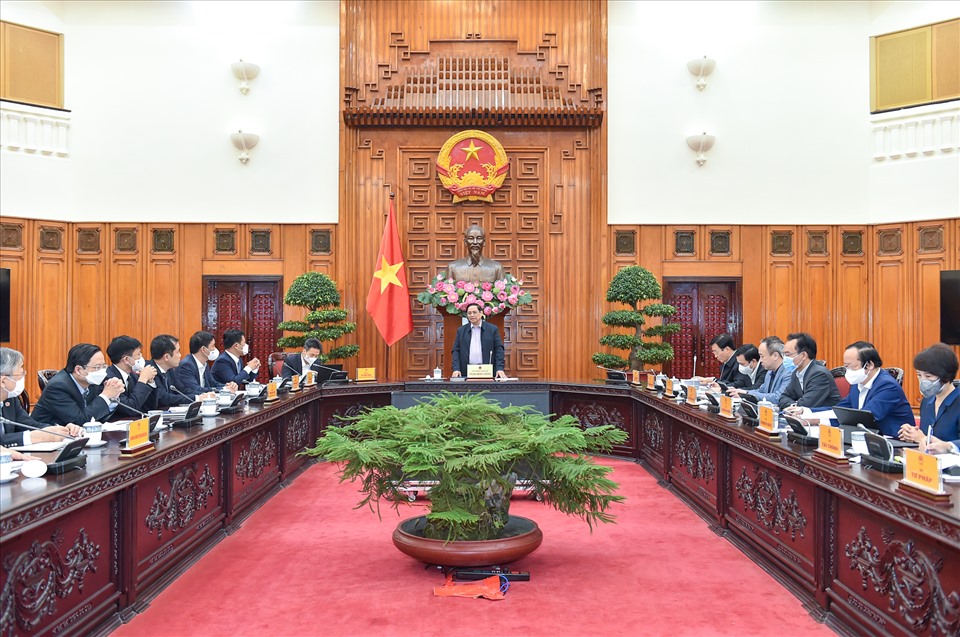
Prime Minister Pham Minh Chinh: The general requirement for the operation of Vietnam National University, Hanoi is to be stronger and more decisive, worthy of being the leading institution in the university system. Photo: VGP/Nhat Bac
While generally agreeing with the directions and tasks for the coming period reported by the Vietnam National University, Hanoi and the opinions contributed by delegates at the meeting, the Prime Minister added and emphasized some further points.
Firstly, it is necessary to elevate the status of Vietnam National University, Hanoi in the new phase as the whole country implements the Resolution of the 13th National Congress of the Party; to have mechanisms to maximize the release of the enormous human resources so that the staff can contribute even more; to handle harmoniously, rationally, and effectively the relationship between the State, society, and the market, and to strengthen public-private cooperation.
Secondly, focus on concretizing and institutionalizing the Resolution of the 13th National Congress of the Party, Resolution 29 of the Central Committee on fundamental and comprehensive reform of education and training, Resolution 20 on the development of science and technology, and the resolutions of the Party Congress of Vietnam National University, Hanoi. Regarding organization, structure, staffing, autonomy mechanisms, Party building work, and the staff, it is necessary to closely adhere to and concretize the Party's resolutions on these issues and the Law on Higher Education. The Prime Minister requested the development of programs, projects, plans, policies, and mechanisms, focusing on leadership and direction, allocating resources, and setting specific goals for each year and for the next five years to elevate the status of Vietnam National University, Hanoi.
Thirdly, focus on overcoming shortcomings, limitations, and weaknesses to ensure the smooth, efficient, and effective operation of the system, especially in training, research, and mission fulfillment; overcome the problem of scattered, unfocused, and indecisive investment when resources are limited.
Fourth, it contributes to raising the intellectual level of the people, training high-quality human resources, and nurturing talents in accordance with the Party's Resolution, effectively and efficiently serving the three strategic breakthroughs.
Fifth, training is a cornerstone of Vietnam National University, Hanoi. The Prime Minister particularly emphasized the need to focus on students, teachers, and the university, identifying learners as the center, the university as the foundation, and teachers as the driving force. The focus should be on training human resources in basic sciences – a traditional field of the university; and training human resources for Vietnam National University, Hanoi and other universities.
Strengthen linkages and joint ventures with localities, businesses, and organizations to train human resources that meet not only national but also international standards, focusing on foreign language and computer skills training in the context of deep integration. Innovate student recruitment and focus on controlling output. Adopt advanced training technologies.
Sixth, research should focus on summarizing practical experiences to serve major national programs and address practical issues arising in the process of the country's socio-economic development.
The Prime Minister suggested several research topics such as national territorial sovereignty; building a socialist democracy; policy advice on innovation and the Fourth Industrial Revolution; building an advanced culture rich in national identity; regional cultural characteristics; policies and solutions for epidemic prevention and control, economic recovery and development; resource depletion, population aging, climate change, circular economy, green economy, renewable energy; digital transformation; post-harvest technology, and building agricultural product brands…
On Saturday, regarding university autonomy and the position and role of Vietnam National University, Hanoi (VNU), the Prime Minister requested a review of the practical implementation of the VNU model from 1993 to the present, adhering closely to the Party's guidelines and policies, based on legal regulations and the actual situation, in order to propose specific solutions to the competent authorities. The general spirit is to increase authority, decentralization, autonomy, flexibility, and investment, using public investment to drive private investment.
A key task highlighted by the Prime Minister is the need to focus on completing the Vietnam National University construction project in Hoa Lac with high determination, great effort, decisive and effective action, and a new mindset and approach. The Prime Minister emphasized the requirement to implement the project as a national university urban area; construction can be phased, but the planning must have a long-term vision.
The Prime Minister suggested a "5-in-1" model for this university urban area: a talent training center; a modern technology transfer and research center; a national and international-level innovation center; a smart, modern university city; and a center for public-private partnerships and research and training.
Author:Ha Van
Source:baochinhphu.vn
Newer news
Older news

