
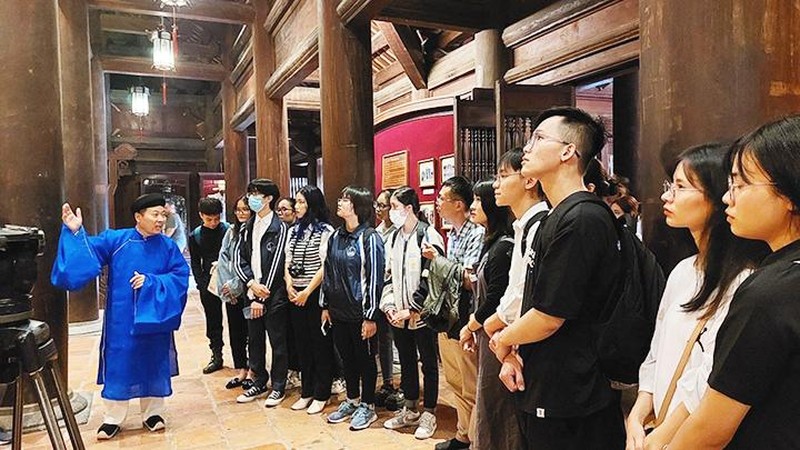
Dr. Dinh Thanh Hieu lectured on reciting couplets to students majoring in Sino-Vietnamese studies at Thai Hoc House, Van Mieu - Quoc Tu Giam in 2022.
The Sino-Vietnamese (Hán Nôm) heritage is "proof" of Vietnam's thousand-year-old cultural tradition. The two characters, Hán Nôm and Hán Nôm, clearly represent the written heritage of the nation, a crucial part of classical Vietnamese literature. Since Vietnam entered the modernization process in the early 20th century, Hán Nôm and Hán Nôm characters are no longer widely used in society. Hán Nôm texts – the cultural heritage of our ancestors – are no longer widely read and understood by the majority of modern generations. This poses a risk of cultural disconnect between tradition and modernity…
Sino-Vietnamese script (Hán Nôm) is of great importance in modern society, helping people preserve and interpret the written documents left by their ancestors. Chinese characters served as the official script in Vietnam for millennia. Much of the traditional knowledge in all fields of natural sciences, social sciences, and humanities in the East Asian cultural sphere (China, Korea, Japan, Vietnam) was expressed through this script. In Vietnam, in addition to Chinese characters, Nôm script was also used. When Vietnam transitioned to a modern cultural paradigm and adopted the Quốc ngữ script, a different writing system, it led to a cultural disconnect, a gap in the foundations of knowledge, culture, and education. Therefore, studying the Sino-Vietnamese heritage is essentially a gateway to accessing the traditional cultural heritage of our ancestors.
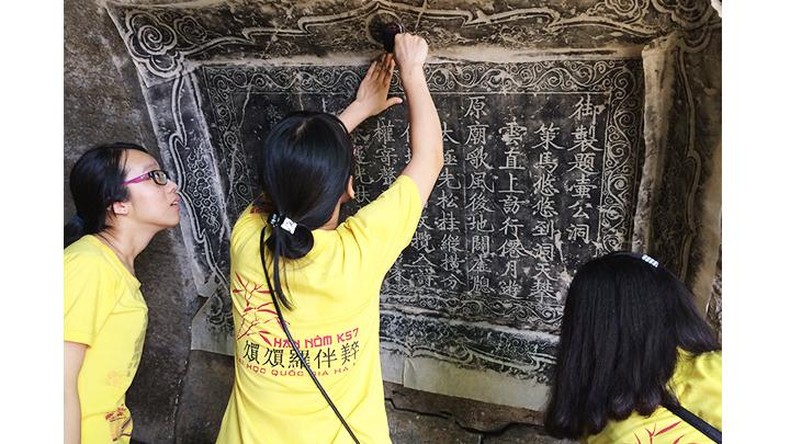
Students majoring in Sino-Vietnamese studies stamped stele at Ho Cong Cave, Vinh Loc, Thanh Hoa in 2015.
The field of Sino-Vietnamese studies is one of the long-standing training programs of the former Hanoi University and of the current University of Social Sciences and Humanities, Vietnam National University, Hanoi.
The field of Sino-Vietnamese studies in Vietnamese universities was established at Hanoi University in 1972, amidst the most intense phase of the war against the US, with the aim of training a team of university-level Sino-Vietnamese scholars. This demonstrated the special attention and foresight of the Party and State in establishing a field of classical studies during the fierce war years, for the long-term future of national culture and scholarship, ensuring an uninterrupted connection with the thousand-year-old cultural heritage of our ancestors.
Since its establishment, the field of Sino-Vietnamese Studies has undergone a full half-century of development. Its mission is to train a workforce proficient in both Chinese and Vietnamese characters, mastering modern specialized and interdisciplinary research methods; capable of exploring and introducing the values of traditional culture, directly contributing to ensuring cultural continuity between tradition and modernity. Graduates of the Sino-Vietnamese Studies program from the former Hanoi University and the current Hanoi University of Social Sciences and Humanities are among the leading forces working in Sino-Vietnamese studies nationwide today. Many generations of Sino-Vietnamese Studies graduates have become leading experts, producing outstanding research works on Sino-Vietnamese studies and traditional Vietnamese culture, and many have held or are currently holding important positions in research, teaching, and administrative institutions.
Currently, the Hanoi University of Social Sciences and Humanities is a prestigious institution nationwide for training in Sino-Vietnamese studies, offering Bachelor's, Master's, and Doctoral degrees. Its mission is to be a pioneer in training and providing human resources with knowledge of Sino-Vietnamese studies for research and teaching institutions, preserving traditional heritage, and managing culture. At the same time, the Sino-Vietnamese studies program is at the forefront of exploring, researching, and publishing Sino-Vietnamese heritage and other related issues. This is both a source of pride and a great responsibility for the institution.
From a training perspective, the research and exploitation of Vietnamese cultural values from the Sino-Vietnamese heritage requires students to possess relatively specific and suitable qualities if they wish to develop their expertise well, while admissions can only be based on a general standard. Regarding the foundation of Sino-Vietnamese knowledge, students are admitted almost as "blank slates," just beginning to learn individual Chinese and Vietnamese characters. After four years of university training, achieving the required output standards is a challenge and requires significant effort and investment. Graduates in Sino-Vietnamese studies who work in their field are primarily recruited into government agencies. The reality is that the limited staffing quotas of government agencies currently pose a challenge to the field's graduates. Many talented students with good professional prospects lack suitable jobs upon graduation, forcing them to adapt to other career fields or those only partially related to their specialization, making it difficult to achieve their goals. Most students majoring in Sino-Vietnamese studies pursue a second degree in Chinese, broadening their horizons and preparing them for a wider range of jobs after graduation.
In the future, with the mechanism of university autonomy, majors with low enrollment quotas, such as Sino-Vietnamese studies, will face many difficulties and challenges in maintaining their existence. At that time, basic science majors in general, including Sino-Vietnamese studies, will need guaranteed investment and "commissions" from the State. Therefore, the field requires long-term investment and guarantees from the State.
Looking back at the 50-year journey of building and developing the field, especially the current 10 years, the achievements are remarkable, something to be proud of, and provide a basis for confidence in the field's future prospects. However, it is also necessary to recognize the shortcomings and challenges facing the field in the new context and conditions, in order to continuously overcome them and strive to continue building the field of Sino-Vietnamese studies to be worthy of the trust of society and the invaluable contributions of previous generations.
Link to the article in Nhan Dan Newspaper:https://nhandan.vn/hoc-han-nom-de-ket-noi-truyen-thong-va-hien-dai-post723722.html
Author:Dr. Dinh Thanh Hieu
Newer news
Older news

