
In a context where data and information are increasingly becoming vital resources, archival studies are gradually asserting their essential role in the effective management, preservation, and utilization of documents and records in agencies and organizations. Beyond traditional archival work, this field of study also opens up numerous career opportunities in today's digital transformation era.
When archiving becomes the foundation of digital information and data management.
In an interview with a reporter from the Vietnam Education Electronic Magazine, Associate Professor, Dr. Dao Duc Thuan - Head of the Archival Studies Department, Faculty of Archival Studies and Office Management, University of Social Sciences and Humanities (Vietnam National University, Hanoi) said: Archival studies is not simply the job of "keeping a collection of documents that are no longer needed" as many people mistakenly believe, but is a science associated with information management and the preservation of the memory heritage of society.
Accordingly, at the University of Social Sciences and Humanities (Vietnam National University, Hanoi), students majoring in Archival Studies are equipped with theoretical and practical knowledge of social sciences and humanities, administration, document management, and archiving, along with necessary professional and supplementary skills. The training program aims to enable graduates to directly perform administrative, document management, and archiving tasks, as well as advise and support management work in agencies and organizations.
According to Associate Professor, Dr. Dao Duc Thuan, after graduation, graduates in Archival Studies can take on many job positions in state agencies, political organizations, and socio-political organizations from the central to local levels, such as civil servants, document and archive staff, administrative staff, secretaries, and administrative assistants in businesses.
In addition, graduates have the opportunity to work in archiving service providers and private archives as managers or archiving specialists. They can also develop careers as data administrators, researchers, or lecturers at research and training institutions specializing in document management, archiving, and office administration.
To meet the increasing demands of society for human resources in the fields of administration, document management, and archiving, the University of Social Sciences and Humanities (Vietnam National University, Hanoi) has developed and expanded its Archival Studies training program in a modern direction, increasing its adaptability to the trend of digital transformation.
A notable new feature of the Bachelor of Archival Studies program, to be implemented in 2025, is the first-ever opening of two specialization pathways, allowing students to choose according to their abilities, needs, and the development trends of the labor market in the context of building a digital government in Vietnam.
Specifically, students can choose to specialize in either Administration - Secretarial Studies or Digital Secretarial Studies - Archiving. With the Administration - Secretarial Studies specialization, students will be exposed to topics such as digital transformation and information security in secretarial work, administrative procedures, state apparatus organization, and administrative processes.
Meanwhile, the Digital Archival and Records Management specialization focuses on knowledge of data storage and databases, digital archiving operations, information security in digital archival and records management, and digital transformation in the field of records management and archiving.
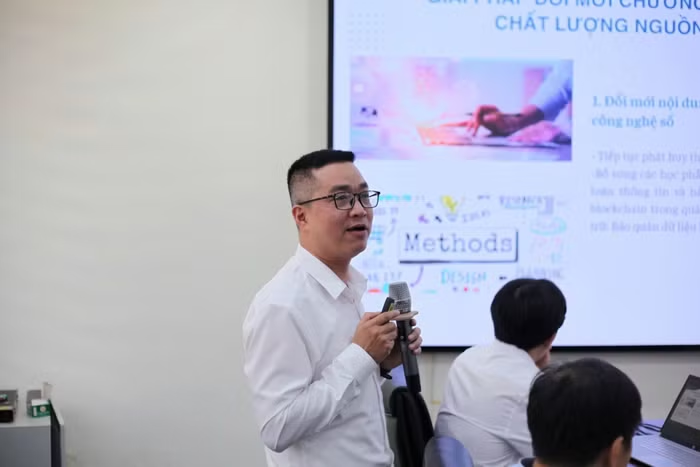
Associate Professor, Dr. Dao Duc Thuan - Head of the Archival Studies Department, Faculty of Archival Studies and Office Management, University of Social Sciences and Humanities (Vietnam National University, Hanoi). Photo: university website.
Besides modernizing its training programs, the University of Social Sciences and Humanities (Vietnam National University, Hanoi) also places special emphasis on enhancing practical experience for students in Archival Studies through a wide network of cooperation with National Archives Centers, local archives, state management agencies from central to local levels, and many large corporations and businesses.
Accordingly, students not only complete internships at the end of their course, as in the traditional training model, but also participate in practical training and professional experience from their second year. This process helps students quickly access the real-world work environment, understand the operational processes of administrative, document management, and archiving work in agencies and organizations, as well as the professional requirements in the context of current digital transformation.
Notably, some programs also provide opportunities for students to gain practical learning and professional experience at overseas institutions, contributing to broadening their professional thinking and integration capabilities.
During their studies and practical training, students directly participate in projects involving the digitization of records, the organization of scientific documents, data management, and the construction of digital archiving systems. This early exposure to practical professional work not only enhances their professional skills but also cultivates analytical thinking, problem-solving abilities, and a professional work ethic.
"This is also considered one of the factors that helps students majoring in Archival Studies increase their competitive advantage when entering the labor market," said Professor Thuan.
Sharing with reporters about her reasons for choosing Archival Studies, Tran Thi Phuong Thao, a K67 student majoring in Archival Studies at the University of Social Sciences and Humanities (Vietnam National University, Hanoi), said: Before studying, I thought this was just a field related to paperwork and files, mainly "storing documents in warehouses," stable but rather dry and lacking innovation. I imagined that the work of an archivist mainly revolved around organizing and classifying documents and offered few opportunities for diverse development.
However, after studying for a while, Thảo realized that this field of study was much more modern and interesting than she had initially thought. According to her, it's not just about "document management" but also involves information and data management – a particularly important resource in the digital age.
What impressed me most was the level of technology application in the training program. Students not only learned traditional archiving skills but also gained access to many new topics such as document digitization, data management, information systems, and digital transformation in document management and archiving.
In fact, this field of study is of great significance to society, as archivists contribute to preserving the "memory" of organizations and the nation, from administrative records and historical documents to operational data of agencies and businesses.
Evaluating the quality of education at the University of Social Sciences and Humanities (Vietnam National University, Hanoi), Phuong Thao believes that the university not only focuses on imparting knowledge but also aims to develop critical thinking skills and long-term development potential for students. According to her, the curriculum is well-structured, systematic, and clearly oriented, helping learners not only "know" but also deeply understand and apply their knowledge in various contexts.
This is also a crucial factor in helping students adapt to the constantly changing job market today.
One of the things that impressed Thao was the team of highly qualified and dedicated lecturers. Based on her experience, many lecturers simultaneously participate in scientific research, conduct in-depth studies, or collaborate with agencies and organizations, so the teaching content is always up-to-date and relevant to practice. As a result, students don't feel that learning is overly academic; instead, they can clearly see the connection between classroom knowledge and the real-world needs of society.
In addition to classroom learning, the school also provides opportunities for students to participate in many academic and extracurricular activities such as seminars, thematic discussions, and interdisciplinary programs. "These activities help students broaden their perspectives, increase their networking abilities, and gradually improve their skills and career orientation," Thảo shared.
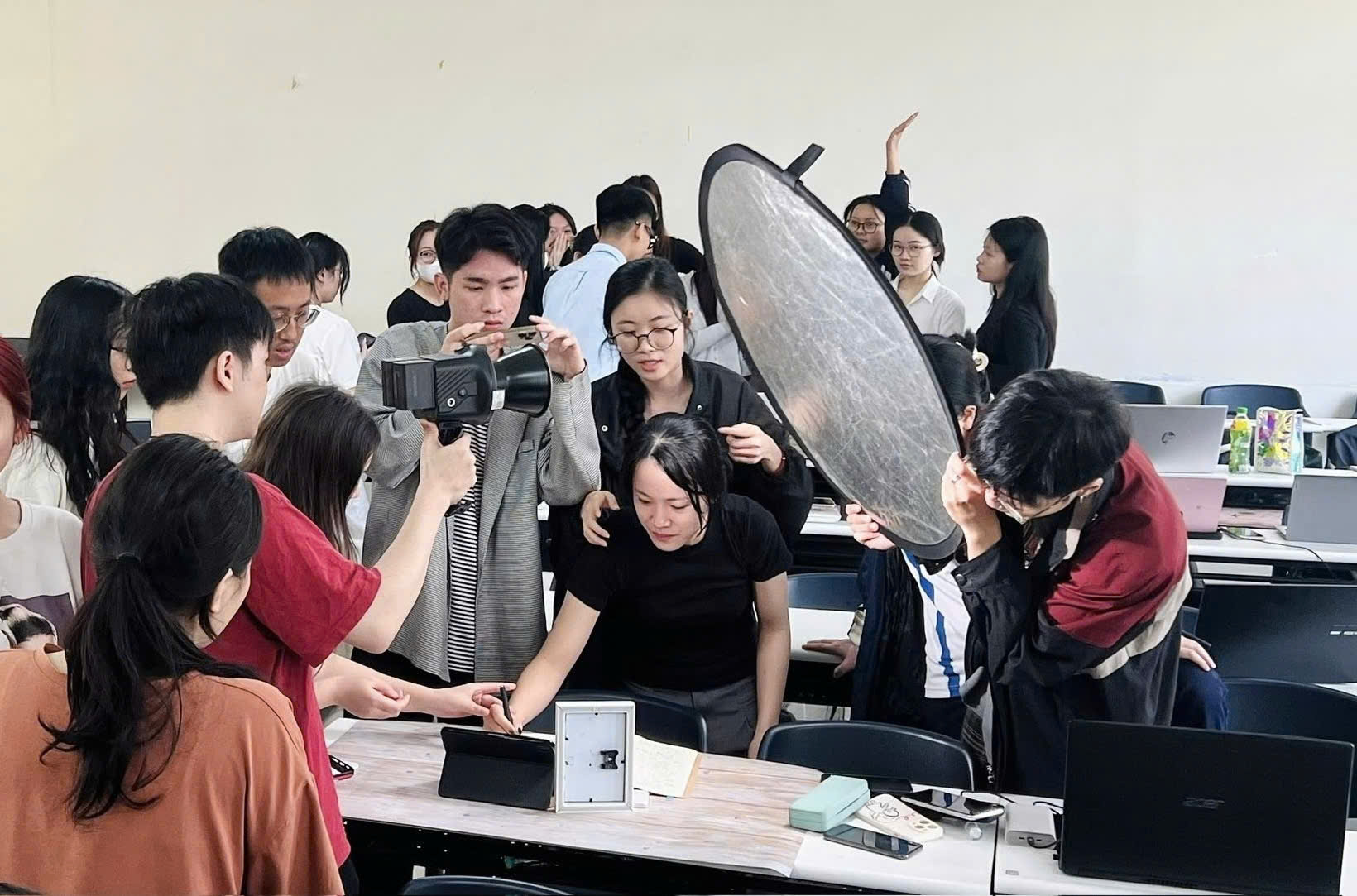
Students majoring in Archival Studies practice communication skills and tools in archival work.
From the academic environment to diverse career opportunities for Archival Studies students.
In the context of the rapid development of digital data, electronic document archiving and data management are playing an increasingly important role in the operations of agencies, organizations, and businesses. The digital transformation and digitization of records and documents are opening up many new career opportunities for Archival Studies students.
Associate Professor, Dr. Dao Duc Thuan observed that in the 21st century, data can be considered the "oil" of the digital age. However, data only truly has value when it is organized, stored securely, and exploited effectively. This also presents a new development opportunity for the field of archiving and institutions training in archival studies.
Currently, many agencies, organizations, and businesses have a great need for human resources capable of managing and operating information systems and digital archives. Therefore, job opportunities for students majoring in Archival Studies are not limited to traditional archives but also extend to many new positions such as digital data analysts, system administrators, or digital transformation consultants for businesses.
With a training program that emphasizes digital skills and modern information management capabilities, graduates can confidently meet the demands of the job market.
According to Professor Thuan, although not a "noisy" field of study, Archival Studies plays a vital role as the "backbone" of national governance and historical research. Without a well-structured archival system, many management decisions would lack a legal basis, and history might be reduced to fragmented, unreliable memories.
To make the field of study more accessible and appealing to students, the University of Social Sciences and Humanities (Vietnam National University, Hanoi) is orienting its Archival Studies development towards Digital Humanities. Accordingly, the university aims to help prospective students understand that studying Archival Studies is not only about documents and records, but also about accessing technology, managing data, and promoting the value of documentary heritage in preserving national cultural identity.
At the same time, the school also promotes extracurricular activities, clubs, and experiential projects to help students better understand the value of their field of study to many areas of social life.
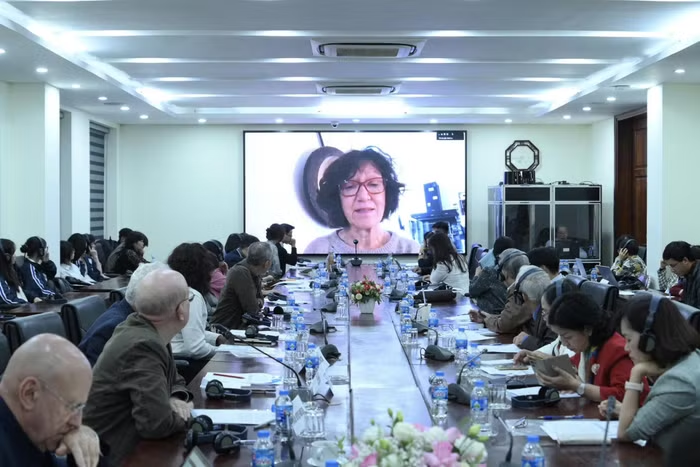
In addition to training activities, the school actively creates opportunities for students to attend workshops and seminars. Photo: school website.
From a student's perspective, Tran Thi Phuong Thao assesses the learning environment at the Department of Archival Studies and Office Management, Faculty of Social Sciences and Humanities (Vietnam National University, Hanoi) as a learning environment with depth and clear academic orientation.
In my opinion, students should not only have systematic access to specialized knowledge but also be encouraged to delve deeper into issues, ask questions, and develop research-oriented thinking throughout the learning process. As a result, learning is not simply about receiving information but becomes an active process of exploring and understanding the essence of their field of study.
In addition, the department offers a diverse range of academic activities, from seminars and thematic discussions to participation in scientific research projects. Through these, students have the opportunity to hone their analytical, synthesis, and logical presentation skills, as well as learn scientific research methods – essential skills not only for their studies but also for their future careers.
Through practical activities, students gain access to professional skills such as document organization, file digitization, data management, and archive system operation via hands-on experience sessions organized by the faculty. In addition, the faculty facilitates internships and practical training, allowing students to experience a professional work environment from an early age. These practical experiences not only reinforce professional knowledge but also support students in developing professional skills, adaptability, and a clearer career path.
Sharing her career aspirations after graduation, Thảo said she hopes to pursue a career in Administration - Human Resources or Administration - Legal Affairs, positions that require the ability to manage information and operate processes accurately and scientifically.
The female student stated that Archival Studies has helped her build a solid foundation in organizing and managing information, from classifying and storing traditional records to processing digitized data. These are all essential skills in a modern administrative environment, where accuracy, transparency, and the ability to quickly access information are always highly valued.
Author:According to Vietnamese Education
Older news

