
To realize the goals set by General Secretary and President To Lam for Hanoi National University, strategic directions need to be translated into concrete and synchronized actions. This requires the entire system to remove bottlenecks in governance, training, research, and innovation, thereby effectively exploiting the potential of intellectuals, scientists, and students.
Realizing the mission of an 'elite university' through a comprehensive set of solutions - Image
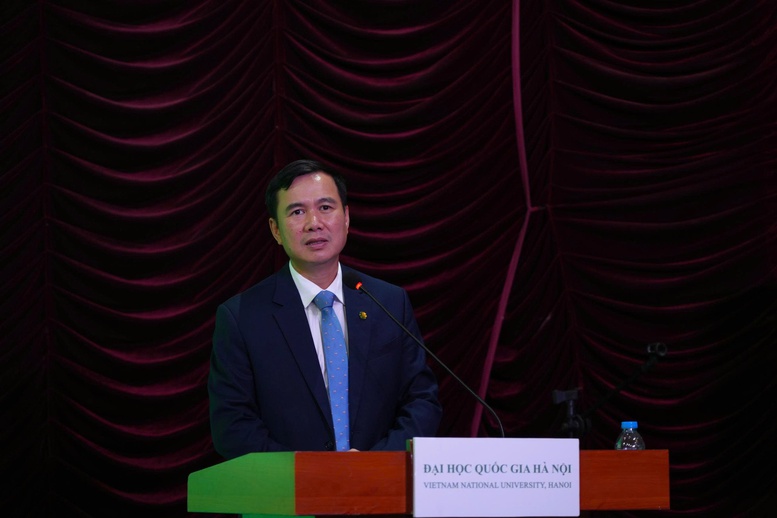
Associate Professor Bui The Duy: The orientations of General Secretary and President To Lam open a new phase of development for Hanoi National University - Photo: VGP/Thu Trang
Macroeconomic resources are ready for a new phase.
Frankly assessing this historical opportunity and responsibility, Associate Professor Bui The Duy, Director of Hanoi National University, affirmed that the presence and development orientations of General Secretary and President To Lam have opened a period of determined development for the university. According to Associate Professor Bui The Duy, to meet the new development requirements of the country, the governance and academic system of Hanoi National University needs substantial changes. This requires the university to boldly change old practices while promoting the academic values accumulated over many generations.
This is a pivotal moment as major bottlenecks in terms of mechanisms and finance at the macro level are gradually being thoroughly resolved. Associate Professor Bui The Duy pointed out: "The guidelines are in place, the institutions are open, and the resources are ready." In fact, since last year, the university's funding for science and technology has been increased and prepared; this year, the targeted program for educational development has also been completed. With the conditions regarding mechanisms, finance, and investment programs gradually perfected, and meticulously prepared by the Party, the Government, and relevant ministries, the challenge for the university is to immediately transform this momentum into concrete, quantifiable results, rapidly advancing the university's international standing.
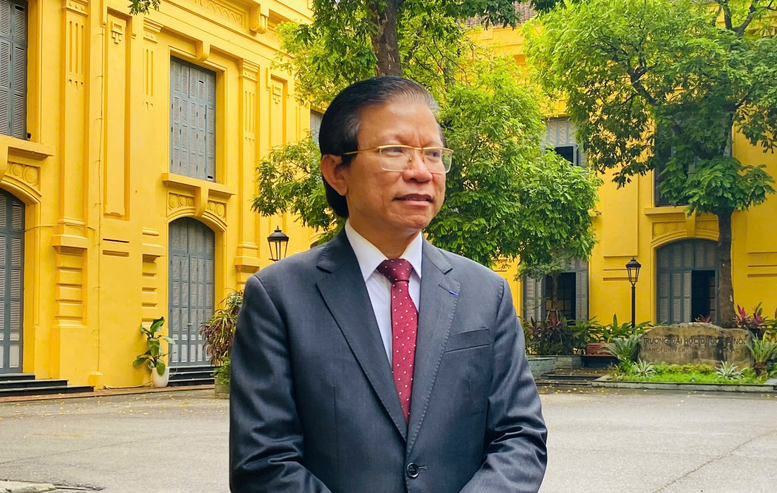
Professor Hoang Anh Tuan: The mission of a major academic center is not only to absorb the most advanced knowledge of humanity - Photo: VGP/Thu Tranrice
Harmonizing traditional culture and future technology.
Regarding long-term development thinking, defining a philosophy of human development that integrates preserving identity with mastering new technologies is considered the foundation of an elite university. Professor Hoang Anh Tuan, Rector of the University of Social Sciences and Humanities (Vietnam National University, Hanoi), analyzed that the mission of a major academic center is not only to absorb the most advanced knowledge of humanity but also to spread the core values of Vietnam to the world. In the context of major policies on science and technology development, innovation, and digital transformation being promoted in sync with the national development strategy, the university must shoulder the responsibility of leading the thinking and knowledge of the entire higher education system.
With the wave of digital transformation and the explosion of artificial intelligence sweeping the world, Professor Hoang Anh Tuan believes that universities need to position themselves to achieve harmonious development between tradition, culture, and modern technology. According to him, students in this new era not only need digital skills and the ability to master modern technology, but also need to be nurtured with a foundation of Vietnamese culture and core values. This is a key factor in proactive integration, rather than being assimilated into the trend of globalization.
He emphasized that technical capabilities can only be sustainably developed when based on the core values of the Vietnamese people. The combination of modern knowledge and cultural identity is also key for Hanoi National University to affirm its position in the process of international integration, while simultaneously playing a role in academic diplomacy activities as directed by General Secretary and President To Lam.
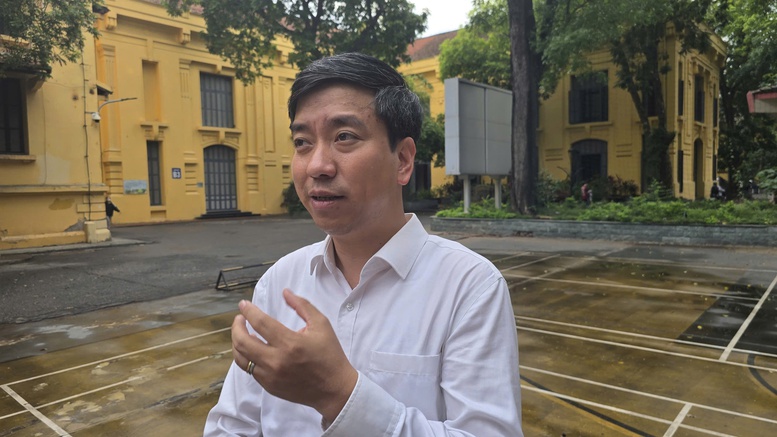
Associate Professor Dr. Trinh Ngoc Kiem: Hanoi National University needs to implement comprehensive solutions to achieve breakthroughs in science and technology - Photo: VGP/Thu Trang
Optimizing the research environment in practice.
While strategic thinking and educational philosophy shape the direction, the actual working environment in laboratories is where the success or failure of future-oriented core technology research is determined. From the perspective of an organization directly promoting application, Associate Professor Dr. Trinh Ngoc Kiem - Director of the High-Tech and Innovation Park (Vietnam National University, Hanoi) - frankly points out the practical bottlenecks in retaining and developing the capabilities of leading scientists. In practice, it has been observed that talented professors and experts sometimes find themselves "isolated" when the support staff, research students, or full-time collaborators working alongside them are too few.
To enable Hanoi National University to become a leading institution in science, technology, and innovation, directly contributing to the country's double-digit growth targets as directed by General Secretary and President To Lam, Associate Professor Dr. Trinh Ngoc Kiem proposed a three-pronged, groundbreaking solution. This includes focusing on investing in the comprehensive equipping of laboratories, ensuring stable running costs instead of forcing scientists to self-finance from short-term projects, and building a robust support system for postgraduate research students.
According to him, the essence of great scientists is a passion for challenges and dedication; when they are given a state-of-the-art working environment and "big problems" of national strategic importance, their intrinsic motivation will be strongly activated. Effectively managing the relationships and motivations of these stakeholders is the core foundation for closely integrating the "three-party" model.
When mechanisms, resources, and the research environment are synchronously connected, Hanoi National University will be able to form strong research groups and create scientific and technological products with high practical application potential. This will also be the foundation for the university to gradually affirm its role as a leading innovation center of the nation in the new development phase.
You can't grow with a scattered mindset.
Sharing his thoughts on the directives of the General Secretary and President, Professor Nguyen Dinh Duc said that the most noteworthy aspect of the General Secretary's speech was the perspective on schools not only as long-standing training institutions, but as institutions that must be directly linked to national development challenges.
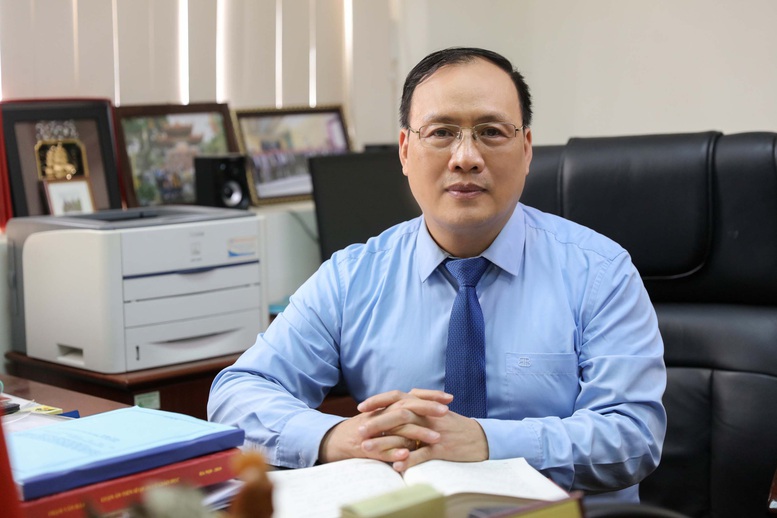
Prof. Dr. Nguyen Dinh Duc - University of Technology, Vietnam National University, Hanoi
According to Professor Nguyen Dinh Duc, PhD, from the University of Technology, Vietnam National University, Hanoi, the important point in the General Secretary's statement is that Vietnam National University, Hanoi is recognized not only for its 120-year tradition, but also for its role in leading research, innovation, and solving the country's development problems in the new era.
He argued that the two words "National" in the name of Hanoi National University are not just an administrative designation. They represent a requirement for responsibility: to train leading personnel, create new knowledge, and participate in solving major national problems.
Professor Nguyen Dinh Duc particularly emphasized the requirement to build the university into an elite, modern, multidisciplinary institution operating according to an innovative model. However, according to him, "elite" cannot be understood solely in terms of entrance selection, but must be measured by top-tier research capabilities, the ability to create strategic technologies, policy influence, and the level of substantial contribution to socio-economic development.
From that perspective, he argued that one of the most important issues today is the need to change the mindset of university governance. Hanoi National University needs to operate based on objectives and outputs rather than purely administrative management. Member units, research institutes, or strong research groups must have clear missions, specific targets, and evaluation mechanisms based on the quality of scientific products, patents, technology transfer, or policy impact, instead of primarily relying on the number of research projects or publications.
Another point emphasized by Professor Nguyen Dinh Duc is the issue of university autonomy. According to him, although universities have specific mechanisms in place under the law, in reality they still face many constraints regarding finance, personnel, science and technology, and resource utilization. He argues that if it wants to compete with leading universities in Asia, Hanoi National University needs to be granted greater autonomy in recruiting and rewarding talent, international cooperation, commissioning research, and commercializing scientific results.
He also argued that university research needs to be directly linked to national development problems instead of just focusing on academic publications. Issues such as digital transformation in state administration, semiconductor workforce training, AI applications in education and healthcare, smart cities, and climate change should be considered major research directions that universities must participate in solving. "Universities cannot just stop at scientific publications. Knowledge must be applied to policy, technology, and specific development problems," emphasized Professor Nguyen Dinh Duc.
Drawing from the story of Hanoi National University, Professor Nguyen Dinh Duc argues that the message from the General Secretary and President is not just for one university. It calls for a transformation across the entire Vietnamese higher education system: from training based on existing capabilities to training based on national development needs; from dispersed research to focused research; and from input-based management to management based on results and actual impact.
According to him, the current problem is no longer a lack of goals, but rather a mechanism to translate those goals into concrete results. Hanoi National University must solve the problems of mechanisms, human resources, governance, and focus resources on strategic areas instead of developing in a scattered manner as before.
Author:According to the Government Electronic Newspaper
Newer news
Older news

