
On September 23rd, the Ministry of Education and Training organized a training workshop on exploiting and using the Legal Code; reviewing, systematizing, and inspecting legal normative documents. This activity aims to enhance the professional capacity and skills of legal staff at units under and directly affiliated with the Ministry of Education and Training.
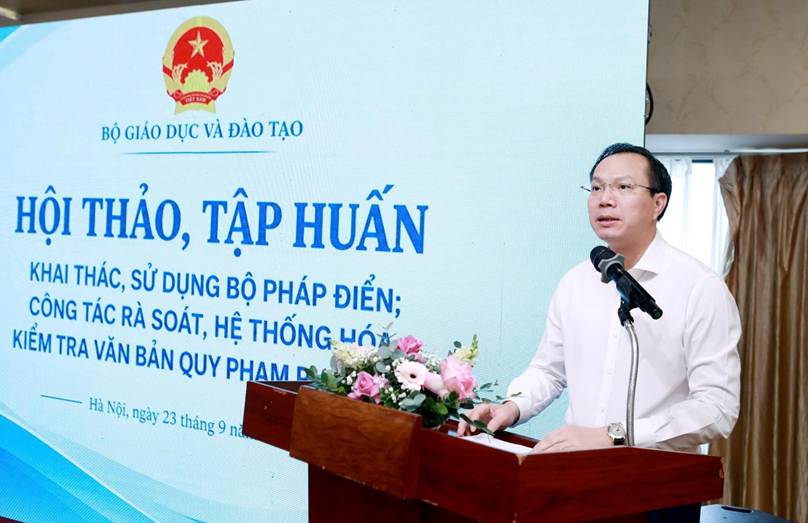
Deputy Minister of Education and Training Doan Trung Kien delivered the opening remarks at the program. Photo: Dinh Tue.
In his opening remarks at the workshop, Deputy Minister of Education and Training Doan Trung Kien emphasized that, in the context of the increasing demands for building a rule-of-law state, perfecting institutions and organizing the implementation of laws, Resolution No. 66-NQ/TW of the Politburo sets out the requirement to build a synchronous, unified, open, transparent, feasible legal system and to improve the effectiveness of law enforcement.
According to the Deputy Minister, the quality of the legal system is not only reflected in the promulgation of correct regulations but also depends on the ability to access, search, apply them consistently, and promptly detect and address outdated regulations. Therefore, codification; review and systematization; inspection and handling of legal documents are regular and continuous tasks directly linked to the quality of state management in education.
AI opens up new ways to review documents.
One of the notable topics at the workshop was the discussion on the application of technology and artificial intelligence in supporting the review of legal documents.
The entire content of the training program on the application of artificial intelligence in legal work was developed based on practical professional requirements and was approved by Associate Professor Dr. Nguyen Nhu Ha, Deputy Director of the Legal Department, Ministry of Education and Training, before implementation. The content review and approval process ensured that the training program closely adhered to the professional requirements of legal work, was consistent with the scope of professional duties, and aligned with the application of technology in state management activities.
The training content focuses on methods for using AI in document processing support steps such as reading and classifying documents; identifying relevant legal basis; recognizing articles, clauses, and points requiring comparison; organizing information; creating review basis forms; assisting in identifying issues requiring further verification; and generating traceable results.
The approach is based on the principle that AI is a tool to support business operations, not a replacement for the analysis, evaluation, and decision-making of professionals and competent authorities.
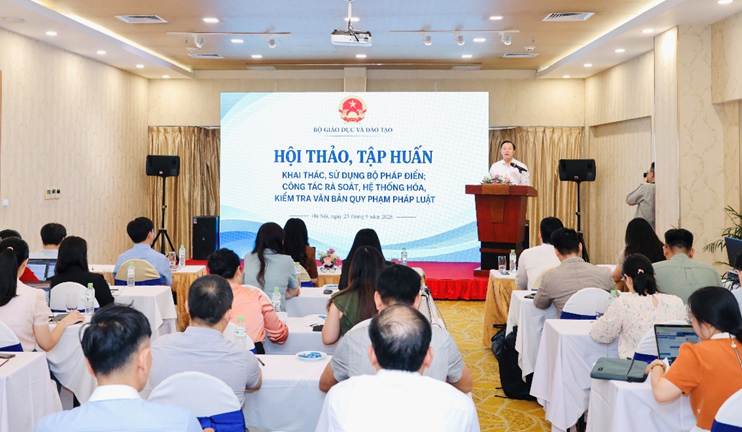
Deputy Minister Doan Trung Kien emphasized that the application of technology must go hand in hand with ensuring accuracy, information security, and the responsibility of specialized units.
Deputy Minister Doan Trung Kien affirmed that the application of technology and artificial intelligence is a suitable direction for digital transformation and can contribute to improving the efficiency of handling large volumes of work. However, the application of technology must simultaneously ensure accuracy and information security; the results obtained from supporting tools cannot replace the responsibility of assessment and evaluation by specialized units.
This message also highlights a crucial requirement for AI research and deployment in the legal field: the technology needs to be placed within a controlled business process, where humans define tasks, select data sources, verify evidence, evaluate results, and are accountable for professional conclusions.
USSH leverages interdisciplinary strengths in applying AI to legal work.
At the workshop, Dr. Dao Minh Quan, Deputy Head of the Department of Information Management, Faculty of Social Sciences and Humanities, Vietnam National University, Hanoi, discussed practical case studies and shared experiences in using artificial intelligence technology in reviewing, systematizing, and verifying legal documents.
The participation of the University of Social Sciences and Humanities clearly demonstrates an interdisciplinary approach to the digital transformation of legal activities: combining professional knowledge, information science, data management, and artificial intelligence to solve specific problems of state management agencies.
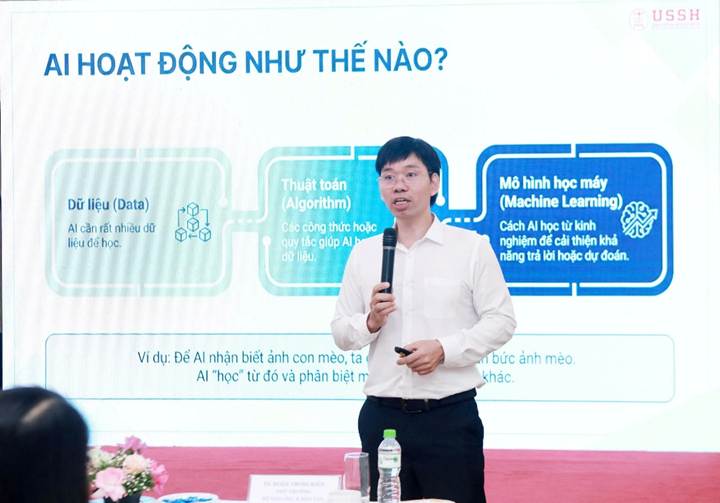
Dr. Dao Minh Quan shared a lot of useful information about using AI in legal work.
Instead of viewing AI simply as a question-answering tool, the approach introduced at the workshop focuses on designing structured AI processes that clearly define the role of AI, input profiles, tasks to be performed, resource usage limits, evidence requirements, and output formats.
Following this approach, AI can be used to support each step of the review process: reading and classifying texts; identifying potentially impactful grounds; recognizing relevant articles, clauses, and points; comparing regulations; creating a review basis form; and assisting in identifying issues requiring further examination by legal experts.
In particular, requiring AI to always clearly indicate the source of the text, the relevant clause, and the basis for each assessment enhances the ability to trace, verify, and explain the results – a particularly important factor for AI applications in the legal field.
This research and technology transfer direction is also consistent with VNU-USSH's strengths in training human resources in information management, data management, digital transformation, and AI application in social sciences and management fields.
Technology must be linked to human skills and responsibilities.
Practical experience in conducting document reviews shows that this task is not simply about compiling a list of documents. The review results need to clearly identify the regulations that need to be addressed, the legal and practical basis, the proposed solutions, the responsible agencies, and the implementation roadmap.
Deputy Minister Doan Trung Kien requested that units continue to enhance their responsibility in coordinating with the Legal Department; proactively identify inadequate, overlapping, or inappropriate regulations, and monitor the implementation of the review results so that recommendations are addressed effectively and efficiently.
Based on this requirement, the application of AI in legal work must adhere to the principle of "AI support – human verification – expert unit decision." Technology can help shorten the time for searching and processing information, but determining the legal value of a document, assessing its legality, consistency, feasibility, and ultimately proposing a solution remains the responsibility of the competent officials and agencies.
This approach both leverages the big data processing capabilities of AI and minimizes the risk of relying on automated results or unverified information.
From university research to practical support for government administration.
The direct participation of VNU-USSH in training, exchanging, and guiding the practical application of AI for legal staff at units under and directly affiliated with the Ministry of Education and Training demonstrates the increasingly clear role of the university in connecting research and training with practical problems of national governance.
For a field demanding high precision and accountability like law, the value of a university lies not only in introducing new technologies but, more importantly, in researching methods for using technology correctly, verifiably, and responsibly.
With its foundation as a leading university in social sciences and humanities, and its strong development in research directions in information and data management, digital transformation, and AI, VNU-USSH is well-positioned to become a bridge between technology, people, and institutions, contributing to bringing new achievements of artificial intelligence into solving practical tasks of state management agencies.

The delegates took a commemorative photo at the event.
The workshop therefore not only contributed to updating legal expertise but also highlighted a clear trend: AI is gradually becoming an important supporting tool in public administration and institution building; in this process, universities like VNU-USSH play a crucial role in research, training human resources, and transferring safe, effective, and responsible AI application methods.
Some photos from the workshop/training session.

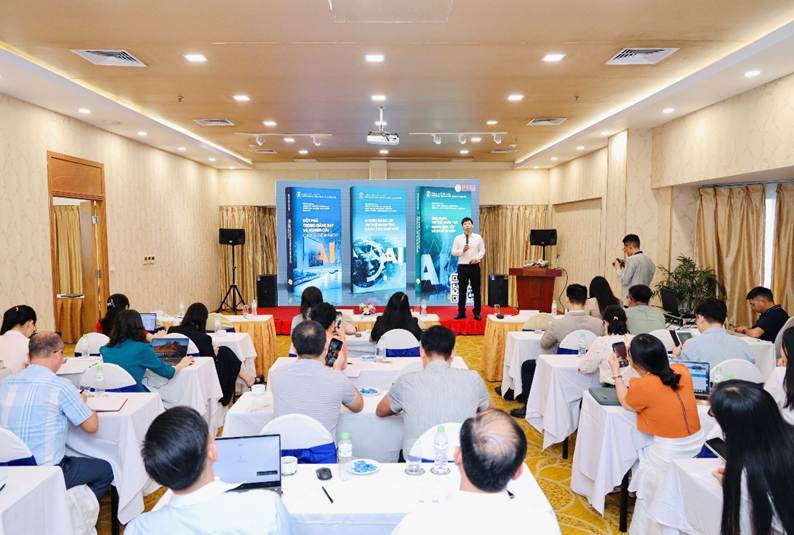
Author:Department of Information Management
Newer news
Older news

