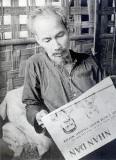
In the vast legacy of President Ho Chi Minh's revolutionary career, journalism occupies a particularly important position. His journalistic activities began with articles criticizing the French colonial regime under the pseudonym Nguyen Ai Quoc, such as...Colonial mindset, Indigenous issues,...All were written in 1919. The pen name Nguyen Ai Quoc first appeared in the Annam Petition to the Versailles Conference. This was an extremely important document on the path to finding a way to save the country; it affirmed the goal and direction of the struggle for national independence and freedom. During these years, he wrote many articles for various newspapers.Humanity, Workers' lives, The downtrodden.
The last articles were written in 1969, when his health had deteriorated but his pen remained sharp, attacking the enemy and imbued with compassion for his compatriots and comrades. These articles were:Enhancing responsibility for the care and education of children and adolescents.(1/6/1969), Reply letter to US President Richard M. Nixon(August 25, 1969). A week after his death, he left behind a sacred testament for his compatriots and comrades…
Throughout his life, journalism was always considered a leading ideological spearhead in the task of protecting and building the country. Among the titles he was given, he did not consider himself a poet, although his poetry, especially...Prison DiaryIt is an immortal work of poetry. He considered himself a political commentator and journalist with the responsibility of an all-rounder in journalism. He organized and directly led newspapers.The Suffering People, Youth, Independent and National Salvation Vietnam, Truth, PeopleIn the period after the August Revolution, Ho Chi Minh continuously wrote hundreds, even thousands, of articles related to pressing contemporary issues, providing long-term guidance for the revolutionary struggle. During his time in France, he published a newspaper.People who suffer together"Mr. Nguyen was chosen by everyone to get the newspaper running, so he handled writing, editorial management, proofreading, publishing, and communication."[1]Articles by Nguyen Ai Quoc in the newspaperPeople who suffer togetherIt made a loud noise.
From 1923 onwards, while in the Soviet Union and China, he wrote numerous articles about the situation in those countries in both Russian and Chinese.
Regarding journalistic activities during this period, he demonstrated the outstanding character and capabilities of an international journalist. Upon returning to Vietnam, he directed the newspaper.Vietnam is independent., a revolutionary newspaper of the pre-insurrection period. After the August Revolution until his death, besides the title Ho Chi Minh, he also used a series of pseudonyms appropriate to different topics, content, and circumstances such as TL, DX, Tran Luc, Chien Sy, CB, LT, Chien Thang. Some of his works includeNew lifeunder the pen name Tan Sinh,Modify working methods.under the pseudonym XYZ,Walking and telling storiesunder the pen name T. Lan.
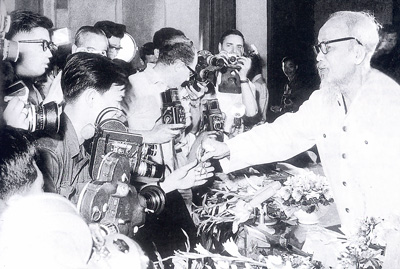
Throughout his 50 years as a journalist, President Ho Chi Minh contributed to approximately 2000 articles and journalistic outlets. These articles encompassed various journalistic genres such as news, commentary, political essays, letters, short stories, appeals, and interviews.
For his significant contributions, he is honored as a great journalist of the nation, laying the foundation for revolutionary journalism in Vietnam.
The press is a spiritual weapon of a regime, society, or class; therefore, in every era and every political regime, the press is used as a tool for class struggle. Revolutionary journalism operates and develops according to the fundamental principles of the Party and State's political line.
InLetter to the Huynh Thuc Khang Journalism ClassIn June 1949, President Ho Chi Minh outlined six key points for revolutionary newspapers:
“1. The newspaper's mission is to propagate, encourage, train, educate, and organize the people to lead them towards a common goal;
2. The common goal is resistance and nation-building, aiming for a victorious resistance and successful nation-building;
3. The newspaper's guiding principle is to unite the entire nation in patriotic emulation. Therefore;
4. The target audience of a newspaper is the vast majority of the people. A newspaper that is not popular with the vast majority of the people does not deserve to be called a newspaper. To be popular with the people, to have them consider the newspaper as their own, then:
5. Content means that articles must be simple, easy to understand, accessible, practical, and engaging. And:
6. The format refers to the arrangement of the articles; the printing must be clean and clear.
Currently, Vietnamese newspapers often have the following shortcomings:
After three months of study, the class concluded. The teacher sent another congratulatory letter and advice: "In these three months you have learned multiplication tables. If you want to be good at calculations, you must..."study more, Rightstudy forever.[3]
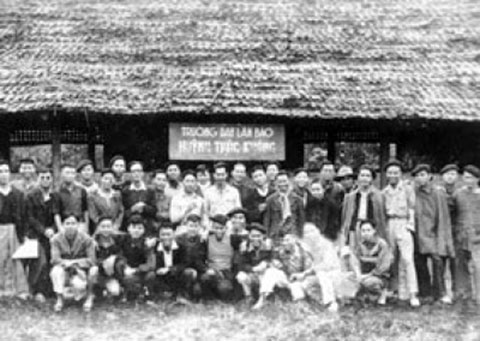
The Huynh Thuc Khang journalism class on its opening day.
Based on President Ho Chi Minh's opinions, we present the following viewpoints:
a. The primary goal of revolutionary journalism is to serve the Fatherland, serve the people, and build the country.
At the Second Congress of the Vietnam Journalists Association, the author wrote:
“Our press must serve the working people, serve socialism, serve the struggle for national reunification, and serve world peace. Therefore, all those involved in journalism (writers, printers, editors, distributors, etc.) must have a firm political stance. Politics must be paramount. Only with the right political line can everything else be done correctly. Therefore, all our mainstream newspapers must have a clear political line.”
"Our press is not for a select few to read, but to serve the people, to propagate and explain the policies of the Party and the government, therefore it must have a mass character and a fighting spirit."
Emphasizing the fighting spirit and firm class stance of revolutionary journalism also emphasizes that responsibility to each journalist. The journalist, the writer, is the true owner of the newspaper. In the congratulatory telegram from the Afro-Asian writer attending the conference, he wrote:
"For us writers, the pen is a sharp weapon, and the newspaper article is a revolutionary manifesto to unite party members and the masses in the struggle against old and new colonialism, led by American imperialism, for independence, social progress, and world peace."[4].
The press not only has a significant impact on ideology and awareness but also has the potential to become a driving force of the movement. Lenin had profound insights on this issue:
"The role of the press is not limited to disseminating ideas, providing political education, and attracting political sympathizers; the press is not only a collective propagandist and a collective advocate, but also a collective organizer."[5].
Understanding the crucial function of journalism, President Ho Chi Minh dedicated his life to using it for the revolutionary struggle. With thousands of articles written throughout the revolutionary period, he believed all aimed at a single purpose: fighting against colonial imperialism, liberating the nation, achieving independence and freedom, and building socialism.
"Speaking of the content, what you all call the subject matter, all of Uncle Ho's writings had only one theme: fighting against colonialism and imperialism, fighting against feudal landlords, and propagating national independence and socialism. That's the kind of connection Uncle Ho had with journalism."[6].
b) The press must serve the people, contributing to enhancing the people's position and contribution to the revolution.
In the relationship between the press and the people, opinions often focus on the impact of the press on the people. In reality, this is a two-way relationship. The development of the press depends on the level of education of the people, and the press plays a positive role.
Marx pointed out and emphasized the role of the people in the development of journalism:
"Clearly, wherever the press is still in its infancy, the spirit of the people is also in its infancy, and the resounding expression of daily political thought from a newly awakened people will be less mature, less formed, and more hasty compared to the thinking of a people who have grown up, become more resilient, and have gained self-awareness through political struggles."[7].
The foundation of journalistic development lies in the level of education of the people. It is no coincidence that the level of journalistic development varies among countries. The crucial issue is the level of public awareness, consciousness, and ideology. When discussing journalistic activity, a dynamic and sharp ideological weapon, one cannot speak of neutrality, free from the constraints of political and social tendencies. Proletarian journalism serves the proletariat, the people. President Ho Chi Minh clearly pointed out the directional nature of journalism and the people-serving orientation of revolutionary journalism.
"We often ask: Who does the press serve? Some say that in capitalist countries there is freedom of the press and the press has no class distinction. That's not true. For example, newspapers in France such as..."Figaro,newspaperFrance in the afternoon,...On the one hand, it lulls the people into complacency, divides them, and causes them to lose their fighting spirit and class solidarity; on the other hand, it serves the bourgeoisie. These are political newspapers. Then there are sensationalist newspapers, newspapers about love affairs, newspapers that specialize in exposing the secrets of wealthy people to blackmail them. Are French newspapers truly legitimate? No! For example, the newspaper...HumanityThey were often targeted by the media who tried to sabotage them: imposing fines, sending thugs to vandalize, creating difficulties with printing paper, and sometimes even confiscating newspapers."[8].
During the period of reform, the people were a homogeneous bloc, united in ideology, equal in interests, and their cultural level was raised, thus creating favorable conditions for the development of revolutionary journalism. In an article about readers' opinions, he paid attention to the suggestions made by readers in the newspaper with a sincere and genuinely receptive spirit:
This is a positive expression of the people's attitude towards the press. In an article about the press for readers, he presented some reader opinions on the press with practical comments and suggestions. He requested that the press cherish and accept correct opinions in order to improve. This very idea opened the way for the creation of press forums, which modern newspapers have effectively utilized. Press forums contribute to bringing the press and the people closer together, creating conditions for the press to contribute to society.
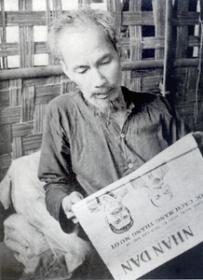
c) The press must keep pace with and lead the way in the times; it must be modern.
Journalism is an activity of disseminating information, so it must be timely. Throughout his journalistic career, as editor-in-chief of many newspapers, writing about many political and social events of the nation and many countries, Ho Chi Minh's journalism always had the significance of discovery with a broad and far-sighted vision, several steps ahead of its time. With the articles in the newspaper...People who suffer togetherand practiceThe Indictment of the French Colonial RegimeNguyen Ai Quoc was the first to fire powerful shots at the era of colonialism, shaking the system and signaling its collapse. His writings during his time in Guangzhou (China) and the Soviet Union demonstrated a combination of patriotism and socialism, representing new ideas for the liberation of modern nations.
The newspaperVietnam is independent.Under his direction, he oversaw revolutionary propaganda activities during the pre-insurrection period. And after the revolution, at each stage and at each point in time, Ho Chi Minh's press always carried the significance of discovering and marking ideological milestones that were important to the times. Many of his articles combined topicality and long-term relevance. The article about the execution at Lynch recounts the brutal crimes of imperialism and remains relevant. His writings during crucial periods for the country, such as...Declaration of Independence, Call to Arms for National Resistance, Nothing is more precious than independence and freedom, Testament…His writings forever carry the spirit and vitality of the nation, deeply touching the hearts of the people. His calls for "Unity, unity, great unity. Success, success, great success"; his moral teachings on "diligence, thrift, integrity, and righteousness"; on cultivating socialist morality; and on combating individualism will forever remain guiding principles and sincere admonitions. Many more could be mentioned, and whenever life or tasks require advice or guidance, readers can find it in his journalistic handbook. His articles on caring for the elderly, children, women's issues, and the poor all carry profound humanistic meaning.
Time has passed—a decade, two decades…a century—but the relevance and enduring value of Ho Chi Minh's journalism remain vibrant and powerful.
d. Journalism must be truthful, distinctive, and have its own character.
When discussing journalism, it's crucial to determine the authenticity of the events being described. Some Western journalists often mention five elements: "Who, When, Why, Where, What" when talking about journalistic reporting. Timeliness and authenticity are inviolable characteristics and criteria. Because real people and real events, regardless of the genre—journalism, photography, or news film—must adhere to the principle of respecting authenticity. During a visit to an art exhibition, he emphasized the need to distinguish between paintings and photographs; they cannot be used interchangeably. In the article...Opinions on creating and publishing books about good people and good deeds.President Ho Chi Minh chaired a meeting with many publishers and journalists to discuss the publication of books about good people and good deeds. He determined that using examples of good people and good deeds to educate and prevent evil was effective. Good people and good deeds are real people and events; writers only need to describe the truth without embellishment or exaggeration, and fabrication is strictly forbidden. President Ho Chi Minh instructed:
"Keep it simple and use only the truth; don't make things up."[9].
This is not a work of fiction with artistic embellishments. Books about good people and good deeds must be even more truthful and accurate. Adding a few details that the reader perceives would ruin the meaning.
There are many types of newspapers: socio-political newspapers, specialized newspapers, newspapers of organizations and groups, etc. Currently, there are hundreds of types of newspapers: central and local, specialized newspapers, newspapers of organizations, etc. The important issue is that each newspaper, in order to fulfill its function, must demonstrate its main characteristics. The duplication of news and images in newspapers is quite common. Many newspapers fail to reflect the characteristics of their respective sectors. The police newspaper must be different from the military newspaper, the women's newspaper from the youth newspaper, and local newspapers from central newspapers. In the letter sent to the newspaper...You fight,The person pointed out:
"Thank you very much for the issues of the magazine."You fight"Here are a few suggestions for you: This newspaper is for Foreign Legion soldiers, cheerful, easily irritated, and emotional young men, not for deeply political thinkers. Therefore, we need humorous pictures and drawings, things that make them happy, short news about Germany and France, especially news related to people's lives (such as food shortages, strikes, and the harassment of government agencies). In short, we need to move them, make them feel comfortable, make them laugh and cry to attract them to our side. We shouldn't write long articles, nor should we write major political articles of the time. What do you think?"
A gentle yet profound letter, insightful and reasonable, thoroughly understanding its target audience, providing them with appropriate intellectual nourishment, and drawing them towards the path of righteousness. Progressive and revolutionary views on journalism are reflected in all of his writings throughout half a century, during both his time abroad and after returning to Vietnam.
2.Ho Chi Minh's press was rich in topicality and realistic material.
Unlike literary works, which, while based on social life, also rely heavily on the effective application of it as artistic fiction, Ho Chi Minh's short stories include:The lament of Lady Trung Trac, The Royal Journey, The Farces, or Varen and Phan Boi Chau,then the playBamboo dragonAll of them take some aspect of reality as a starting point and apply fiction to their writing. In these cases, the writer did not have the opportunity to directly observe and witness the subjects due to different circumstances, but had ideas, knowledge, and real-life experiences, so they had to create works of art. Conversely, Ho Chi Minh's entire journalistic work reflects life in many different forms and at many different levels in an authentic and truthful way.
Ho Chi Minh's journalistic background stemmed from revolutionary activities. He experienced many different circumstances and environments, working and earning a living in countries like the United States, Great Britain, and France, undertaking various arduous jobs. This gave him a profound understanding of the nature of society and a thorough knowledge of many social issues and phenomena.
Ho Chi Minh was a thinker but also a man of action: “Every word and deed of Ho Chi Minh was practical and concrete; he said it and did it, often doing more than he said, sometimes doing without saying, his thoughts manifested in his actions” (Pham Van Dong). Throughout history, his accumulated life experience was incredibly rich, deeply grasping fundamental issues from the general to the specific details of reality.The Condemnation of the French Colonial RegimeThe work is forceful in its arguments condemning the enemy, yet also rich in evidence, drawing from events, people, the cruel and tyrannical French Governors-General, to the suffering of the French colonial people in Indochina, Tunisia, and Morocco. Pham Van Dong made a sharp and appropriate comparison to the work.The Condemnation of the French Colonial Regimeby Nguyen Ai Quoc with the workEngels's *The Condition of the Working Class in England*:
"These are raw pages depicting real life with brutal details, devoid of logic or philosophy, yet they brilliantly illuminate the philosophy of history, the direction of struggle for nations and for humanity."[10].
In his thinking, there was always a combination of theory and practice. Practice was the starting point of activity and also the point of testing and evaluating the effectiveness of those activities. His life spanned two periods: the years of activity abroad (1911-1941), in many countries and lands, experiencing many circumstances, struggling with life and work, from a baker, a hotel cook to a cadre of the movement, an international political activist. Those arduous years, both openly and secretly, including two periods of imprisonment... it must be said that those were difficult but meaningful years, forging countless qualities in the cadre. After 1945, in his position as President, although he did not have many opportunities to interact with the realities of life, with his sensitive understanding, he grasped life through many different methods. During the war against the French, he sometimes inspected military campaigns, enduring hardships in the mountains and forests of Viet Bac. Upon returning to Hanoi, he quickly grasped urban and rural life during the early years of socialist construction. Then, during the period of socialist construction, he continued to follow the struggle of the people and army of the South through each campaign, receiving news of the war. Regardless of the circumstances, he explored life through various methods, sometimes directly, sometimes through press information... all contributing to the richness of his journalistic writings and his close guidance of the movement. Although burdened with countless important national affairs in peacetime and wartime, domestic and foreign affairs, he still used the press to praise good people and good deeds and criticize negative phenomena. (Article)WeddingWritten on March 25, 1965, the article recounts two weddings: one that exemplified simplicity and frugality, and another that criticized extravagance.The older you get, the better you become.(Dated October 22, 1965), praising the elderly people of Ha Giang, Pho Yen, and Bac Thai for setting an example for their descendants in the production emulation movement and providing support from the rear to the front lines.We must do a good job of evacuating.Under the pseudonym Chiến Sỹ (published on July 10, 1966), the author emphasized the importance of evacuation, including collective evacuation, school and office evacuation, and individual evacuation. Regarding production, he was concerned with flood and drought control. In combating...DroughtSomeone reminded us, "Adding a bucket of cool water will make an extra bowl of golden rice" (Newspaper).People(October 9, 1966). Besides articles addressing specific issues in the daily lives of individuals and units, he was able to generalize reality, pointing out the strengths and weaknesses with specific evidence of the movements in a city or locality. In three articles and three speeches in Thanh Hoa province on June 13, 1957, in Nghe An province on June 14, 1957, and in Ha Tinh on June 15, 1957, he very specifically pointed out the strengths and weaknesses of the local movements.
In his speech to the people's representatives of Thanh Hoa, President Ho Chi Minh highlighted several strengths of the Thanh Hoa people and army: “The civilian laborers contributed greatly to the Dien Bien Phu campaign. Thanh Hoa contributed 120,000 civilian laborers, transporting food for the troops. Now, wherever the Vietnamese language is spoken, the name Dien Bien Phu is heard. Wherever the name Dien Bien Phu is heard, the people of Thanh Hoa also share in the honor. Among the young people who joined the army were heroic comrades such as Lo Van Buong, Pham Minh Duc, To Vinh Dien, and Le Cong Khai. These are outstanding sons and daughters who bring glory to the province and to our entire country.” Speaking to young women, he praised the women of Thanh Hoa: “The women of Thanh Hoa have a very good work ethic; this benefits both the family and the country. I hope that men will compete with women.” Regarding shortcomings, he pointed out: “Firstly, the people are still very wasteful. Production without saving is like wind blowing through an empty house.” Another shortcoming of the people of Thanh Hoa: "They borrow money from the government and then don't repay it. Not to mention taxes and other expenses, just the bank loans alone amount to 2 billion VND, and they refuse to pay. Not repaying debts to the government not only harms the government but also harms the people."1.
Frank, sincere, and specific, he clearly pointed out the nature of the Thanh Hoa movement. A day after June 14, 1957, he again spoke to cadres throughout Nghe An province. His article, over 4,000 words long, highlighted the strengths of the entire Nghe An province:
“A. During the resistance war, you comrades united the people and led them to serve the resistance war to victory. That is a good point.”
B. When peace was restored, the comrades worked together with the people to implement the 1956 plan of the Party and Government, which was a significant advantage.
C. After the land reform, the comrades tried to unite with the people to correct mistakes. That is another good point.
"Generally speaking, the vast majority of comrades have endured hardship and difficulties, and have strived to fulfill the tasks assigned by the Party and the Government. This is a significant and commendable achievement."[11].
Regarding the drawbacks:
The first shortcoming: The issue of unity "still has many shortcomings. This is a significant shortcoming."
The second drawback: Competing in terms of treatment and status.
President Ho Chi Minh added some further points. He advised cadres to study, saying, "Today, we shouldn't study just to get degrees or to escape production. We must study politics, culture, and technology to enhance our understanding."
He also reminded officials to be honest and fair, emphasizing that loans from banks and tax debts must be repaid as state and public funds. "If we don't repay them, where will we get the money to lend to others? Therefore, I advise all Party members and officials to be fair and square; I don't expect any more sacrifices from you. Pay back whatever you owe."
Another point that he emphasized was the need for consistent and effective ideological work, emphasizing the importance of "self-criticism and criticism." He stressed the need to enhance organization, discipline, and a sense of responsibility. Without organization and discipline, there would be freedom, indiscipline, and anarchy. One day after 1957, he spoke with representatives of Party members and officials from Ha Tinh province. The lengthy speech was delivered in a warm and intimate tone.
Regarding the positive aspects: The speaker also spoke about the contributions of the people of Ha Tinh in correcting the mistakes of the Land Reform and building new rural areas. He specifically cited several exemplary individuals. For example, "Comrade Secretary of the Ky Hai Party Branch, despite the cold and rainy weather, did not fear the cold and spent the whole day shielding the people from the rising water while they built the dikes. That is a good quality, showing self-sacrifice for the people." Then there was Comrade Thien, who, despite her poverty, still established a community work team.
Regarding the shortcomings: Critics point out that "there is a phenomenon of poor unity among cadres inside and outside the Party, old and new cadres, and old and new Party members."[12].
He also pointed out some shortcomings of Party cadres in Ha Tinh and Nghe An: Some individuals, with a sense of self-importance, thought that they were the first to achieve great things in the revolution, having organized the Soviets... thus becoming arrogant and conceited, looking down on everyone else, being petty and lacking humility. He also instructed on the immediate and long-term tasks of Ha Tinh. Over three days in three different provinces, he delivered lengthy, meticulously prepared speeches with many specific examples, ranging from strengths and good examples to ideological ailments and shortcomings. These cases demonstrated his ability to grasp the reality of the revolutionary movement in the three provinces of Thanh Hoa, Nghe An, and Ha Tinh in a profound, accurate, and concrete way. This is also a common characteristic in Ho Chi Minh's writings.
One of his most astute intellectual abilities was his capacity to accurately and quickly grasp essential information from both domestic and foreign newspapers for use in his writings. This was a need to understand and learn about life through journalism. Even in 1946, when he visited France and stayed at Mr. Aubrac's house, his host provided him with a full complement of important newspapers every morning. He would sit on the grass and read numerous newspapers in French, English, and Russian. Throughout his life, newspapers remained his closest and most essential source of intellectual nourishment. He learned about local truths through local newspapers, and about events in various sectors through the newspapers of those sectors and organizations; every day presented a wealth of diverse issues. His initiative to record and document good people and good deeds in newspapers, and to create a book titled "Good People, Good Deeds," was a groundbreaking idea based on journalistic data.
Reading foreign newspapers, especially major newspapers from France, England, America, Russia, and China, provided insightful coverage of the positive and negative aspects of life in those countries. Hundreds of articles, written under various pseudonyms, about American society and capitalist countries, demonstrated the diligent, determined, and intelligent spirit of the author. This quality is crucial and not easily achieved.
Ho Chi Minh's press truthfully and accurately reflected major political and social events, as well as issues of human ideology and morality throughout each stage of the revolution. On the other hand, alongside the flow of reality, whether intense and vibrant or peaceful, there was always a journalist who consciously sought to understand, analyze, and express their attitude, contributing to shaping the direction of social life through these events.
3.The humanistic values and cultural depth of Ho Chi Minh's journalism.
Stemming from the ideals that he fought for throughout his life—to liberate the nation, achieve independence and freedom, and bring happiness to the people—his writings always firmly uphold the nationalistic stance and the interests of the people. Journalism typically functions to disseminate and quickly update news according to the passage of time, thus making it difficult to broaden knowledge about many aspects of life. Journalism focuses heavily on events, the emergence of socio-political events, and their impact on life. Ho Chi Minh's journalism also shares these characteristics, but he particularly emphasizes the human element; events are closely connected to people, and actions are also closely linked to people.
In particular, the right to life was a concern of the author in many of his writings.Declaration of Independence1776 in America and the French RevolutionDeclaration of Human Rights and Citizen RightsThe year 1971 appealed to him because of its emphasis on upholding and protecting human rights.Declaration of IndependenceA 1776 American article stated, "All men are created equal. They are endowed by their Creator with certain unalienable Rights, among which are the Right to Life, Liberty and the pursuit of Happiness," and "men are born free and equal in rights."Declaration of Human Rights and Citizen Rights1971).
These progressive ideas deeply permeated and were embraced by him right there in America. But here, a contrasting situation arises: crime, a brutal crime of torturing and destroying people, a crime not committed by an individual but by a frenzied mob rushing in to stab and slash: Execution, Lynch, with a spirit of outrage at the perpetrators and compassion for the unfortunate victims. The article describes it truthfully and accurately down to the smallest detail, deeply moving the reader. The article has both denunciatory and humanistic value. The newspaperHorizonA sharp commentary from the German Democratic Republic stated: “This indictment remains perfectly relevant. It reminds us that imperialists of all kinds, then and now, have always been mortal enemies of mankind. With this indictment, Ho Chi Minh emerged as a true fighter of proletarian internationalism and a defender of human rights and freedom for all oppressed people, regardless of their country of residence.”
The French colonialists, who called themselves civilizers, and the American imperialists, who boasted about American freedom, American culture, and American morality, surely both had many good people and many admirable cultural aspects, but also countless bad things, such as unemployment, theft, prostitution, and drug use. Yet, they failed to recognize their own shortcomings and instead smeared the cultures of the colonized nations. Nguyen Ai Quoc exposed the malicious intent of the colonialists when they displayed many unflattering images of the colonized countries at the 1922 Colonial Exhibition.
At the Marseille conference, besides the paintings depicting Vietnamese officials kneeling before the puppet king, along with mastiffs and the governor-general, and naked laborers pulling rickshaws, there were also films showing old women chewing betel nut with blackened teeth, thin, ragged farmers, and people in loincloths climbing coconut trees. They called this the image of "Annam." Ho Chi Minh always consciously protected and upheld the national culture that had developed beautifully for thousands of years. He criticized the despicable and vile actions of Khai Dinh. Alongside this, he praised the spirit of Phan Boi Chau through stories such as:The lament of Lady Trung Trac, The farces or Varen and Phan Boi Chau,We should praise and promote the good and beautiful aspects of our national culture and morality, paying particular attention to educating the younger generation.
Towards the end of his life, when discussing the creation of books about good people and good deeds, he also recalled memories from his youth, emphasizing respect for traditional morality, especially filial piety towards parents and loyalty to the country.
Recalling the pastTwenty-Four Filial Piety StoriesThe speaker said, "Even at nearly 80 years old, I still remember the stories of Old Lai, the couple Guo Ju, and the young Han Lu Xi, and how filial they were to their parents. Even illiterate people knew stories like that in the old days. You children should learn from our ancestors' methods of education. You can do even better because today's morality is broader and more profound; it's not just about filial piety towards parents, but also about loyalty to the country and devotion to the people."[13].
Ho Chi Minh's press also possessed a profound cultural value. He paid particular attention to cultural issues and the cultural aspects of events. He was passionate about studying and researching the culture and literature of many nations. "Mr. Nguyen enjoyed reading Shakespeare and Dickens in English, Lu Xun in Chinese, and Hugo and Zola in French. Anatole France and Leo Tolstoy can be said to be his cultural mentors."[14].
General Võ Nguyên Giáp also remarked: “He was interested in studying philosophical and political ideas, especially revolutionary thought and French literature. Fluent in many foreign languages, he absorbed the spiritual values and humanitarian ideas of many ancient and modern cultures, East and West. He read the New Books of China and Japan. Now he is studying Renaissance and Enlightenment philosophy and literature. He studies the economics of Ricardo and Adam Smith, the works of Karl Marx... he reads Victor Hugo, Shakespeare, Lu Xun, and Tolstoy in their original texts. He studies while writing articles and plays. In the eyes of his friends, Nguyễn Ái Quốc “was an outstanding person in many fields, a learned man, and at that time some observed that a new kind of culture emanated from Nguyễn Ái Quốc.”
Through Ho Chi Minh's writings, we see how he creatively applied much of his Western cultural knowledge. From the story of Khai Dinh's trip to France with ulterior political motives to his use of Plato to criticize the puppet king, this was a unique and innovative idea.Special hobbies)In the articleLocals are preferred.The author alludes to Shakespeare's play Othello. In some articles, the author uses a distinctive writing style:
“Mr. Joseph Cayoh, former prime minister, unconventional financier, a writer who wasn't bad, not even relatively bad as Einstein said, after ruling over 40 million French people, having amassed luxury brands and billions of dollars, he wrote books, and one morning he was scratching his head frantically. Not scratching his hair because he had no hair at all – but scratching his ears – while simultaneously asking himself and others: Where is Europe going? Where is France going?”
"Hey, Mr. Prime Minister, tell me where the feet of Europe and of France are, and I'll tell you where Europe and France are going." (Comment on the article)ZoologyPublished in Le Paria in 1925, the poet Che Lan Vien remarked, "It is truly satirical and deeply moving, satire in blood, laughter expressing the resentment of all the feelings of the colonial people that we were at that time." He also had a profound understanding of Chinese culture and literature. In his concluding remarks at the launch of the Vietnam Labor Party, he quoted two lines of poetry by Lu Xun:
With wide, disdainful eyes, he looked down upon a thousand strongmen.
Bowing down like horses, the children
And he explained that "a thousand strongmen" refers to powerful enemies, for example, the French colonialists and the American interventionists, also signifying hardships and difficulties. "The children" means the large, gentle masses of people, also representing tasks that benefit the nation and the people. The Vietnam Labor Party fears no enemy, no matter how ferocious, and is not afraid of heavy or dangerous tasks, but is ready to gladly serve as a loyal servant of the people."
Regarding Vietnamese culture and literature, he always mentioned traditions and national heroes to set examples for life today, showing respect for great literary authors such as Nguyen Trai, Nguyen Du, and Nguyen Dinh Chieu. In many of his writings, he vividly used folk songs, either in their original form or with modifications to suit the context.
As long as there are mountains, rivers, and people,
After defeating the American invaders, we will rebuild in more than ten days.
People also often use verses inThe Lament of the Warrior's WifeFrom the Tale of Kieu to journalistic works, everything blends seamlessly, making the writing vivid. Ho Chi Minh's journalism, rich in this quality, has contributed to creating a unique style and distinctive mark for his articles.
Journalistic works are about how news of the times is reported and reflected, and the writer's perspective and evaluation. There's no need for direct emotional expression as in poetry or prose, nor for artistic embellishment; therefore, writers rarely reveal themselves through their writing. This reality easily creates a close resemblance, even overlapping aspects, between different pages of writing in journalism. While it's possible to discuss an author's journalistic style, it's not easy. It requires both thought and talent to create a distinctive journalistic style. Ho Chi Minh's journalism has its own style and characteristics, primarily stemming from his consistent ideology across political and social events and issues. This consistency is based on a single purpose, an ideal that he dedicated his life to in the struggle for the nation. The subject's imprint is evident in the way he addresses and resolves issues: flexible yet resolute, with a focus on effectiveness. People often advise that nothing is easy and nothing is difficult; if something is easy but one becomes complacent, it will not succeed, but if something is difficult but one is determined and strives to complete it, the results will be good. Ho Chi Minh's writings are rich in knowledge—knowledge about politics and society connected to the times of each period, knowledge about people, and knowledge about social relationships. The complete works of Ho Chi Minh are a treasure trove of political, social, and cultural knowledge, a great contribution to the development of the Vietnamese revolution, and a handbook where everyone can find advice, a lesson, or a way to solve a problem.
[1]Tran Dan Tien, 1975.Stories about President Ho Chi Minh's activities. Truth Publishing House.
[2]Ho Chi Minh - Complete Works, Volume 5, pp. 625-626.
[3]Ho Chi Minh - Complete Works, Volume 5, page 653.
[4]Nhan Dan Newspaper, April 24, 1965
[5]Lenin's Complete Works, Truth Publishing House, volume 34, page 592.
[6]Ho Chi Minh - Complete Works, Volume 9, page 419.
[7]C. Marx, P. Engels Complete Works, Volume 1, page 238.
[8]Ho Chi Minh - Complete Works, Volume 9, page 414.
[9]Ho Chi Minh - Complete Works, Volume 12, page 559.
[10] Literature MagazineNo. 3-1970.
[11]Ho Chi Minh - Complete Works, Volume 8, pp. 406-415.
[12]Ho Chi Minh - Complete Works, Volume 8, pp. 416-423.
[13]Ho Chi Minh - Complete Works, Volume 12, page 558.
[14]Tran Dan Tien, 1975.Stories about President Ho Chi Minh's activities. Truth Publishing House.
Author:Professor Ha Minh Duc
Newer news
Older news

