
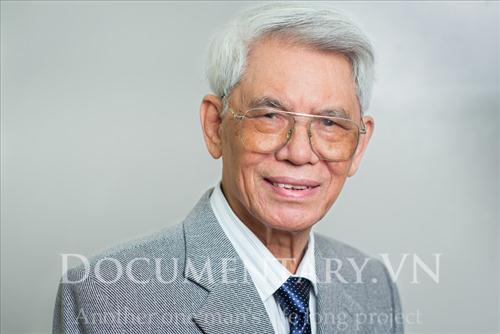
Born in a poor coastal village – Diem Dien salt village (Thai Thuy district, Thai Binh province), where people toiled under the sun and rain to produce precious salt, a product of their sweat and toil – and lacking a tradition of formal education, Associate Professor Dr. Le Huy Tieu, unlike most of his peers, was a studious and avid reader from a young age. He particularly loved poetry and literature and showed a literary inclination quite early on (he even won a prize in a children's writing competition during the French colonial period). As he grew older, his favorite genre remained novels, especially classic Chinese novels, which were always his bedside reading. Literature became his calling from then on, and when he had the opportunity to study in China, he chose to pursue none other than Literature.
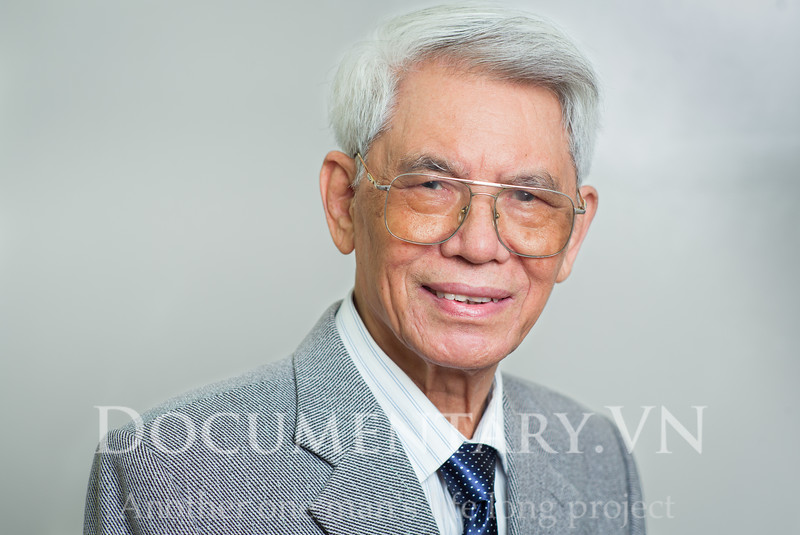
Associate Professor, Doctor, Distinguished Teacher Le Huy Tieu/Photo: Thanh Long
After completing his secondary education in 1954, he was sent to China to study. After a year of language study at the Nanning campus, he officially became a student at Shandong University in China. During his five years at this prestigious university (1955-1960), he was always an outstanding foreign student, respected and loved by his teachers and friends. Proof of this is that, even in recent years, during a visit back to the university for its founding anniversary, he still brought back a wealth of memories of the teacher-student and foreign friendships, along with recollections of a "glorious era" that seemed so long ago.
Graduating with honors from Shandong University in 1960, he returned to Vietnam and was accepted to work at the Faculty of Literature, Hanoi University, where he remained for 40 years until his retirement in 2000. During those 40 years, following in the footsteps of Professors Dang Thai Mai, Truong Chinh, and others, he made significant contributions to the education of many generations of students and the development of Chinese studies in Vietnam.
As an educator, he teaches 200 to 300 hours annually to students of all levels. Initially, upon joining the university, he was assigned to teach classical Chinese literature, but during periods of staff shortages, he had to take on additional responsibilities in modern Chinese literature, and later contemporary Chinese literature. This demanding workload also provided him with opportunities to delve deeper into and achieve new milestones in the study of contemporary Chinese literature, contributing to filling the gap in the field of Chinese studies in Vietnam.
Throughout his teaching career, in addition to supervising hundreds of undergraduate theses for students in his department as a mandatory annual task, fifteen years after his retirement, he has successfully supervised dozens of graduate students and doctoral candidates in defending their master's and doctoral theses at the university and other training institutions such as Hanoi Pedagogical University, the Institute of Literature, etc. With his professional prestige, even after more than a decade of retirement, he is still frequently invited to participate in many doctoral thesis defense committees in Hanoi and Ho Chi Minh City. And recently, in September 2013, despite being well past the age of "rarely seen," he was personally invited by Guangxi Nationalities University to be a visiting professor.

Associate Professor Dr. Le Huy Tieu in his youth
Having worked at a research university, his teaching and training work always went hand in hand with research, and sometimes research even seemed more important. Over the past several decades, both during his working years and after retirement, he has written dozens of research papers on Chinese culture and literature published in specialized journals such as the Journal of Literary Studies, the Journal of Chinese Studies, and the Journal of Foreign Literature, etc. He has also led numerous research projects at various levels, for example, leading a university-level project.New Sino-Vietnamese terms that have recently appeared in the social sciences.(Completed in 1995), co-chair of the project.New Literature and its Influence on Vietnamese Society in the Late 19th and Early 20th Centuries(Approved in 1997, published by the National Political Publishing House that same year). And especially, with the desire to guide and nurture the younger generation when "the old bamboo is aging but the new shoots haven't yet sprouted," even though he had retired and no longer had any responsibilities, he still proposed and co-chaired a special research project at Hanoi National University with a young staff member in the department.Innovations in Chinese literary criticism theory during the reform and opening-up period (1978-2000)(Reviewed in 2009, revised and published as a book). In addition, he chaired numerous seminars on Chinese and Korean literature (such as the Seminar on New Literature, the Seminar on the Influence of Korean Culture and Literature, etc.) in Hanoi and Ho Chi Minh City, and participated in and wrote papers for many seminars on Chinese literature in Beijing, Shandong, Guangxi, etc.
In the early 1990s, amidst the normalization of relations between Vietnam and China after the war, the demand for learning Chinese and understanding Chinese culture increased. In a situation where textbooks and learning materials, especially reference books, were scarce, the teacher and his colleagues promptly compiled this set of resources.Chinese-Vietnamese Dictionary(Social Sciences Publishing House, 1993). This dictionary was subsequently reprinted many times and is still considered one of the best Chinese-Vietnamese dictionaries, favored by learners. In addition, with his extensive knowledge of Chinese culture and literature, he also compiled valuable books such as:Dictionary of Chinese Idioms and Allusions(Social Sciences Publishing House, 1993)Chinese fables(Women's Publishing House, 1993)...
With his deep knowledge of Ming and Qing dynasty novels and the Chinese language, he (along with his close colleague, Associate Professor Le Duc Niem) was often invited by publishers to proofread and write introductions for the Vietnamese translations of classic works of Chinese literature that they published. Masterpieces such as:Romance of the Three Kingdoms, Water Margin, Dream of the Red Chamber, Eastern Zhou Dynasty…published in Vietnam, primarily through the teacher's editing and introduction, with fresh perspectives.
In addition to his teaching and research work, he is also known as a renowned translator. Throughout his professional life, he has edited or personally translated many important and valuable works.
First and foremost, aware of the lack of textbooks and reference materials on Chinese literature, and aiming to facilitate students' access to foreign literature and avoid rote learning, he proposed and spearheaded the translation of many valuable textbooks and works in Chinese literature, for example, he was the chief translator of the following textbooks:History of ancient Chinese literature, History of modern Chinese literature, History of contemporary Chinese literature;I also translate many novels, novellas, and short story collections by famous contemporary writers such as Mo Yan and Jia Pingao for publishing houses such as Literature Publishing House, the Writers' Association, Education Publishing House, and Labor Publishing House…
In the context of increasingly profound globalization and a growing trend of integration, new literary theories that China has adopted from the West and applied to China are becoming more and more popular. While we are often "behind," I am aware of this and have also focused on translating and introducing Western literary theories and their application in China, such as theories of comparative literature, postmodern literature, ambiguous poetry, stream-of-consciousness art, etc.
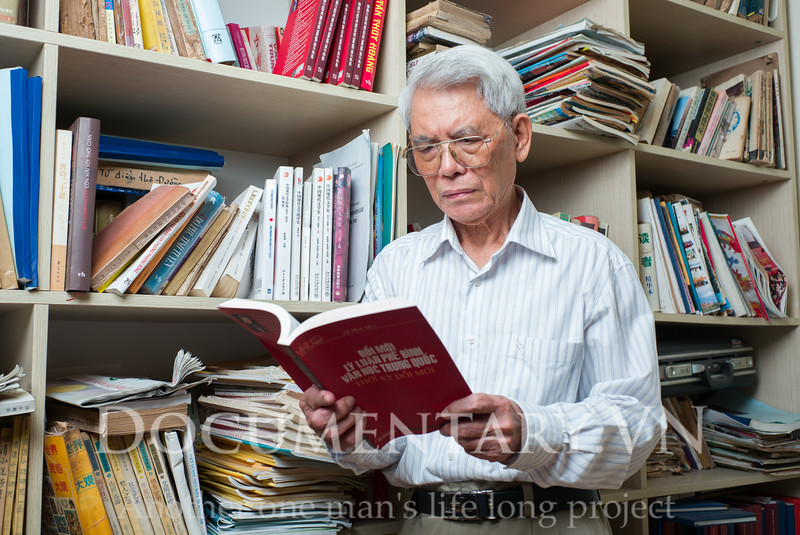
It can be said that Associate Professor Dr. Le Huy Tieu is a multi-talented educator. Besides being a teacher, researcher, and translator, he is also an "unofficial journalist." For decades, he has been a familiar contributor to numerous newspapers such as: Van Nghe, Thanh Nien, Tien Phong, Nhan Dan, Lao Dong, Hon Viet, The Gioi Moi, Kien Thuc Ngay Nay… with hundreds of articles on Chinese culture and literature. In this field, he plays the role of an ambassador for cultural and literary exchange between Vietnam and China.
Give the article about the teacher the title as follows:A lifetime "immersed" in Chinese literature.The author doesn't use any "exaggeration." What does "obsession" even mean? Having retired fifteen years ago (exactly the same length of Thuy Kieu's long wandering) and having reached the age of eighty, he still works tirelessly day and night with every word, and in just the last five years has published several books (translations and original works):Chinese novels during the Reform and Opening-up period(Vietnam Education Publishing House, 2011)Comparative Literature Textbook(Translated by Vietnam Education Publishing House, 2011)Innovations in Chinese literary criticism theory during the reform period.(Hanoi National University Publishing House, 2014), not to mention numerous articles regularly published in journals (such as the journal "Literary and Artistic Criticism") and newspapers. If he wasn't so passionate, why would he always be interested in current literary issues, especially in conferences on translated literature and Chinese culture and literature? Just last year, when the Faculty of Literature organized an International Conference on Translated Literature, we were partly (subconsciously) worried about his health (he often suffered from high blood pressure, heart problems, and had to have a stent implanted), and partly due to the carelessness of youth, no one thought to inform him. He only found out after the conference, and he was very sad and regretful. He blamed us but wasn't angry. He remained the same, always kind and forgiving of the mistakes of "young people." This made us feel even more guilty and remorseful. I would like to take this opportunity to apologize to you, teacher, for the students' thoughtlessness.
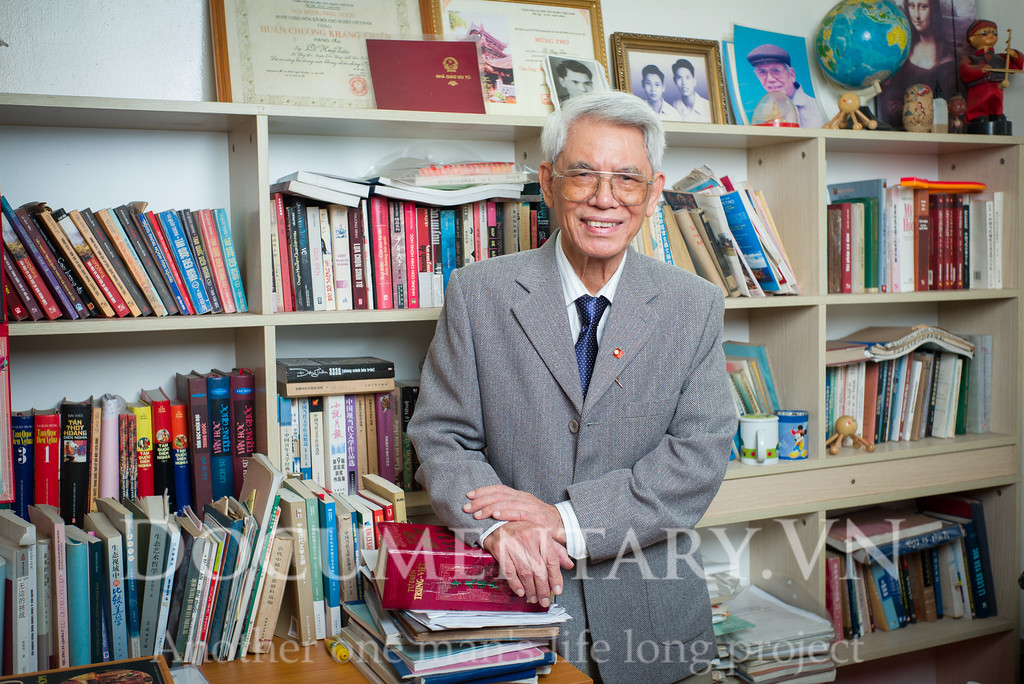
One admirable quality, and one that speaks volumes about the professor's dedication not only to science but also to the emotional realm, is his constant concern for mentoring and nurturing young staff members in translation and research. He takes on research projects from the university and translates Chinese books to provide opportunities for young staff to participate. Even now, he continues to search for excellent books, contact relevant parties for copyrights and funding to support young people in translation, often acting as an editor himself, with the understanding that this allows them to both earn extra income and enhance their professional skills. Perhaps only with such devoted love could he accomplish such things. On behalf of everyone, we would like to express our sincere gratitude to him for everything.
With his inherent meticulousness, whether teaching, writing papers, or supervising graduate students, he always worked with a serious attitude, never doing things carelessly or superficially. It could be said that his seriousness had become his "trademark." To the point that many acquaintances, when pursuing their graduate studies, would bring their dissertations (even those with topics completely unrelated to his research field) to him for review before submitting them to the State-level Dissertation Examination Committee. His reputation spread far and wide, and many Vietnamese graduate students studying in China also sought his help. Many students from the South, even those he had never met, wrote letters asking for his guidance and advice. He was always enthusiastic and selfless in helping everyone. All of this demonstrates the seriousness and carefulness of his work, and the genuine, selfless enthusiasm of his life – a quality that naturally resonated with everyone.
To conclude this article, I would like to mention a story unrelated to science that my teacher often told me with pride and a touch of nostalgia, recalling distant memories. The story goes that during the difficult times of the war against the Americans, when the school was evacuated to Dai Tu (Thai Nguyen), my teacher was assigned to oversee production to increase the food rations for the staff. He was always actively involved in all tasks, from tilling the land and planting vegetables to fertilizing and watering, never shying away from difficulties. Furthermore, he encouraged his colleagues to work together to increase production and share the hardships. Despite the hardships, it became an unforgettable memory in his mind of a difficult time. Perhaps it was here that the qualities of a "salt village man" were fully demonstrated: enthusiastic work ethic, responsibility, and, most importantly, the deep, heartfelt affection, as salty as the very grains of salt from his hometown of Diem Dien.
|
Associate Professor, Doctor, Distinguished Teacher Le Huy Tieu
+ Workplace: Faculty of Literature, Hanoi University (now the Faculty of Literature, University of Social Sciences and Humanities, Vietnam National University, Hanoi). + Management position: Head of the Department of Oriental Literature, Faculty of Linguistics and Literature (1989-1997).
Chinese-Vietnamese Dictionary(co-authored, Social Sciences Publishing House, 1992). Dictionary of Chinese Idioms and Allusions(Social Sciences Publishing House, 1993). Chinese fables(Women's Publishing House, 1993). New Literature and Vietnamese Society(co-editor, National Political Publishing House, 1997). A new perspective on Chinese culture and literature.(Vietnam National University, Hanoi Publishing House, 2004). Chinese novels during the Reform and Opening-up period(Vietnam Education Publishing House, 2011). Innovations in Chinese literary criticism theory during the reform period.(Vietnam National University, Hanoi Publishing House, 2014). |
Author:MSc. Nguyen Thanh Dien

