

Over the past period, despite facing numerous internal and external difficulties and challenges, Vietnam National University, Hanoi (VNU) has consistently affirmed itself as a unified and increasingly developing organic entity. Under the leadership and guidance of the Party committees at all levels, the spirit of solidarity and community within the entire Party organization has been effectively promoted. Could the Secretary please elaborate on the outstanding achievements in political and ideological work during the past term?
First and foremost, the Party Committee and its Standing Committee have always thoroughly instilled and disseminated to all cadres and Party members the Party's guidelines and policies, and the State's laws and regulations, especially in the fields of education and training, science and technology. In the process of implementing the resolutions of the Central Committee and the Hanoi City Party Committee, the Party Committee and its Standing Committee have wisely selected the right and relevant issues, appropriate to the practical conditions of Vietnam National University, Hanoi, as well as its member and affiliated units, to formulate suitable policies and decisions, and to provide decisive leadership and guidance to effectively implement those policies.
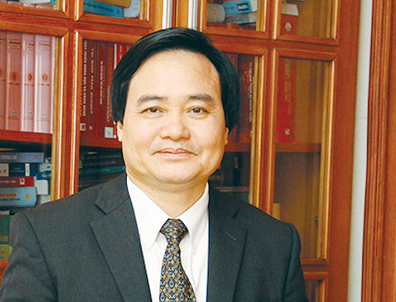
Comrade Phung Xuan Nha - Alternate Member of the Central Committee of the Party, Secretary of the Party Committee, Director of Vietnam National University, Hanoi
The Party Committee and Standing Committee of the Party Committee of Vietnam National University, Hanoi (VNU) have always recognized that doing a good job in political and ideological work is a prerequisite for successfully fulfilling the Party Committee's political tasks. In recent times, amidst the difficult economic situation of the country and the complex international situation, the Party Committee and Standing Committee have identified that one of the prerequisites for overcoming difficulties and challenges is to achieve unity and cohesion, and to maximize the spirit of community among all cadres and Party members. To achieve unity, it is necessary to liberate thinking, and this must begin first with the leadership and management, especially the top leaders. Leaders must have a deep understanding of their role and responsibility towards the common good. But most importantly, leaders must be truly courageous, pioneering, and exemplary, constantly listening to, understanding, and promptly resolving the thoughts, aspirations, and difficulties of cadres, Party members, and civil servants with concrete solutions and actions. Only then can they unite the hearts and minds of the people, thereby creating a combined strength to successfully achieve the mission and goals set forth. Furthermore, practical experience has shown that to create an environment that nurtures and promotes innovation, there must be a truly objective, impartial, and fair assessment of the quantity, quality, effectiveness of work, and contributions of each individual. This will lead to both spiritual and material encouragement, deserved recognition, and the creation of conditions for scientists to best utilize their intellect and creativity, instilling in each cadre and Party member a sense of pride and responsibility to contribute to the development of Vietnam National University, Hanoi.
In fact, the implementation of major policies and guidelines of Vietnam National University, Hanoi (VNU) in recent times has involved thorough discussions and consultations within Party committees, government agencies, and mass organizations at all levels, especially through the widespread consultation of cadres, Party members, and civil servants, thus creating consensus during the implementation process. A prime example is the recent reform of university admissions. This was a new and challenging task, and the Party Committee had a clear direction from the outset. Furthermore, during the implementation process, there was extensive discussion and exchange among all units, creating consensus and leveraging the combined strength of all units and individuals to successfully accomplish this important task. This earned the trust of leaders at all levels, cadres, Party members, and civil servants, and was highly appreciated by society. Another example is the implementation of the State-level Key Science and Technology Program for Sustainable Development of the Northwest Region. This was also a large and complex task, and initially, not all scientists at Vietnam National University, Hanoi (VNU) fully understood the Program. Some argued that VNU's strength lay in basic science, while the Program required research results to be transferred and applied in practice to develop the economy, culture, society, and ensure national defense and security in the Northwest region. They questioned whether VNU's leadership of the Program was truly appropriate. In response to these concerns, ideological work became key to explaining and clarifying VNU's role, position, responsibilities, and scientific potential in gathering scientists not only within VNU but also, with its prestige, attracting scientists from both within and outside the country to successfully implement the Program. The philosophy of "science for humanity," combining interdisciplinary sciences in solving development problems, and especially the profound sense of responsibility of Vietnam National University, Hanoi towards the difficulties faced by ethnic minorities in the Northwest region, has enabled the Northwest Program to assemble a strong scientific team, implement its plan correctly, and initially achieve positive results, which have been recognized and highly appreciated by the provinces in the region.
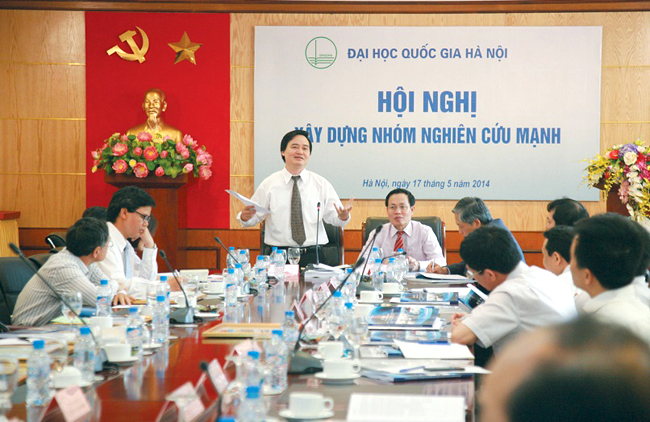
These are just two of many examples showing that the Party Committee and its Standing Committee attach special importance to innovating and improving the quality and effectiveness of political and ideological work by overcoming formalism and general slogans, and instead adopting concrete approaches that take into account the specific characteristics of Vietnam National University, Hanoi. The key point is to promote a democratic spirit, ensure the harmony of interests, and all work towards the common goal of the organization.
Along with numerous implemented action programs, the study and emulation of Ho Chi Minh's moral example has been creatively and flexibly applied in all activities of Vietnam National University, Hanoi, particularly in movements to improve the quality of training and scientific research, creating widespread dissemination throughout the Party Committee. At the same time, the Party Committee and its Standing Committee have effectively directed efforts to understand students' thoughts on major national issues, as well as sensitive issues related to national sovereignty, through practical activities that help students develop a correct and positive understanding of their responsibilities as young people in the cause of building and defending the Fatherland.
The specific actions and outstanding results achieved in the past period demonstrate that, under the leadership and guidance of the Party Committee and the Standing Committee of the Party Committee, political and ideological work within the Party Committee of Vietnam National University, Hanoi has undergone significant changes, becoming more in-depth, practical, and effective. This has contributed to creating a shared cultural community and a harmonious academic environment where lecturers, scientists, and students live and work together openly, amicably, and creatively.
Thus, political and ideological work has created the foundation and become the "support base" for VNU to continue achieving great successes in fulfilling its political tasks. Could the Secretary please elaborate on some of the outstanding results in the implementation of VNU's political tasks during the past term?
With a spirit of high determination, a willingness to think outside the box, take action, and most importantly, a bold willingness to change outdated leadership and management thinking, Vietnam National University, Hanoi (VNU) has achieved many positive results in fulfilling its political tasks as outlined in the Resolution of the 4th Congress of the VNU Party Committee.
First and foremost, it involves building and promulgating strategies, plans, and development programs for Vietnam National University, Hanoi (VNU) that are appropriate to practical conditions and new development trends. The Party Committee and its Standing Committee have closely supervised the development and promulgation of the VNU Development Strategy to 2020, with a vision to 2030, which specifies concrete, clear, quantifiable goals, targets, tasks, and solutions, and especially takes into account the conditions for implementation to ensure feasibility and effectiveness. Along with this, they have directed member and affiliated units to develop and promulgate their own development strategies based on the overall goals and targets of VNU. Development plans and action programs have been developed and are being implemented effectively step by step.
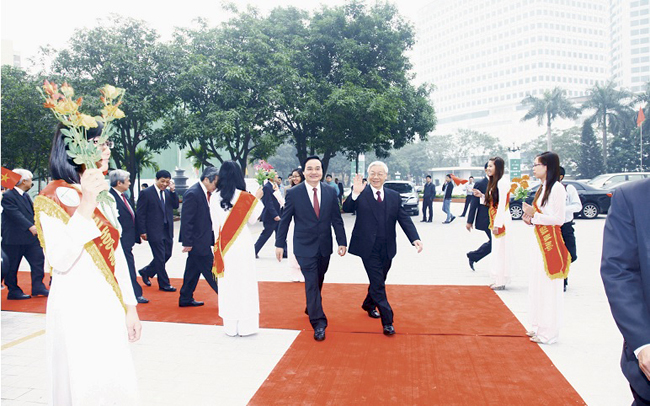
General Secretary Nguyen Phu Trong visits Vietnam National University, Hanoi.
In the area of organizational development and staffing, a notable achievement is the implementation of the Project to Adjust, Reorganize, and Develop the Organization within Vietnam National University, Hanoi (VNU). This is a crucial political task that has received widespread support and consensus from cadres, Party members, and scientists. Therefore, the implementation process has been smooth, reducing the number of coordinating units from 43 to 30, ensuring a streamlined structure and avoiding overlapping functions and responsibilities. This has contributed to gradually perfecting VNU as an organic entity, focusing resources on development according to the research-oriented university model. The development of staff, especially scientists, has been prioritized and promoted during this term. Several policies to attract talented personnel from outside and retain existing staff have been issued and implemented relatively effectively. As a result, the number of scientific staff at Vietnam National University, Hanoi with doctoral and scientific doctoral degrees increased significantly, from 38% in 2010 to 47% in 2014. Specifically for the fields of natural sciences, technology, and economics, this rate reached over 70%; the percentage of scientific staff holding professor or associate professor titles reached 20.6% of the total scientific staff, approximately three times higher than the national average.
Furthermore, the Standing Committee of the Party Committee has focused on closely leading and directing the development of the Science and Technology Development Strategy until 2020; implementing the planning of science and technology activities according to four main fields (Social Sciences and Humanities, Natural Sciences and Medicine, Engineering and Technology, Interdisciplinary Sciences); planning strong research groups linked to specific research programs; and planning training majors and specializations. Accordingly, the training majors and groups of majors in VNU are arranged in conjunction with specific science and technology fields and the needs of the labor market. Practical implementation has shown that the "map" of training majors and specializations linked to science and technology activities and quality assurance conditions at VNU has become more coherent. This also serves as an important basis for stratifying investment in the future, bringing benefits and creating equality for units and scientists, especially those in the social sciences and humanities, which have historically not received investment commensurate with the importance of this field.
Besides a strong human resource base, achieving development goals requires appropriate financial resources and infrastructure. Therefore, Vietnam National University, Hanoi (VNU) has placed special emphasis on enhancing its scientific and technological potential, providing maximum support to scientists through investments in building laboratory systems, modernizing research equipment, and connecting with domestic and international partners to attract and strengthen resources for the development of VNU and its affiliated units. Although the progress of the VNU construction project in Hoa Lac is slow, VNU leaders have been making great efforts and demonstrating high determination, proactively coordinating with the Ministry of Construction to complete several project components and put them into use, creating a foundation to accelerate the project's implementation in the next term. Resolving this "bottleneck" will create the conditions for us to "take off". Therefore, the leaders of Vietnam National University, Hanoi have traveled extensively and worked with numerous domestic and international partners to mobilize financial resources through public-private partnerships (PPP), achieving initial positive results. I believe the lesson learned here is the need for strong determination and decisive action based on accurate analysis and assessment of the situation, while securing the support of all stakeholders.
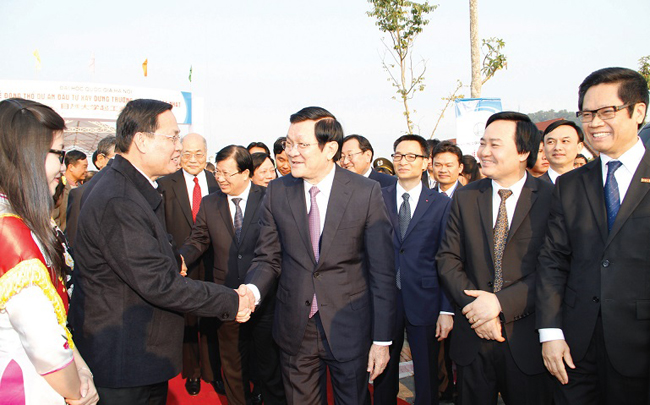
President Truong Tan Sang attended the groundbreaking ceremony for the Vietnam-Japan University (VNU Hanoi).
With such successes, the Party building work of the Party Committee of Vietnam National University, Hanoi must certainly undergo profound changes. Could the Secretary elaborate on this?
Party building work has always been a top priority for Vietnam National University, Hanoi (VNU), considered a key task. In addition to focusing on leading and directing political and ideological work, the Party Committee and its Standing Committee pay special attention to personnel work, as people are the decisive factor in success. The VNU Party Committee and its Standing Committee have led and directed the reform of several aspects of personnel work, ensuring adherence to the principle of unified Party leadership in personnel work and management of the staff. Appointments, transfers, rotations, utilization, and personnel policies have been implemented in accordance with regulations and principles. The Party Committee has concretized the Party's regulations on personnel work to ensure unified implementation throughout the Party organization. Training and development of personnel according to planning, especially young personnel, has been given attention. The rotation of cadres, creating opportunities for young leaders to gain experience and exposure at grassroots units, has contributed to standardizing and developing a pool of leaders and managers at all levels, meeting the development requirements of Vietnam National University, Hanoi. Party organizations at the grassroots level are regularly strengthened and consolidated, gradually improving the leadership capacity and fighting strength of grassroots party organizations, party committees, and cadres and party members to build a clean, strong, and capable Party organization with the courage and fortitude to successfully lead the political tasks set forth. Cadres and party members, especially leaders and managers, must set a good example, practice what they preach, speak less and do more, and work effectively and concretely.
It is gratifying that during the past term, the Party Committee and its Standing Committee have effectively led and directed the planning and development of personnel, particularly the development of young cadres through the activities of the Scientists' Club. The leadership of Vietnam National University, Hanoi (VNU) advocates that personnel planning and development should not be based solely on resumes but must be honed through practical experience and evaluated and selected based on practical experience. As a result, we have proactively developed personnel plans for the Party Congresses of various units and VNU, with a rich and high-quality pool of candidates. Those included in the planning process have been thoroughly prepared and are linked to leadership and management positions. Furthermore, the work of transferring, appointing, and rotating cadres has been implemented effectively in a fair, impartial, and objective manner, primarily using work performance as a measure. To date, this work has proceeded smoothly and has received the consensus of a large number of cadres, lecturers, and scientists.
Furthermore, the Party Committee of Vietnam National University, Hanoi (VNU) has seriously implemented Resolution No. 4 of the Central Committee (11th term) "Some urgent issues concerning Party building today". Accordingly, collectives and individuals have conducted self-criticism and criticism with a serious, open-minded, and frank attitude; after the review, Party committees at all levels have focused on leading and directing the implementation of plans to overcome and correct the shortcomings and weaknesses identified during the review process, and have achieved some important results. The methods of leadership and direction have undergone significant changes. The content and programs are prepared meticulously, concisely, practically, and democratically, clarifying the responsibilities of the head, each Party committee member, and members of the Standing Committee of the Party Committee. Therefore, many major issues of the Party Committee of VNU are discussed and agreed upon before implementation, so cadres, Party members, civil servants, and employees all feel respected and enthusiastic when participating in deciding on important tasks of VNU.
Regarding the activities of mass organizations, during the past term, there has been harmonious and effective coordination with all levels of government within the Vietnam National University, Hanoi (VNU) to maximize the combined strength and successfully implement important political tasks of VNU. In particular, the legitimate rights of cadres, civil servants, and employees have been ensured, contributing to creating enthusiasm and encouraging dedication to the overall development of VNU. However, along with the achievements, the practicality of some activities of mass organizations is still lacking. This is due to inadequate task identification, implementation conditions, and supervision. In the future, this limitation needs to be overcome so that mass organizations within VNU can fulfill their roles and make practical contributions to building a clean and strong Party Committee, as well as the development of VNU.
Based on the achievements of the past term, what are the Secretary's expectations for the development of Vietnam National University, Hanoi in the coming period?
Under the close leadership and guidance of the Party and the State, with the effective support and cooperation of ministries, sectors, and domestic and foreign partners, and the unity, effort, and high determination of the Party Committee and the Standing Committee of the Party Committee, the tasks set out at the 4th Congress have been basically successfully implemented, with some tasks exceeding the set targets. This is an important prerequisite for the Vietnam National University, Hanoi to develop even more strongly in the coming period.
I believe that, under the leadership and guidance of Party committees at all levels, the effective management of government agencies at all levels, the involvement of mass organizations, and the concerted efforts and high determination of cadres, Party members, civil servants, and workers, we will continue to build on our strengths, overcome limitations and weaknesses, and create new achievements. In particular, we will successfully implement two breakthroughs: developing the workforce, especially the highly qualified scientific workforce, and developing infrastructure, with a priority on accelerating the progress of the VNU construction project in Hoa Lac, meeting the requirements for developing VNU into an advanced research university. By successfully implementing these two breakthroughs, VNU will truly break through and develop to a new level.
In the face of great goals and new opportunities, I hope that all cadres, Party members, scientists, lecturers, and students of Vietnam National University, Hanoi (VNU) will continue to work together, innovate, and create so that VNU can continue to develop rapidly and make breakthroughs, achieving even greater accomplishments in the new phase. Only in this way will VNU be worthy of the trust and expectations of the Party, the State, and the People.
Thank you very much, Comrade Secretary!
Author:PV (according to vnu.edu.vn)
Newer news
Older news

