
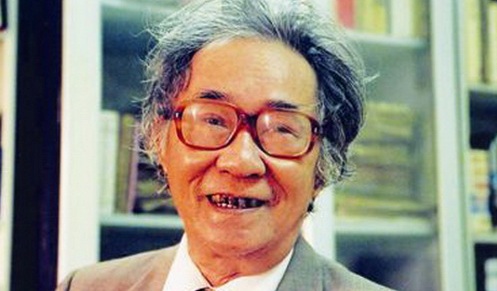
However, whenever Professor came to work in the archives, we young staff members would try to get close to him to listen to him talk about all sorts of things. His stories were like an "encyclopedia," so they were very captivating and fascinating to us at the time. Later, I learned that he had previously been a "teaching staff member" of the department, but due to some incident, he (along with Professor Cao Xuan Hao) had to switch to being a "documentation officer" and could no longer teach in class. Gradually, we also learned that he was actually Nhu Thanh, a famous translator of that era. And it wasn't until the 2000s, when I was tasked with researching the history of the Linguistics Department of the Faculty of Literature in particular and of Hanoi University in general, that I learned he was the first Head of the Linguistics Department (for two years) of the Faculty of Literature when Hanoi University was established in 1956.
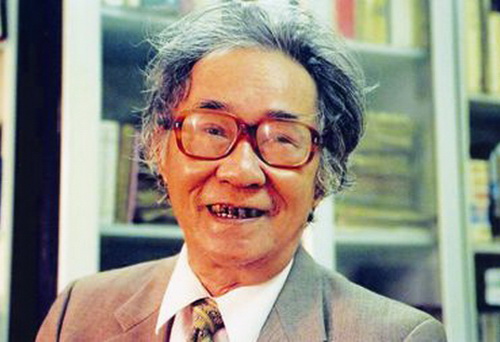
Associate Professor Phan Ngoc was the first Head of the Linguistics Department (for two years) of the Faculty of Literature when Hanoi University was established in 1956.
Perhaps the brief things I've just told about Professor Phan Ngoc are unknown to only a few people, just like I was before. Later, from 1980 onwards, when he transferred to work at the Institute of Southeast Asian Studies... Vietnam Academy of Social SciencesdWhen Professor Pham Duc Duong was in charge, his position was that of a "senior specialist." The research works he published during this period included:Language exposure in Southeast Asia1983,Exploring Nguyen Du's style in The Tale of Kieu1985,Vietnamese culture, a new approach.1994,Vietnamese cultural identity1998,An examination of cultural studies - Literature through linguistics.The year 2000 and many other works were enthusiastically received by readers. The year2000Among those works, two were gifted by the Vietnamese State.State Award Regarding science and technology.
For myself, I have a few memories of Professor Phan Ngoc that will stay with me for life. Here, I would like to recount just one impressive memory about his profound knowledge and enthusiasm for historical linguistics. In 1979, I enrolled in the first cohort of the Candidate of Sciences (now Doctorate) program at Hanoi University. A group of three professors supervised my doctoral research, with Professor Nguyen Tai Can as the overall supervisor and thesis advisor. Because my thesis topic related to historical phonology, Professor Nguyen Tai Can asked me to seek guidance from many professors, including Professor Phan Ngoc, to learn more about this field. Therefore, I visited his small house on Bui Thi Xuan Street countless times to ask him about the history of Vietnamese phonology in the work of H. Maspero, which he had translated from French using a handwritten copy in the archives of the Faculty of Linguistics. Back then, in the field of historical phonology, there were virtually no written materials in Vietnamese. Professor Phan Ngoc wholeheartedly and enthusiastically guided me through many difficult points in H. Maspero's work. Perhaps, without his dedicated assistance, writing the part of my dissertation related to the historical phonology of the Vietnamese language would have been incredibly difficult.
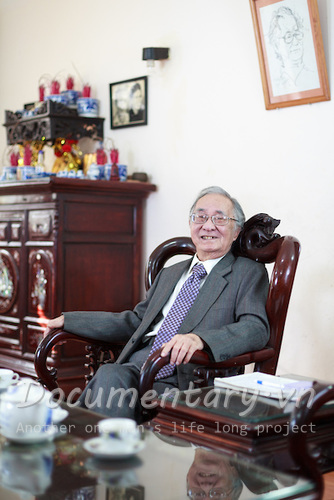
Photo: Jackie Chan
It wasn't until 2011 that I had the opportunity to visit him again. That day, November 19th, after the Department of Linguistics had finished its celebratory gathering for the faculty members, I asked Associate Professor Dr. Nguyen Van Chinh, then the Vice Dean of the Department of Linguistics, to drive me to visit Professor Ngoc. That day, after having a drink and inquiring about their health, I noticed that he seemed very happy, so I boldly told him:
- Teacher, it's been a long time since we last had the opportunity to visit you. We have a few "anecdotes" about you that we would like you and your wife to explain in detail.
The teacher smiled and asked me in return:
Okay. But what is it that you're so curious to know?
- Sir, I'd like to ask you a few stories about you that I've only heard from others, but I don't know the truth of them. As you know, the Linguistics Department of Hanoi University used to have many "extraordinary" foreign language experts like Professor Hao, Professor Can, etc. We, your descendants, admire you for your ability to use the foreign languages you knew. Besides Chinese and French, which you learned at school, other languages like Russian, English, Italian, Greek, and German were self-taught. So, how did you self-study to achieve such results?
- Well, saying I learned it on my own is both true and not entirely accurate. It was thanks to the "guidance" of my father. When he was working in Hue, instead of sending me to the National School, he sent me to study at a Catholic school there. According to him, attending a Catholic school provided the opportunity to learn Latin. As a linguist and historian, he surely knew how important Latin was to Western languages. Thanks to seven years of studying Latin at the Catholic school in Hue, along with my linguistic knowledge, I was able to "self-learn" languages that weren't taught in school. That's the key to my ability to use various Latin-based languages, sir.
But Latin is very difficult to learn, isn't it, teacher?
- It's difficult, but even though it's difficult, I have to learn it because foreign languages are the "key" to unlocking the world. My grandfather chose and guided me to strive for this.
After hearing the teacher's explanation, we understood that his foreign language skills were well-deserved and due to his own efforts. Then I continued to ask him about another concern:
- Sir, we know your pen name, and the name you use in some of your translations, is Nhữ Thành. We heard that the name Nhữ Thành, combined with your name Ngọc, creates a very profound meaning?
- I want to tell you that the name Nhữ Thành that I use was given to me by my grandfather, not by me. I'm sure that when he chose this name for me, he was subtly reminding me of something. That name is a shortened version of an ancient saying with a historical anecdote, used to offer advice. I use that name to obey my grandfather's admonition.
- Sir, do you remember the exact wording of that "anecdote"?
- At this age (he was 86 at the time) and even now, I don't remember everything. But I still remember one part of the proverb used to spell out the name Nhữ Thành that my grandfather chose for me. The Sino-Vietnamese pronunciation is "Bần tiện ưu thích, dung ngọc nhữ vu thành dã". If you research the meaning of the whole proverb, you'll understand my grandfather's intention when naming me.
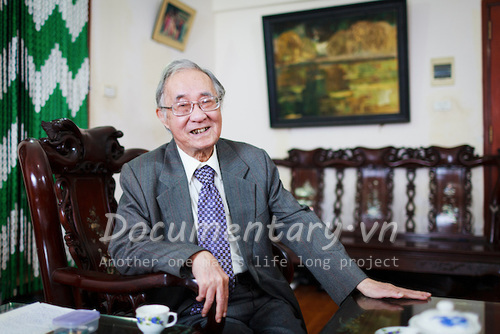
Photo: Jackie Chan
I transcribed the Sino-Vietnamese pronunciation of the sentence the teacher read, and when I got home, I looked up the original Chinese text of the sentence.Poverty is preferred, jade is found in the wilderness." (貧 贱 懮 戚 鄘 玉 汝 于 成 也) then I sent an email to Mr. Pham Anh Sao to check if those Chinese characters were correct according to the Sino-Vietnamese pronunciation. After that, I asked Mr. Dinh Thanh Hieu (whom we Literature students call the "expert" on Chinese allusions), a lecturer in the Sino-Vietnamese Studies department of the Faculty of Literature, to help me interpret and trace the origin of that sentence. Mr. Hieu told me that the full sentence in the poem "Tay Minh" by the great scholar Truong Tai of the Song dynasty was:富 貴 福 澤 天 厚 吾 之 生 也,貧 贱 懮 戚 鄘 玉 汝 于 成 也" (Wealth and blessings are bestowed upon me by Heaven; poverty and hardship are bestowed upon you by your beauty and grace."Wealth and blessings are a gift from heaven to our lives; poverty and sorrow are meant to refine us into jade." Thus, the title "Nhữ Thành" that Mr. Phan Võ chose for Teacher Phan Ngọc encapsulates all the "gains and losses" in his life. And in real life, Teacher Phan Ngọc overcame all the "poverty and desires" to "become jade from humble beginnings."
On May 29, 2015, while at lecture hall number 19, Le Thanh Tong Street, to celebrate Professor Ha Minh Duc's 80th birthday, Mr. Tran Hinh mentioned that the university wanted him to write about his memories of Professor Phan Ngoc, but he had already written what he knew about him. He hoped that "linguists" like me, if we knew anything more about Professor Phan Ngoc, would write it down for the university. To be honest, when it comes to writing about memories of our former Faculty of Literature, many of us are both very knowledgeable and talented writers; I, on the other hand, know little and lack the knack for writing. Thanks to a few memories of Professor Phan Ngoc like the ones above, I would like to record a few lines to congratulate him on his 90th birthday.
Hanoi, June 4, 2015
|
ASSOCIATE PROFESSOR PHAN NGOC
+ Workplace: Faculty of Literature, Hanoi University. + Management position: First Head of the Department of Linguistics (Faculty of Literature, Hanoi University) (1956-1958).
Language exposure in Southeast Asia, 1983 (co-authored). Exploring Nguyen Du's style in The Tale of Kieu, 1985. Tips for explaining Sino-Vietnamese words, 1991. Vietnamese culture and a new approach., 1994. Literature viewed from a cultural perspective.. How to interpret literature using linguistics., 1995.
+ State Award for Science and Technology in 2000 for a group of works on Vietnamese culture, includingVietnamese culture, a new approach.(1994) andExploring Nguyen Du's style in The Tale of Kieu (1985). |
Author:Prof. Dr. Tran Tri Doi

