
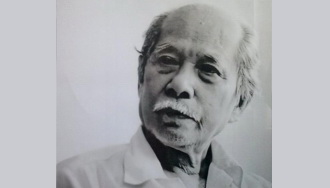
Another unique aspect, compared to some of his contemporaries who received formal training (Dang Thai Mai, Nguyen Manh Tuong, Tran Duc Thao, Hoang Xuan Nhi), is that Truong Tuu is considered a professor who completely "rose through the ranks" and was recognized through self-study. Through his writings...Self-confessionAccording to accounts later recorded by Ton Thao Mien and Ha Cong Tai, Truong Tuu recounted that he was born into a poor family (few people know this, they assume he belonged to a middle-class family). His grandfather was a district magistrate but died after only about ten days, and his grandmother took the whole family back to their hometown of Gia Lam to work and support themselves. His father, though quite strict, allowed Truong Tuu to develop freely according to his own wishes. This would have a significant impact on the formation and development of his personality, both in his life and in his scientific pronouncements. In 1927, while in his second year at Hang Than Primary School, Truong Tuu participated in a strike by a group of students from Buoi School demanding that the French authorities release Pham Tat Dac, the author of the poem.Summoning the Water SpiritHe was expelled from school. However, with his intelligence and determination, Truong Tuu soon continued his "self-education" path: he left Hanoi for Hai Phong to learn the lathe trade, and once again, due to his liberal ideas, he was expelled. Returning to Hanoi, Truong Tuu and some friends formed a self-study group and completed the French baccalaureate program a few years later. From 1941 to 1946, Truong Tuu served as the Literary Director of Han Thuyen Publishing House, from where some of his scientific works, along with those of other scientists such as Dang Thai Mai and Cao Huy Dinh, were published. During the resistance war against the French, Truong Tuu was a member of the Vietnam Cultural Association, Vice-Chairman of the Thanh Hoa Cultural Association, participated as secretary of the resistance arts and culture federation in Zone IV, taught at the Cadet School, and later at the preparatory university, the predecessor of the University of Literature, where he was officially appointed professor in 1957 but was later dismissed…

Professor Truong Tuu (1913 - 1999)
Perhaps, if he hadn't faced the "storms" of life, Truong Tuu would have made even more contributions to teaching and scientific research. An unexpected event transformed him from a teacher, journalist, and writer into a physician for nearly 40 years, from 1959 until his death in 1999. After leaving teaching, Truong Tuu quietly returned to his family home on Hang Ga Street, self-taught in medicine, treating patients and saving himself. He passed away on August 16, 1999, leaving behind much sorrow for his colleagues and generations of Literature students from both the University of Hanoi and the University of Education. After his death, especially after 1986 when the country underwent reforms, many scientists, including his students and admirers, have undertaken activities to reaffirm the contributions of the dedicated professor Truong Tuu. Thousands of his writings have been reprinted. Two scientific seminars on him, organized by Hanoi Pedagogical University and the Vietnam Writers Association in 2008 and 2013, aimed to highlight both the contributions and limitations of Professor Truong Tuu to the country's social sciences. In 2014, Professor Truong Tuu was awarded a prize by the Hanoi Association of Literature and Arts.Lifetime Achievementfor his immense contributions to science.
How can we accurately and objectively assess the life and career of Professor Truong Tuu after a long period of neglect and even misunderstanding? First, it can be affirmed that, in terms of his character, according to some recent researchers, Truong Tuu was a dedicated and honest educator, journalist, and writer. What is particularly noteworthy is that his vast knowledge was largely accumulated through self-study and hard work, so sometimes his scientific pronouncements were not easily accepted by many contemporaries. However, it cannot be denied that, in any field, Truong Tuu lived life to the fullest, with a natural and enthusiastic spirit, in his roles as a citizen, writer, educator, and scientist. In just over 25 years, from 1931 to 1956, Truong Tuu left behind thousands of pages of writings in various fields (literature, culture, philosophy, history); He is also a writer (with dozens of published works such as...)A soldier-1938,When the bib falls down– 1939,When people are hungry– 1940,A double collar– 1940…), a fervent social activist dedicated to the common progress of the nation. Some of his students, including Professor Ha Minh Duc, Professor Nguyen Dinh Chu, Professor Dang Thanh Le, and Professor Nguyen Van Hoan, recount that even now, after many decades, they still vividly remember Professor Truong Tuu's resounding and enthusiastic lecturing voice. Regarding Truong Tuu's literary career, Nguyen Vy, a contemporary, said: “Truong Tuu belonged to the self-taught type of writer, thanks to extensive reading. Perhaps partly due to the training at the Polytechnic School, and also possessing innate literary talent, his reasoning was very sharp, his sentences like hammers and pliers. His words rang out like the sound of iron being hammered on an anvil. Always fiery, jarring to the ear.” Others commented that Truong Tuu's writing was somewhat dry (Phong Le). Truong Tuu himself...Self-confessionHe also admitted that he lacked talent in fiction. His most significant contributions probably lie primarily in scholarly works, research, and literary criticism, not only in the field of literature but also extending to philosophy, history, and culture. From 2003 to 2014, researchers Trinh Ba Dinh and Nguyen Huu Son collected, selected, and introduced three works considered to be Truong Tuu's most representative:Truong Tuu - Collection of Research and Criticism, Labor Publishing House, 2007;Truong Tuu - Collection of Prose, Labor Publishing House, 2009; Truong Tuu - Selected Works on Cultural Studies, Literature Publishing House, 2013. In particular, the two books on research and criticism have relatively fully shown both the strengths and weaknesses of Truong Tuu in his research career.

Assessments of Truong Tuu in the fields of research and criticism, to be fair, have not yet reached a completely unified consensus. Some argue that his applications in Vietnamese literary criticism, especially in the critique of The Tale of Kieu, were "hasty and extreme." Others believe that at the time Truong Tuu applied his "scientific approach to criticism" (which he adopted from many modern Western schools of thought such as Positivism, Psychoanalysis, and even Marxism), it was somewhat "crude," even "shocking." However, given that the social sciences in Vietnam were still in their nascent stages, it cannot be denied that Truong Tuu's innovative explorations brought a breath of fresh air. Professor Nguyen Van Trung, a researcher in the South before 1975, commented that the critical and research style of Truong Tuu - Nguyen Bach Khoa affirmed this: "Nguyen Bach Khoa was the first and only person to present a clear critical concept and apply it systematically, with a captivating writing style. Without considering whether the Marxist critical concept is correct or not, just considering the theoretical aspect and writing it systematically, it must be acknowledged that Nguyen Bach Khoa was more successful than all the critics before him and currently (i.e., in 1968, the time Nguyen Van Trung wrote this article) (A Brief Survey of Literature, 1972)."
A truly accurate and fair assessment of Professor Truong Tuu's contributions would certainly require more opinions and time. But for now, we, the generation of teachers and students of the Faculty of Literature, Hanoi University, have every right to be proud of him, the professor who "achieved success through hard work" during a time of "glory and bitterness".
|
PROFESSOR TRUONG TUU
Philosophy of Truyện Kiều, published in the East-West Weekly, 1931. My pen experiments, Dai Dong Bookstore, Hanoi, 1938. Vietnamese Book of Poetry, Han Thuyen, 1940. Nguyen Du and The Tale of Kieu, Han Thuyen, 1944. The psychology and ideology of Nguyen Cong Tru, Han Thuyen, 1944. The future of Vietnamese arts and culture, Han Thuyen, 1945. The Tale of Kieu and the era of Nguyen Du, 1956.
|
Author:Tran Hinh

