Attending the opening ceremony, on the side of the peer quality assessment expert team were Dr. Pham Van Thuan, Vice Rector of the University of Education, VNU Hanoi, as the team leader; Ms. Vu Thi Mai Anh, from the Institute for Quality Assurance, as the team secretary; and Dr. To Thi Thu Huong as a member.
Representing the University of Social Sciences and Humanities, Vietnam National University, Hanoi, were Assoc. Prof. Dr. Tran Thi Minh Hoa, Vice Rector of the University and Vice Chairperson of the Management Science Program Evaluation Council; also present were representatives from various functional departments within the university and faculty members from the Faculty of Management Science.

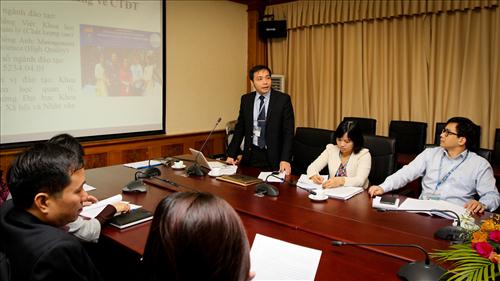
Associate Professor Tran Thi Minh Hoa, Vice Rector of the University and Vice Chairperson of the Management Science Program Evaluation Council, is delivering the opening speech for the program.
Quality assurance of training units is an urgent requirement in the process of international cooperation and is an important task that VNU has set for its member units, aiming to both comply with legal regulations and demonstrate the responsibility of training units to society.
The purpose of the self-assessment of training program quality is to evaluate the extent to which training programs at all levels meet the Accreditation Standards for Training Programs stipulated by the Vietnam National University. This aims to assess the current state of quality, improve and enhance the quality of training programs, and prepare for accreditation applications.
In June 2015, the University of Social Sciences and Humanities, Vietnam National University, Hanoi, issued a decision on the establishment of the "Self-Assessment Council for the High-Quality Bachelor's Program in Management Science" with 17 members. To implement the self-assessment plan, the Faculty of Management Science developed a very detailed plan and held a faculty-wide meeting to disseminate the plan and assign clear tasks to specialized teams.
This activity has attracted widespread attention from all leaders, lecturers, and students in the Faculty. Through this, faculty members and students in the Faculty have become more aware and responsible for ensuring educational quality in the performance of their assigned tasks, contributing to improving the effectiveness of work, the position, and the responsibility of the Faculty towards students and society.
In her opening remarks, Associate Professor Tran Thi Minh Hoa, Vice Rector of the University and Vice Chairperson of the Management Science Program Evaluation Council, emphasized: The University of Social Sciences and Humanities, Vietnam National University, Hanoi, is a prestigious university with a long tradition. For many years, the University has consistently been a leading unit within Vietnam National University, Hanoi, in quality accreditation and self-accreditation.
The university itself agrees that participating in accreditation allows us to identify our current position, our strengths, and our weaknesses, thereby proposing directions and solutions to improve the quality of education, ensure the best learning and research environment, and ultimately become a research university in the future.
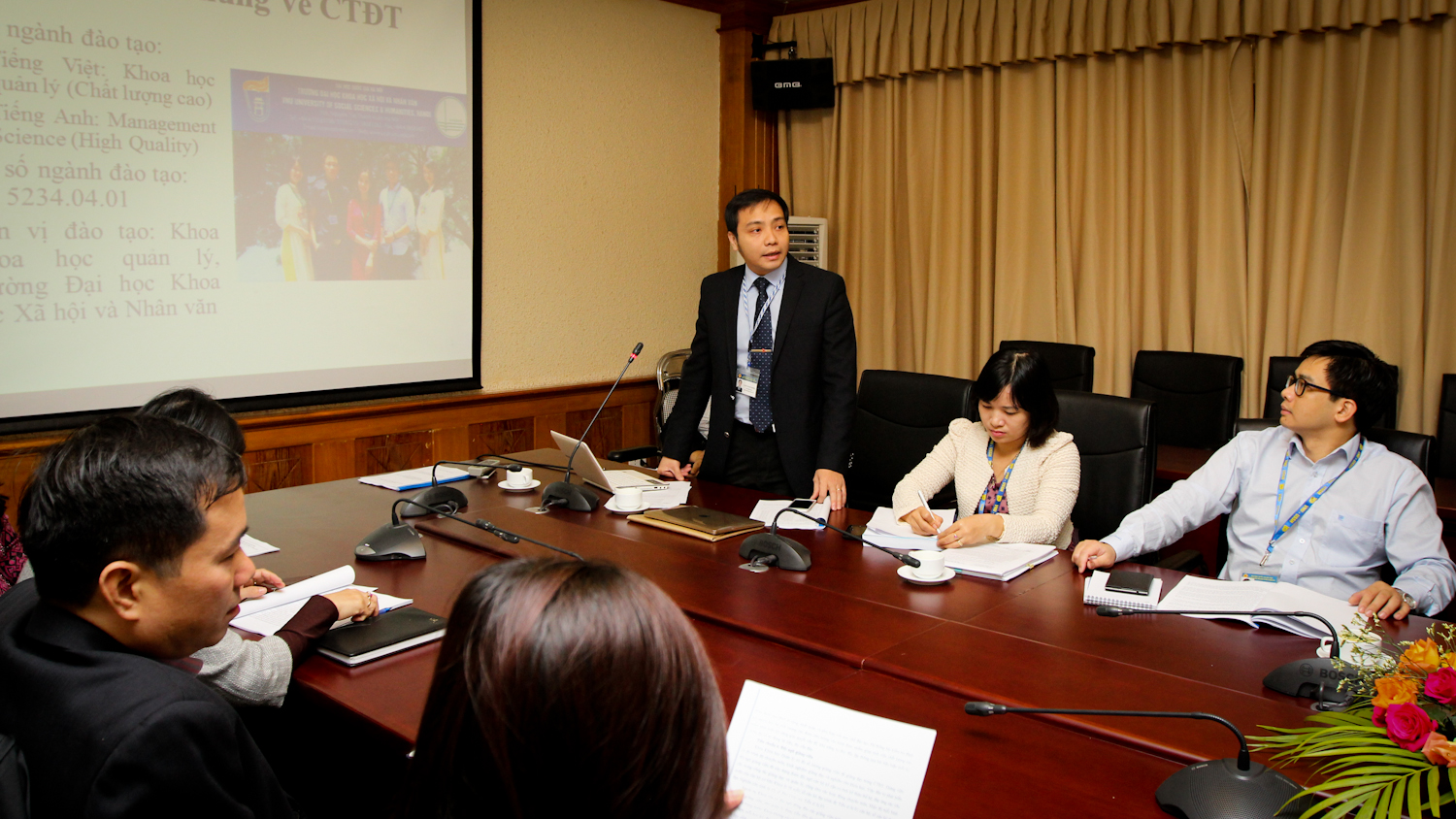
Dr. Dao Thanh Truong, Head of the Faculty of Management Science, is presenting his report.
Following the opening remarks, Dr. Dao Thanh Truong, Head of the Faculty of Management Science, on behalf of the faculty, staff, and students of the department, presented a summary of the evaluation report on the high-quality Bachelor of Management Science program.
Following the opening session, in the morning, the evaluation team will conduct an assessment of the evidence at the Faculty and organize interviews. The peer review program for the high-quality Bachelor of Management Science program is expected to take place over two days, from December 15th to 16th, 2015.
|
Some fundamental strengths of the high-quality Management Science program. 1. Training program and training program learning outcomes. The Faculty of Management Science has developed a training program that aligns with the overall situation of the University and Vietnam National University, Hanoi. The program differs from the standard Management Science curriculum by adding several management-related courses: game theory, geopolitics, etc.; requiring a B2 certificate or equivalent in foreign language proficiency; students defending their theses in English; and mandating scientific research (a prerequisite for completing a thesis)... The program design is based on modern educational philosophies, referencing the content of management science training programs in countries around the world, as well as the results of surveys on social needs, reflected in feedback from final-year students, alumni, lecturers, experts, and employers, in accordance with management practices in Vietnam. The knowledge blocks, number of modules, and study schedule are reasonably allocated. The faculty aims to increase the time allocated to specialized subjects. The department has made the training program and program description publicly available through various information channels, creating convenience for students, academic advisors, and training managers in their use. The program offers a high degree of articulation from bachelor's to master's level. The learning outcomes of the entire training program and the learning outcomes of each specific module are easily measurable in terms of knowledge, skills, and attitudes, helping learners to orient their learning development as well as their ability to change careers in the future or continue pursuing lifelong learning goals, meeting the needs of society and the learners themselves. 2. Teaching and learning strategies The teaching and learning strategy is clearly defined in terms of philosophy, from students to faculty; innovative teaching methods…create a high level of interaction between students and faculty. The learning environment fosters student initiative and promotes consensus throughout the faculty. The teaching staff for the program are well-trained, highly qualified professionals (mostly PhDs, Associate Professors, and Professors) with pedagogical and international teaching experience, proficient in advanced teaching and assessment methods; and must also be experts to inspire students to identify and solve problems, think creatively, and think critically.
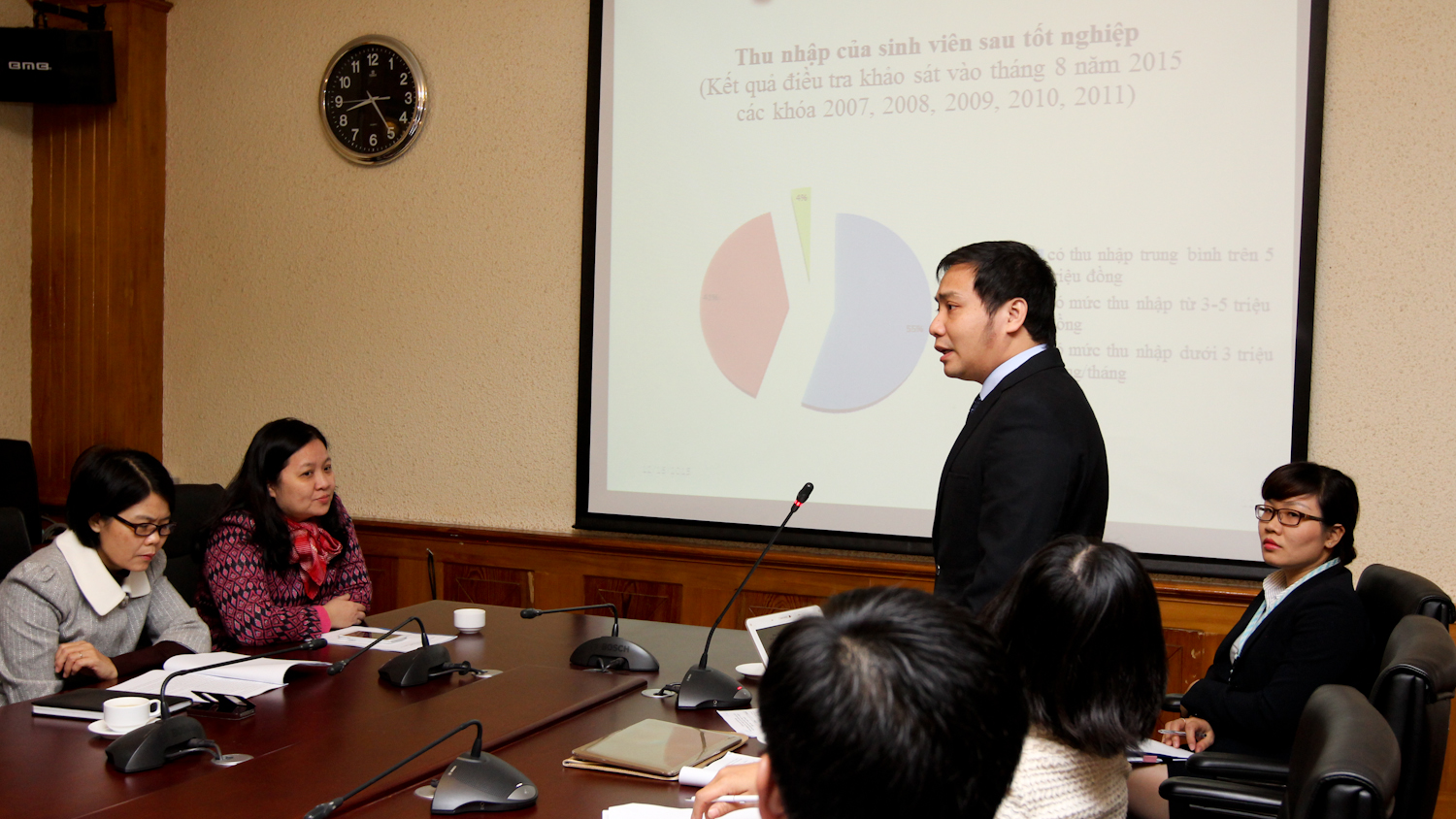
Dr. Dao Thanh Truong is presenting on the topic of student income after graduation. 3. Scientific research The scientific research achievements of the faculty members in the department are commensurate with a high-quality training unit. Several state-level scientific projects, protocols, ministerial-level projects, and VNU-level projects have been and are being implemented. The Faculty Party Committee has passed a resolution stating that each lecturer in the faculty must have a publication in an ISSN journal (a higher requirement than the University's standard) and each lecturer must teach 2-3 courses within the faculty's curriculum. 4. Learners and learner advisors The student intake is well-selected, not only from applicants who directly apply to the department but also from students in other departments within the university. 100 students from the high-quality program found employment after graduation. The training of high-quality programs always receives the attention and consensus of the entire faculty. The faculty has assigned a team of enthusiastic, responsible, experienced, and foreign-language-proficient academic advisors to be in charge of the high-quality classes. Extracurricular activities are always given priority. The school and faculty always prioritize gathering feedback from stakeholders to design, develop, and adjust training programs, improve the quality of courses, and ensure alignment between training and employment. |
Author:Dinh Hau
Newer news
Older news