In the 2011-2012 academic year, the University of Social Sciences and Humanities continued to make new strides in all aspects of its work. Regular activities related to undergraduate and postgraduate training, international cooperation, training inspection, and quality accreditation were carried out according to plan and regulations. Scientific research and international cooperation continued to expand and are forming new directions and opportunities. The training of staff was emphasized. The University continued to affirm its position within the structure of the Vietnam National University, Hanoi and in the higher education system. The following are the basic results.
University education: the number of students graduating early in the 2008-2009 cohort increased fivefold.
Regarding curriculum development and learning materials, the University completed the adjustment of 22 curricula according to output standards, completed the project to develop the Southeast Asian Studies and Public Relations majors, implemented the project to develop the high-quality Psychology major, completed 6 projects under the pilot scheme of a new financial mechanism for basic science majors of Vietnam National University, Hanoi, and made adjustments to the component project of the Linguistics major under the high-quality program to better suit the actual conditions and objectives of the project. The learning materials system has been effectively invested in with the acceptance of 47 course materials, 83 course guidebooks, 21 lectures, 9 textbooks, and 12 translated materials; published 40 books, textbooks, and reference materials; and signed 14 new contracts for compiling lectures, textbooks, and translated materials. Contributing positively to the in-depth development of credit-based training, the University of Social Sciences and Humanities has made innovations in teaching methods: implementing four pilot courses with lecturers selected for 52 classes, and piloting the use of course websites in teaching for 25 courses. In particular, the use of course websites to increase interaction between teachers and students has initially received positive feedback from both lecturers and students, opening up prospects for application on a university-wide scale. For the first time, a course on "Course Design and Teaching Methods," jointly organized by experts from the Singapore International Foundation, helped enhance the professional skills of 45 young lecturers.

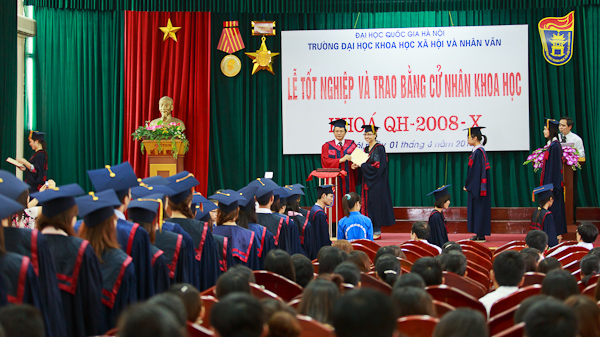
Regarding the organization and management of training, the QH-2008-X cohort had 89 students in Management Science, 62 students in Library and Information Science, and 21 students in Philosophy graduating one semester early. This number increased fivefold compared to the number of students graduating early in the QH-2007-X cohort. This is a positive sign reflecting students' adaptation to the credit-based training method, enabling them to find the best learning path in their individual circumstances.
Postgraduate training: nearly 30% increase in master's degree enrollment.
In 2011-2012, the University organized two postgraduate admissions rounds with 842 postgraduate students, including 4 students in the NVCL program and 10 foreign students; and 59 doctoral candidates, including 4 in the NVCL program and 1 foreign doctoral candidate. Compared to the previous academic year, the enrollment scale for master's degree programs increased by nearly 30%. The total number of postgraduate students accounted for approximately 35% of the regular undergraduate students. The training and assessment process is gradually becoming more organized, better meeting the requirements of the credit-based training method. Last academic year, the University successfully defended the theses of 453 postgraduate students who met the output standards and were recognized as graduates; and successfully defended the dissertations and proposed that the Vietnam National University, Hanoi, award doctoral degrees to 30 doctoral candidates, including 5 foreign doctoral candidates. Postgraduate training programs are increasingly being improved in terms of interconnectedness, collaboration, meeting social needs, and high integration. The university has adjusted 53 postgraduate programs according to output standards, integrating and adjusting the names of some programs according to the new industry codes of the Ministry of Education and Training. Currently, the university has 55 postgraduate programs in various disciplines, including 2 specialized programs. Three postgraduate programs are currently under evaluation and awaiting approval by the Vietnam National University, Hanoi (Master's programs in Anthropology, Film Arts, and Aesthetics); and six other programs are under development (Doctorate programs in Religious Studies, Doctorate in Science and Technology Management, Master's programs in Vietnamese Cultural History, Master's programs in Chinese Studies, Master's programs in Office Management, and Master's programs in Clinical Psychology). The university has signed 12 contracts for the compilation of lectures, textbooks, and translated materials, and has organized the evaluation of 5 lectures, textbooks, and translated materials.
Scientific research: 05 educators receive the prestigious State Award for Science and Technology.
This is one of the areas of activity with outstanding achievements in the past academic year. Promoting a proactive and independent approach, the University has collaborated with relevant agencies and partners to propose and implement numerous research projects for staff and students. Therefore, the funding and the system of scientific activities of the University are diverse and abundant. In the 2011-2012 academic year, 61 research projects at various levels were completed, with 72.2% achieving a good rating. Currently, the University is implementing 2 state-level projects, 10 projects funded by the National Science and Technology Fund, and 71 other projects. The University organizes a scientific conference for young staff, creating conditions and encouraging young staff with master's degrees or higher to register for Group A and B projects of the Vietnam National University, Hanoi and the National Science and Technology Fund. 100% of the basic-level projects for young staff are doctoral candidates and postgraduate students. The university published 685 articles in scientific journals and presented reports at scientific conferences, including 21 scientific reports published in international scientific journals. There were 26 conferences and seminars, including 17 international scientific conferences and seminars, many of which were interdisciplinary and highly specialized, such as: New research directions on Southeast Asia, Contributions of socio-political organizations in policy making, Regional integration: EU and ASEAN perspectives, Cultural exchange between Vietnam and East Asia: viewed from a socio-historical and anthropological perspective, Environmental journalism, etc. Student research continued to be maintained and developed, with 18% of the university's students participating in research, producing 706 student research reports. In 2011, the university had 2 projects that won the "Young Scientific Talent" award from the Ministry of Education and Training; and 8 projects that won the Student Research Award from Vietnam National University, Hanoi.

One of the outstanding achievements of the University of Social Sciences and Humanities in the past academic year was the awarding of prestigious State prizes for science and technology to five faculty members. These faculty members are: the late Professor Tran Quoc Vuong - Ho Chi Minh Prize - for his work "Vietnamese Culture - Tradition and Modernity", Professor Ha Minh Duc - Ho Chi Minh Prize - for his work "Ho Chi Minh's Literary and Journalistic Career and Some Theoretical and Practical Issues of Vietnamese Culture and Arts", Professor Doan Thien Thuat - State Prize - for his work "Vietnamese Phonetics", Associate Professor Dr. Nguyen Thua Hi - State Prize - for his work "Thang Long - Hanoi in the 17th, 18th, and 19th Centuries", and Professor Dr. Nguyen Thien Giap - State Prize - for his work "Words and Lexicology of the Vietnamese Language". This is a significant recognition from the Party and the State for the contributions of generations of teachers and scientists of the University of Social Sciences and Humanities to the cause of science and education, and the building and development of the country.
Organization and Personnel: Improve the training and development of personnel.
Aiming to build and develop a qualified staff, the training and professional development of staff in the past academic year was highly valued and yielded encouraging results. 170 staff members were sent abroad for study, research, and teaching, an increase of 35%. The number of staff pursuing postgraduate studies reached its highest level ever. As of May 2012, the university had 150 doctoral candidates and 50 staff members pursuing master's degrees both domestically and internationally. Over 70% of lecturers are proficient in English for teaching and research, and 16% are proficient in other foreign languages. The university sent 402 staff members for training and professional development in various fields. Regarding the implementation of national development tasks, the university sent 4 lecturers from the History and Linguistics Departments for professional development and English language proficiency training in the United States and Australia; and opened an advanced English course for staff members of the Linguistics Department. In addition, the internal spending regulations have been adjusted to encourage employees, especially young staff members, to improve their skills and qualifications through work and study. During the past academic year, 11 staff members successfully defended their doctoral dissertations, and 2 lecturers were recognized as Associate Professors.
Political and ideological work and student affairs: innovation in many activities.
Political and ideological education has been effectively implemented, with many diverse and innovative activities. The school continues to implement phase 2 of the "Studying and Following the Moral Example of Ho Chi Minh" campaign and other student campaigns through various lively and practical forms; democratic regulations are implemented through dialogues between school leaders and students of all courses, with over 500 students participating. Many volunteer and charitable activities are organized, and commemorative activities for major holidays are held solemnly and effectively. The school organized a Party awareness training course for 272 outstanding union members, including staff and students, and admitted 54 new Party members. Student affairs also yielded good results: social policies and healthcare for students are well implemented; career counseling, job placement surveys for graduates, and job search opportunities for students are regularly emphasized. The student database login process was completed promptly.

404 full-time students, 3 postgraduate students, and 30 part-time students were awarded for their academic achievements, work performance, and overcoming difficulties to excel in their studies; 161 students and young staff members were recognized as Outstanding Young Faces at the University level, including 11 students and 4 staff members recognized as Outstanding Young Faces at the Vietnam National University, Hanoi level. The University actively collaborated with businesses to organize internships for students; introduced graduating students to organizations and businesses for recruitment; announced the list of students expected to graduate in 2012 so that localities could proactively plan for recruitment; and coordinated and successfully implemented the 2012 university admissions counseling day organized by the Ministry of Education and Training and Tuoi Tre Newspaper.
Foreign relations and international training cooperation: bringing the total number of signed international cooperation agreements to 152.
In the 2011-2012 academic year, the University continued to sign 10 new cooperation agreements and 2 more cooperation agreements with foreign universities, bringing the total number of cooperation agreements signed with foreign partners to 152. The University organized and implemented international programs and projects funded by various foundations such as: the Project to Support the Development of the Anthropology Department, the Anthropology Research Project, the Project to Develop Doctoral Programs and Enhance Teaching and Research Capacity in Anthropology, the Project on Researching Vietnamese Education Policy, the Project to Enhance Teaching Capacity in European Studies in Vietnam, the Project to Develop the International Studies Department (Phase 2), the Project on Course Design and Teaching Methods (funded by SIF Foundation, Singapore)... The University welcomed 590 students and 210 international scientists to participate in seminars, scientific exchanges, internships, studies, and research at the University; There were 170 faculty members and 16 students who went abroad for work, scientific exchange, conference attendance, research, and study.

International joint training programs continue to be maintained with short-term programs, "3+1" and "2+2" bachelor's degree joint training programs, and postgraduate joint training programs in the following fields: Child and Adolescent Developmental Psychology, Organizational Management, Hotel Management, and Science and Technology Management.
Quality assurance: conducting internal assessments according to AUN standards.
For many years, the University of Social Sciences and Humanities has been a leading institution within the Vietnam National University, Hanoi (VNU) in quality assurance. The university continues to conduct external evaluations of the Tourism Studies program, the Oriental Studies program, and has completed the draft self-assessment report for the Archival Studies and Office Management programs. Notably, for the first time, the university conducted an internal evaluation of the Linguistics program according to the standards of the ASEAN University Network (AUN). In addition, the evaluation results of lecturers' teaching showed positive progress: the quality of course organization and implementation, course syllabuses, lecturer teaching activities, and the university's assessment activities have all shown significant improvement. Specifically: The quality of course organization in the first semester of the 2011-2012 academic year reached 4.04/5 compared to 3.82/5 in the second semester of the 2010-2011 academic year. The general course curriculum showed significant progress, achieving a score of 4.25/5, compared to 4.05/5 in the second semester of the 2010-2011 academic year. The course curriculum was highly rated, scoring 4.25/5 compared to 4.05 in the second semester of the 2010-2011 academic year. Teaching activities were rated well in terms of overall teaching quality, achieving 4.32/5 compared to 4.13/5 in the second semester of the 2010-2011 academic year. Assessment activities also achieved a high score of 4.32/5 compared to 4.09 in the second semester of the 2010-2011 academic year. The overall average score for teaching quality reached its highest level ever at 4.25/5. The quality of course organization, curriculum, teaching activities, and assessment in the faculties was highly appreciated by students. Typical examples include the History (4.54/5); Philosophy (4.43/5); Information and Library Science (4.33/5); Political Science (4.31/5); International Studies (4.26/5); and Literature (4.23/5). Also in the 2011-2012 academic year, the Academic Advisory and Support Unit (CASA) was established, under the Center for Quality Assurance in Education. CASA's function is to advise students on study skills and career skills, and to support lecturers in improving their teaching capacity.