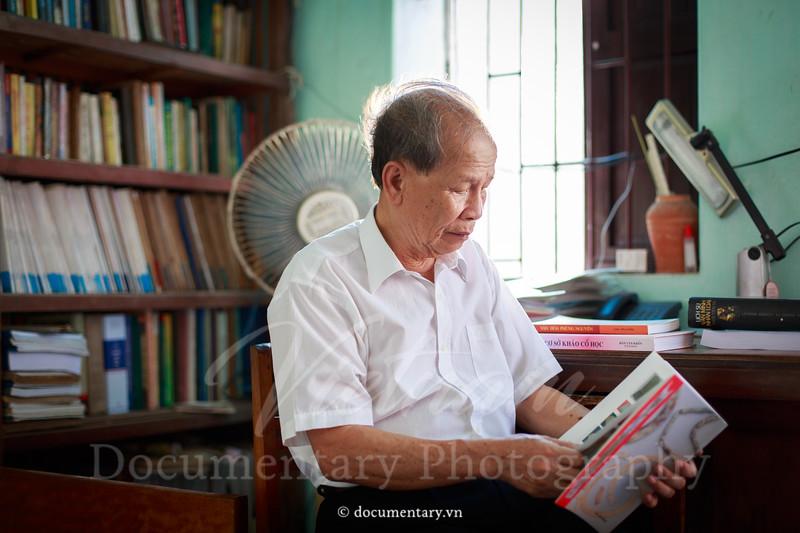
Han Van Khan was one of the first generations of Archaeology students in the Faculty of History at Hanoi University (now the Faculty of History, University of Social Sciences and Humanities, Vietnam National University, Hanoi). Those generations benefited from the intellectual elite of the "founding generation" of scholars such as Tran Van Giau, Dao Duy Anh, and Tran Duc Thao, nurtured and educated by the "four pillars" of the Vietnamese academic community: Dinh Xuan Lam, Phan Huy Le, Ha Van Tan, and Tran Quoc Vuong. Furthermore, having received his doctoral training in the West, Han Van Khan possessed both the sensibility of Vietnamese tradition and the rationality of Western learning. These academic environments formed a crucial foundation for shaping the personality of Han Van Khan later in life.
As an archaeologist, he has conducted fieldwork and excavated numerous archaeological sites in various regions of Vietnam and internationally, from Bulgaria to Vietnam. He traveled from the dome-shaped mounds of the Phung Nguyen, Dong Dau, and Go Mun cultures in the central plains, through the Dong Son cultural sites along the main rivers of the Red River Delta, to the pottery production areas of Hai Duong, and then to the port cities of Pho Hien, Van Don, and Hoi An… His footsteps also stopped at the ancient capital of Co Loa of An Duong Vuong, the village of the two kings of Duong Lam, and the capital of the Ho Dynasty… But his earliest and most intensive work was with the Phung Nguyen culture and the Xom Ren site in his ancestral homeland.
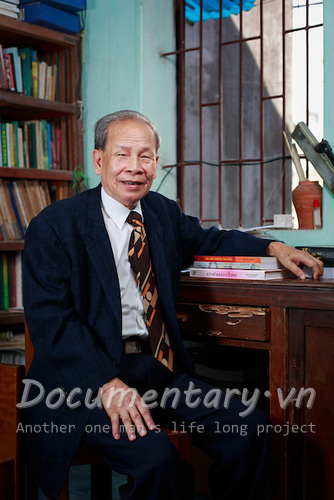
Associate Professor, Doctor, People's Teacher Han Van Khan was the Vice Head of the Faculty of History (1982-1984, 1985-1987), and Head of the Department of Archaeology (Faculty of History) (1992-2009) / Photo: Thanh Long
WithPhung Nguyen cultureAssociate Professor Han Van Khan is considered one of the pioneers who "paved the way" for the research process of the first cultural period of the Metal Age in Northern Vietnam in particular, and contributed to the research of the Hung King period in general. In his articles published in journals...ArcheologyDuring the 1970s and 1980s, he conducted in-depth analysis of many elements in Phung Nguyen culture pottery, such as pattern types, pattern creation experiments, manufacturing techniques, and pottery types. Based on this, he proceeded to divide the Phung Nguyen culture into distinct periods. For the next 40 years, he focused his research on the crucial early period of copper metallurgy. This book...Phung Nguyen cultureThis work was born from the results of extensive and long-term research, which identified the basic characteristics and main developmental stages of the Phung Nguyen culture. It is a work that any researcher of Phung Nguyen culture, both domestically and internationally, should consult before formulating their own research ideas.
With Xóm Rền, just a short distance from his home across a low-lying field – the place that sparked his archaeological curiosity in his youth – he was the first to participate in the excavation and remains the only person to date to have fully summarized the history of this largest Phùng Nguyên cultural site. In his work...Xóm Rền - A particularly important archaeological site of the Bronze Age in Vietnam.Archaeologist Han Van Khan made a tremendous effort in truthfully, profoundly, and objectively summarizing the achievements of excavation and research at the Xom Ren site, placing it within the overall Phung Nguyen cultural process and imbuing it with many novel scientific arguments. Through this, he highlighted the important characteristics of an archaeological site that many domestic and international scientists consider exceptionally rare among the more than 70 Phung Nguyen cultural sites. It witnessed pioneering steps in the copper metallurgy revolution and the exploration of the Red River Delta, giving birth to a famous civilization – the wet rice agricultural civilization. He also demonstrated that the people of Xom Ren brought stone carving techniques to their peak and mastered the potter's wheel technique in pottery making.
Originating from his doctoral dissertation on Bronze Age pottery research in northeastern Bulgaria, archaeologist Han Van Khan has always been deeply engrossed in Vietnamese ceramics and their history, from the patterns and production techniques of prehistoric earthenware to the kiln systems of the historical period. We once witnessed him meticulously piecing together fragments of a pottery piece for days on end, only to erupt in immense joy upon discovering a new pattern he had never encountered before. He was particularly interested in excavating, researching, and determining the ceramic composition of the kiln system at the Chu Dau pottery center through collaboration with the Southeast Asian Ceramics Research Centre of the University of Adelaide (Australia) in the 1990s. Building on this foundation, he also expanded his research to include commercial ceramics and river and coastal port systems in northern Vietnam. This has made significant contributions to the research of ceramics and the history of Vietnamese ceramics.
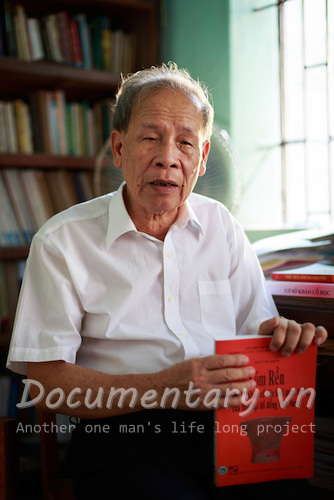
Photo: Jackie Chan
Maritime and island archaeology was also a subject that Associate Professor Han Van Khan began collecting data and researching from the early 1990s. In 1993, he edited the book.History of Vietnam's coastal islandsThis research, part of the State-level project KT03-12, outlined the entire process of human settlement and exploitation during the prehistoric and historical periods on the coastal islands of Vietnam, with particular emphasis on the northeastern coastal region. In recent years, this research idea has been revived by the Department of Archaeology through a workshop.Maritime and Island Archaeology of Vietnam: Potential and Prospects, so that the subject matter can be formed on that foundation of materials.Maritime and Island Archaeologyin the History Department.
As an educator, Professor Han Van Khan was always dedicated and gentle, witty yet serious, wholeheartedly devoted and selfless. Scientific knowledge is boundless, and therefore he always guided us along a straightforward and proper educational path, so that each of us, at different times, could reach a standard level of achievement. He always taught us to distinguish right from wrong and maintain integrity in our relationships, and he always considered this the highest principle of the teacher-student relationship. The image of the "old teacher," at a rare age, often taking us young staff members on excavation practice with students, is an image that remains unforgettable whenever we think of him. Especially when he would still hold the tools and guide each of us novice students on how to properly repair walls and how to excavate the surface to reveal traces of relics, always kind and open, yet with a gentle and witty touch.
The heart and vision of a son for his homeland, the affection and knowledge of an educator for generations of students, the sense of responsibility and shared life of an archaeologist with his colleagues who have accompanied him for the past 50 years, all blend and flourish to form these works:Phung Nguyen culture,Archaeological Foundation,Xóm Rền - A particularly important archaeological site of the Bronze Age in Vietnam....
In him, I received a special favor, a kind of emotional nuance that everyone experiences to some extent in life, but which is difficult to put into words. For a long time, I have always felt a fatherly affection for him, in the truest sense of the word: TEACHER.
In conclusion, I would like to offer my heartfelt gratitude to you, Teacher:
Heart of the Fragrance blended into fertile land,
The ceramic colors blend with exquisite artistry.
Love is understood gently and softly.
The middle path leads to enlightenment.
|
Associate Professor, Doctor, People's Teacher Han Van Khan
+ Department: Faculty of History + Management position: Deputy Head of the Department of History (1982-1984, 1985-1987). Head of the Department of Archaeology (Faculty of History) (1992-2009).
Phung Nguyen culture, National University of Hanoi Publishing House, 2005. Archaeological site (Editor), National University of Hanoi Publishing House, 2008, 2011. Xóm Rền - A particularly important archaeological site of the Bronze Age in Vietnam., National University of Hanoi Publishing House, 2009. Bun-Vietnamese Dictionary (co-authored), 2 volumes, Sofia University Press, Bulgaria.
The Hanoi National University's Outstanding Scientific Work Award in 2009 was given to this work.Xóm Rền - A particularly important archaeological site of the Bronze Age in Vietnam. |
According to the book "Portraits of Outstanding Educators and Scientists 1945-2015" by the University of Social Sciences and Humanities.
Author:Dr. Dang Hong Son

