This time, I went to South Korea to give a guest lecture at Hankuk University of Foreign Studies. During the Covid-19 pandemic outbreak there, I taught almost entirely online for the entire year. The time I had to meet and speak Vietnamese in person with others was very limited.
Perhaps the most striking thing about living abroad is hearing Vietnamese spoken unexpectedly, in the most unexpected places. I've traveled to many countries, and every time I suddenly hear Vietnamese voices around me, my mind focuses on those words and phrases, and I can't think of anything else. Then I suddenly become an "eavesdropper," and I can't help but strike up a conversation.
Around the end of March last year, one afternoon I went to the Daiso store near my school to buy some odds and ends, when I suddenly heard Vietnamese spoken by two young people, around 23-24 years old. "You buy this," "If you want it, buy it," "Why would I buy it?"... About 10 minutes later, I couldn't stand it anymore, so I did something I would never do in Vietnam: I struck up a conversation. "Hello, you two Vietnamese. I'm Vietnamese." After some back and forth, it turned out they were students at the school where I teach. Through conversation, I learned that there are over 100 Vietnamese students at the school.
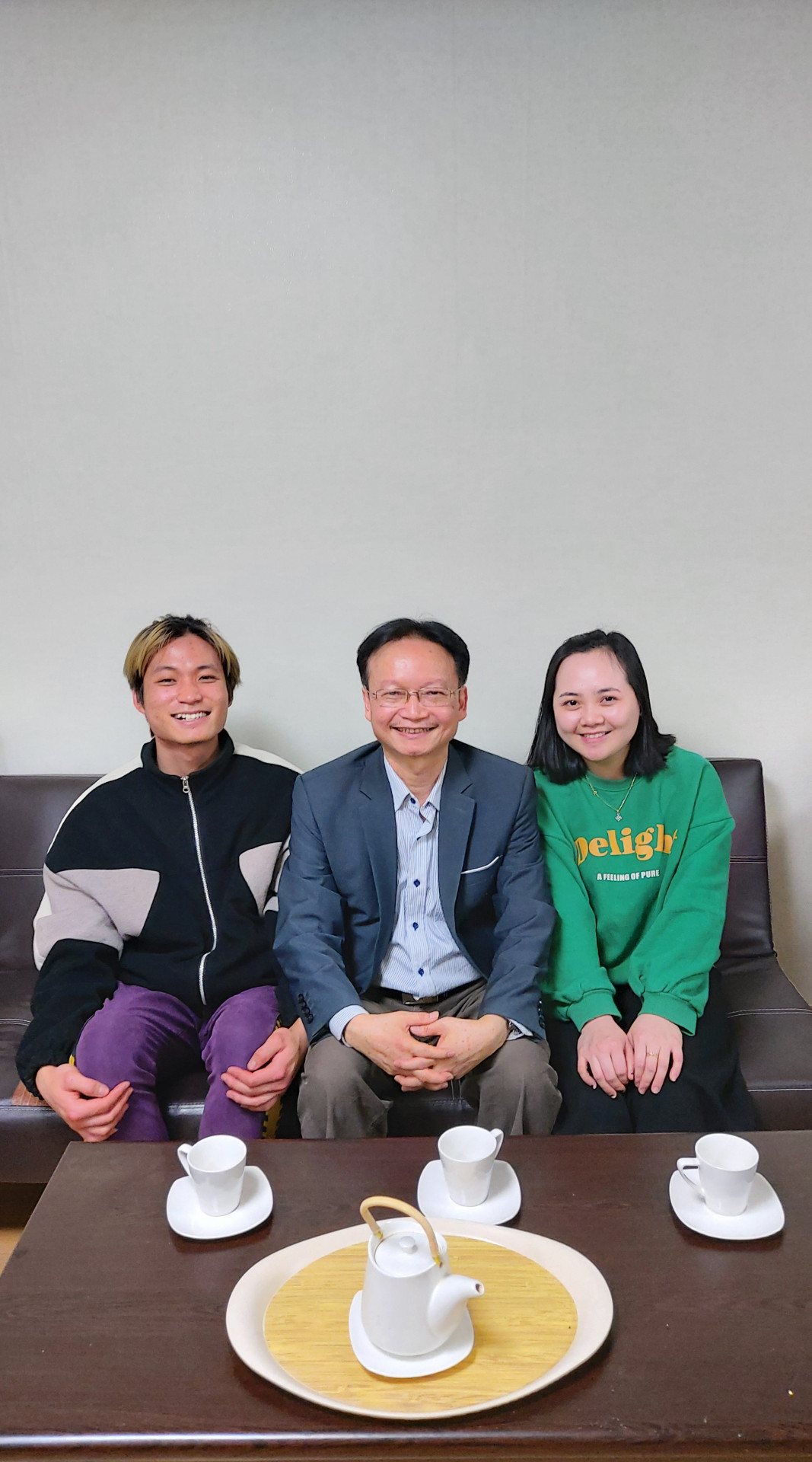 Associate Professor Dr. Nguyen Thien Nam and two students
My niece told my nephew, "Get my contact number, so you can help me if needed." Just a few days later, he took me to buy a bicycle (which I had asked several people for help with, but for a whole month I still didn't know where the bicycle shop was).
One day, while I was at home, my son texted me: "Uncle, can you eat pig's intestines?" "Oh, you're abroad and you're asking that? Of course I can, why?" "Then I'll bring you a treat this afternoon. I'll tell them to order it and have it made." So, at 5 o'clock, he brought me a full plate of intestines, just like in Hanoi, and some pig's intestine porridge too. He said, "I was craving it so much I couldn't resist, so I ordered it online and made it myself, a whole pot!"
Speaking of food, one day I went to Cheongyangni Traditional Market, a fairly famous market in Seoul that sells all kinds of produce, from vegetables and fruits to meat, fish, and even traditional Chinese and Vietnamese medicine... it seemed like they had everything. While strolling around, I happened to see a long row of people selling silkworm pupae, so I immediately bought the smallest bag for 2,000 won (about 40,000 Vietnamese dong) to stir-fry with chives.
That plate of silkworm cocoons brought back a flood of childhood memories. When I was 7 or 8 years old, I lived with my aunt in Thanh Cat, Thanh Chuong, Nghe An. My aunt was a silkworm breeder, raising silkworms and spinning silk. "Farming means eating while lying down, raising silkworms means eating while standing." I still remember that every day, if I had morning classes, I'd go to the fields in the afternoon; if I had afternoon classes, I'd go to the fields in the morning. My aunt assigned me the task of finding a "river of mulberry leaves." I'd go picking mulberry leaves with my friends from the village in the vast mulberry fields along the Lam River. Actually, we were stealing from the cooperative. But the fields were so big that the guards didn't catch us. I also remember one morning picking mulberry leaves in the riverside fields near Cat Dinh village, across the river was Phuong Ky village (Do Luong), when suddenly American planes came and dropped bombs. We had learned from experience that if you looked up and saw a bomb with a shape, it was safe because it was falling far from where you were standing, but if you saw a round shape, it was falling right where you were. I looked up at the sky and saw many circles, so I quickly ran into the village. Bombs had exploded on the other side of Phuong Ky village, and then on the river. Behind me, I could hear the sound of bomb fragments hitting the bamboo stalks along the road, so I ran straight to the fields. That day, Chau, the sister of Chinh from my class, didn't manage to escape in time. Also that day, on the other side of Phuong Ky village, the hero Nguyen Quoc Tri died from a delayed-action magnetic bomb while he was cycling from his house to visit the anti-aircraft artillery position.
Another day, I was passing by Weitei Station near my school (Weitei means Foreign Languages, referring to the station of Hankuk University of Foreign Studies) and saw an old woman selling vegetables along the walkway near the station. In front of her was a pile of young mugwort, and my heart suddenly leaped with joy. I immediately bought some to make mugwort omelets. As I ate, I felt a pang of nostalgia for my hometown.
That's it, when you're far from home, your homeland isn't really anything grand. It's just a Vietnamese greeting, or a taste of memories. But homeland still stirs the hearts of those living abroad, especially during the Lunar New Year. I celebrated five Lunar New Years in Cambodia when I was young, and three in Japan when I was in my 30s and 40s. I understand what homesickness and longing for home feel like during those times. It seems that those living far away understand the value of the Lunar New Year better than those who are at home. I remember when I was in Tokyo, I had a Vietnamese friend, Professor Le Van Cu, who married a Japanese woman and has lived in Japan for 45 years. He said that every Lunar New Year he would "ask his wife's permission" to join a group of Vietnamese friends to celebrate the Vietnamese New Year and stay overnight. My house in Tokyo at that time was also where he and dozens of Vietnamese students gathered to celebrate the New Year.
I'm on a long-term business trip this time, and my term ends this Lunar New Year, but I don't know if I'll be able to get back in time for the holiday because the pandemic is still severe here, and the only option left is to wait for a rescue flight. So, even though it's -12 degrees Celsius in Seoul during the winter, I'm still huddled around my guitar, humming songs.Nostalgia for winterBy musician Phu Quang: "How can I return to winter, the river with its banks of white sand, How can I return to winter, the bridge has broken in autumn...".
It's true that whether I make it back in time for Tet or not, my heart will still sing: Oh, Tet!
Seoul, December 31, 2020
| Associate Professor Dr. Nguyen Thien Nam has taught Vietnamese to foreigners for approximately 40 years, beginning in the late 1980s at the Department of Vietnamese Language, Hanoi University, and later at the University of Social Sciences and Humanities, Vietnam National University, Hanoi. He taught Vietnamese in Cambodia for over seven years in the 1980s and subsequently spent many years teaching in Japan, South Korea, and participating in scientific exchanges in many other countries. His areas of expertise are Vietnamese grammar and methods of teaching Vietnamese to foreigners. He is currently a visiting professor at Hankuk University of Foreign Studies. |