"Give me a mechanism!
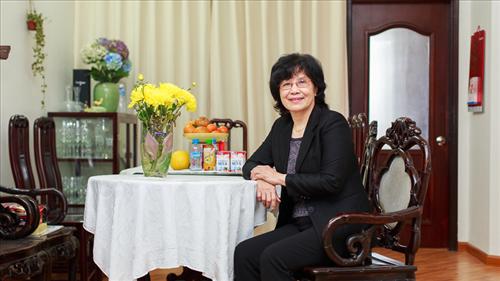
In an apartment on Hoang Dao Thuy Street, there are many photos of the teachers together from their youth, with bright smiles and joy on their faces. It seems that the image and spirit of the teacher still deeply permeate this space. Overwhelmed with emotion, holding the yellowed handwritten diary of her beloved husband, Associate Professor Dr. Tran Thi Kim Chi recalled:
In 1993, Professor Nguyen Van Dao transferred to work at the Vietnam Academy of Science in Ho Chi Minh City. He and his colleagues lived the simple life of ordinary scientists. At the end of 1993, they went to Hanoi for Tet (Lunar New Year). Unexpectedly, this trip created a turning point in Professor Nguyen Van Dao's life and career.
In the teacher's diary - as Ms. Kim Chi shared:He only writes here things that are very important and require a lot of thought." - recorded this event:
"On February 23, 1994, at 9:00 AM, Mr. Quan (Minister of Education and Training Tran Hong Quan - PV) called to arrange a visit to my house to discuss work, and we agreed to meet in the afternoon. Between 2:30 PM and 3:30 PM, Mr. Quan proposed taking over as Director of the National University. After discussing some aspects of the schools, staff, and personnel planning with Mr. Quan, he concluded that he needed time to think and would give an answer later, as there were many issues to consider at that time.
On the afternoon of March 2, 1994, Mr. Quan called home to request approval of the previous day's proposal. He suggested meeting after work, but later, due to other commitments, he rescheduled for Friday afternoon, March 4, 1994.
On March 3, 1994, at noon, Mr. Quan called to suggest scheduling the meeting earlier that afternoon so that the Party Committee of the Government would have to decide on this matter the next day.
From 5:30 PM to 6:15 PM, I met with Mr. Quan at the Ministry of Education. He continued to discuss my transfer to the Vietnam National University, Hanoi. My suggestion was to consider it further and wait until things at the Center were clear and the Government made a decision. Mr. Quan proposed submitting the options to the Government for consideration.
On March 7, 1994, from 4:45 PM to 5:15 PM, Mr. Nguyen Khanh (former Deputy Prime Minister) met with me at the Government Office. Mr. Khanh informed me of the Party Central Committee's and the Government's opinions regarding my appointment as Director of the National University, and that a decision would be made soon if I agreed. I suggested we take our time and wait until everything at the center was settled. I asked: "Does Mr. Kiet (Prime Minister Vo Van Kiet) support my appointment as director?" Mr. Khanh said: "Mr. Kiet supports it, although he doesn't understand me as well as he does. Mr. Khanh advised me to accept, saying it was an important matter, one that the Government was very concerned about." I requested a postponement.
On March 11, 1994, at 10:00 AM, Mr. Quan called to request a meeting to discuss some matters concerning the National University that afternoon."
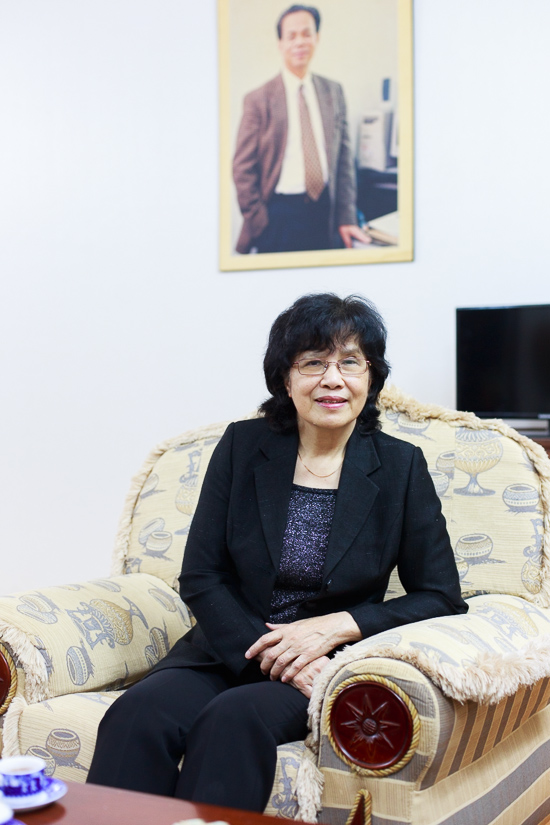
Assoc. Prof. Dr. Tran Thi Kim Chi. (Photo: Thanh Long/USSH)
Associate Professor Tran Thi Kim Chi stated: Although primarily a scientific staff member, Professor has extensive experience in university teaching and is deeply committed to issues related to higher education. In 1981, after participating in a scientific exchange program at over 20 American universities, he wrote an article in the Nhan Dan newspaper (issue dated November 9, 1981) mentioning two things that surprised him when studying the management models at American universities:"Higher education in the US doesn't develop according to a fixed plan; the curriculum, textbooks, exams, and thesis defense are all determined by each individual university. For the most part, universities in the US, whether private or public, charge relatively high tuition fees.""
His experience in management, coupled with these new insights, made him clearly see the shortcomings in higher education management in Vietnam at that time. To meet the demands for quality human resources, a thorough reform of higher education was necessary, meaning a change in the "quality," methods, and content of training, with management being a key factor; universities had to be granted autonomy and accountability. At a time when his ideas about education were at their peak, he was tasked with establishing the Vietnam National University, Hanoi (VNU). This motivated him because it was the place where he could fulfill his aspirations. But this was also a life-or-death challenge, because his years of experience meant he had to confront a stronghold of conservatism and outdated views in higher education.
Deeply concerned about building an organizational and management model at Vietnam National University, Hanoi, the professor often discussed this with the professor:How should universities be built to ensure their development? How should activities be organized to bring about quantitative and qualitative changes? Simply gathering schools and increasing investment funds will not bring about qualitative change!"
In his memoir "Recalling the Difficult Early Days," he wrote:My concerns revolve around the difficulties of organizing a university under a completely new model with a high degree of autonomy in the context of Vietnam.This concern was entirely justified, given that the conditions for building autonomy for Vietnamese universities were very difficult at the time due to delays and stagnation in management awareness and thinking.
Driven by a desire for a mechanism to work with, the Professor recalled the words of the ancient mechanic Archimedes, "Give me a fulcrum, and I will lift the entire Earth." Now, borrowing his words, the Professor says:Give me a mechanism, and I will successfully build the National University.!". A simple statement that encapsulates a grand dream, and especially embodies the unwavering determination and boldness of a leader who dares to think, dares to act, and dares to innovate!
Fighting for the survival of Vietnam National University, Hanoi
If autonomy is the core spirit in the development process of Vietnam National University, Hanoi (VNU) that Professor Nguyen Van Dao wanted to pursue, then the first Regulations on the operation of VNU are the product that most clearly reflects that spirit. Professor Dao pondered deeply before beginning to write these Regulations, because he understood that they were the foundation for the development of VNU.
For four consecutive months (April-August 1994), Professor Kim Chi personally chaired and drafted the regulations with the participation and input of hundreds of scientists from Vietnam National University, Hanoi, and also consulted regulations from many universities both domestically and internationally. Associate Professor Kim Chi recounted:Writing and rewriting, working tirelessly day and night, the new regulations were finally completed in four months. Master Dao's work ethic was truly "tremendous"; he thought quickly and wrote quickly.!”.
On September 5, 1994, the Prime Minister signed a decision promulgating the Regulations on the Organization and Operation of Vietnam National University, Hanoi (VNU), essentially accepting the draft submitted by VNU with the following main contents: VNU was allowed to use a seal bearing the national emblem, had full authority to decide on international cooperation, and was authorized to award bachelor's, master's, and doctoral degrees. This first set of operational regulations for VNU created an important foundation for the development of VNU with a high degree of autonomy.
As his life partner and fellow educator, Associate Professor Tran Thi Kim Chi considers herself fortunate to have been able to be by Professor Nguyen Van Dao's side and share many aspects of his work and aspirations. Witnessing her husband's anxieties and dilemmas, she understands even more deeply that, in reality, the struggle for the autonomy of Vietnam National University, Hanoi (VNU) is neither smooth nor simple. As the highest-ranking leader, and a pioneer and "pioneer" of a new direction, Professor Dao faces pressure from many sides. Because "university autonomy" is so new, it is difficult for even those in educational management, including those close to him, to accept. There are even suspicions that Professor Dao is doing something for his own personal gain.
Professor Nguyen Van Dao's dedication received the support of top leaders, including the late Prime Minister Vo Van Kiet. The Prime Minister once remarked during a meeting at FPT University:When Mr. Dao worked at Vietnam National University, Hanoi, I supported him, but he had to struggle greatly to fight for the survival of Vietnam National University, Hanoi, and to implement that regulation."
When Vietnam National University, Hanoi (VNU) was in its early stages of development, a rather "serious" event occurred. In early 1999, the Ministry of Education and Training's draft education reform plan, specifically the section concerning national universities, addressed the issue of removing VNU's national emblem and completely abolishing its model. The day before a meeting on this matter, Professor Dao received the draft from the Ministry. As usual, Associate Professor Tran Thi Kim Chi read the document beforehand for him. That evening, when he returned home, she exclaimed in surprise:Mr. Dao, please remove the national emblem and abolish the Vietnam National University, Hanoi."!". Almost snatching the document, the professor read it and then stayed up all night writing his counter-argument to the Ministry's project. His thoughts and emotions led him to write 40 pages in a single night, with scientifically sound and forceful counter-arguments.
Some staff members of the VNU Office probably still remember that the very next morning, Professor Nguyen Van Dao mobilized all the secretaries to type and bind the documents into folders to be distributed at the meeting that afternoon. This was VNU's official counter-argument to the Ministry of Education and Training's educational reform program for national universities.
The most tense period was at the end of June 1999. On June 22, 1999, Teacher Dao received news that the Ministry's education reform project had been submitted to higher authorities for final review and approval.
On the afternoon of June 23, 1999, a large number of staff from Vietnam National University, Hanoi (VNU) visited their teacher's home, their hearts heavy with sadness and worry. Quietly, without fanfare, perhaps more than ever, the spirit of solidarity and wholehearted support of VNU staff and employees for their leader was expressed so profoundly and affectionately. Turning through the teacher's documents about VNU from those days, on the far left page was a short but clear inscription:Fighting for Vietnam National University, Hanoi!”.
On June 24, 1999, Professor Dao departed for a meeting in Belgium. On the plane was a delegation from the Government Office going to France. Among them was a comrade who strongly supported the Vietnam National University, Hanoi. He approached Professor Dao, shook his hand, and said, "It's broken, sir.!”.
However, thanks to the persistent struggle of the two National Universities and the support of high-ranking, reputable leaders and dedicated educators and scientists, on July 11, 1999, Prime Minister Phan Van Khai convened a special meeting to discuss issues related to the National Universities. The final decision of the Government was: to maintain and develop the model of the National Universities.
The teacher was very happy! While telling the story to the teacher, he said:At the end of the meeting, a very important person announced that from now on, anyone who wants to leave VNU can leave individually, but the organization will remain!"Professor Nguyen Van Dao's journey with Vietnam National University, Hanoi, has been marked by such challenging and dramatic moments!"
Then came the good news…
Hidden within the stories about Professor Nguyen Van Dao and Vietnam National University, we sense the love, affection, admiration, and trust that his wife holds for this renowned scientist and administrator. As she herself admits, her personality is simple and introverted, seemingly contrasting with the strong, decisive character of Professor Dao – a man with innate qualities for management and leadership that shine even brighter in challenging circumstances. But these differences seem to only further strengthen the bond between two life partners who share common interests in their work and careers.I have learned a lot from Mr. Dao!"—Associate Professor Tran Thi Kim Chi confided to us. Not only did she learn from him the resilience and independence in his work, the determination and steadfastness to overcome adversity, but she also learned the meticulousness and patience of a scientist. In his interactions with colleagues and subordinates, he was very principled in his work but always thoughtful and understanding."
The 10/12 Hall – a place commemorating important events of Vietnam National University, Hanoi (VNU) – has recently been renamed the Nguyen Van Dao Hall. This is a profound expression of gratitude from the leadership and generations of VNU faculty and students for the contributions of Mr. Nguyen Van Dao as a pioneering leader in the development of VNU. The VNU's multi-disciplinary, multi-field university model with high autonomy is also recognized in the 2012 Higher Education Law. At the end of 2013, the Government issued a new Decree on the VNU with broad conditions for its future development. We saw the emotion in her sparkling eyes:This is a great honor and joy for our family, the culmination of many generations of teachers and students of VNU, and the heartfelt wish of Professor Dao during his lifetime. The things that he hoped for and expected regarding VNU have now been achieved. He must be very happy wherever he is…"
Author:Thanh Ha
Newer news
Older news

