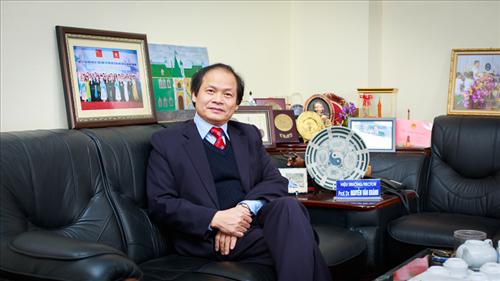
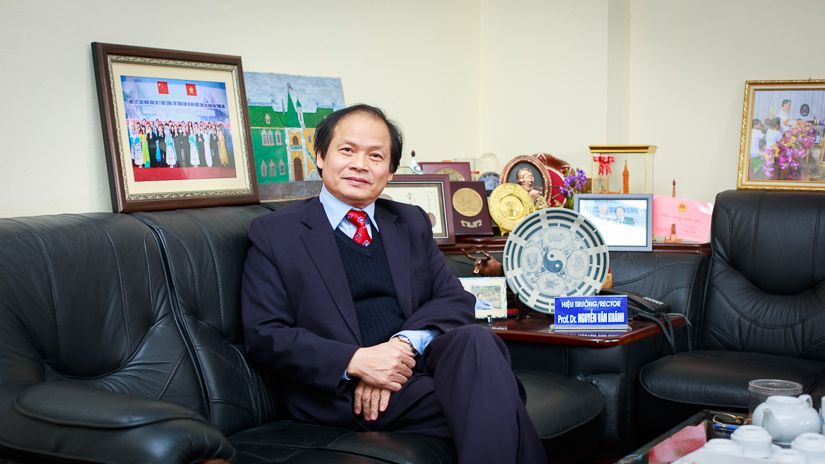
Professor Dr. Nguyen Van Khanh. (Photo: Thanh Long/USSH)
Professor, could you please explain the fundamental reasons behind the necessity of creating an Aurb?
The Red River Basin connects the Northern Delta of Vietnam with Yunnan Province (China), creating a vast geographical region with a unique civilization spanning the territories of both countries. Originating in the Ai Lao Mountains of Yunnan Province (China), the Red River flows northwest-southeast into the Gulf of Tonkin in Vietnam, with a length of 605 km within China and 556 km within Vietnam. The Red River Basin population includes 46 million people living in Yunnan Province and 20 million people residing in the Northern region of Vietnam. From a geographical, natural, and economic perspective, the Red River Basin is a culturally diverse area, rich in natural conditions, and dynamic in economic development. Therefore, cooperation at the national and regional levels between local authorities and scientists is essential to develop necessary policies to promote the sustainable development of this potentially rich region, for the benefit of the people of both countries.
In fact, significant progress has been made in exchanges and development between Yunnan Province (China) and the northern provinces of Vietnam. One of the outstanding results of bilateral economic and trade cooperation is the recent decision by Yunnan Province and Vietnam to establish a "Transnational Economic Cooperation Zone" and organize the Yunnan-Vietnam Economic Forum. An effective cooperation mechanism has been established between the Yunnan local government and several provinces in the Red River Delta to build the Kunming-Hanoi-Hai Phong economic corridor. Thanks to the establishment of cooperation mechanisms in culture and society, both sides have ensured deeper cultural and social cooperation in the Red River Delta, creating favorable conditions for bilateral economic cooperation. Exchanges in education and training have also developed significantly. Currently, Vietnam has 1,800 students studying in Yunnan, ranking first among all Vietnamese students studying in Yunnan.
In this context, cooperation between universities of the two countries – as professional training and research institutions – is essential to research and apply scientific knowledge to serve the practical development of the region. More than ever, universities need to demonstrate their pivotal and pioneering role in development goals. The establishment of AURB affirms these shared concerns of the universities and is also a commitment to directing its research and training activities towards specific goals related to the development of the population and territory within the Red River Basin.
Professor, what are the most important goals that AURB is aiming for?
At the Forum of Rectors of Universities in the Red River Basin, the Rectors of the member universities unanimously adopted the main objectives of AURB, which are:
Firstly, it involves effectively utilizing the unique characteristics and strengths of member institutions, promoting sustainable cooperation among members in the fields of training, research, and the exchange of faculty and students.
Secondly, it aims to fully utilize and develop research, education, and training resources, improve the quality of training at member universities, and increase AURB's influence on the region and the community.
Thirdly, we will implement collaborative activities to enhance the quality of education, training standards, reputation, and influence of AURB.
Fourth, to train human resources suitable for regional cooperation requirements, promote training exchanges; contribute to the development of the economic corridor between Vietnam and China, and contribute to the construction of the China-Southeast Asia Free Trade Area.
Fifthly, we will explore the experiences of reform, development, and international cooperation models in both countries, aiming to build advanced university models.
Professor, could you please tell us about the main areas of cooperation that AURB will be pursuing in the near future?
Firstly, AURB will aim to strengthen collaborations in scientific research in order toserving the sustainable development of the territoryFirst, the research focuses on solutions for maintaining and protecting the natural environment in the upstream areas of the river basin, contributing to improving the quality of life for residents in this basin region. Next, it investigates solutions for the rational use of water resources in the Red River basin, ensuring that water resource exploitation in the upstream areas does not harm the water resources that the downstream basin needs.
Secondly, AURB will cooperate inTraining human resources to serve the sustainable development of the region.Research collaborations will need to be implemented to accurately identify human resource needs for sustainable development in the region, based on research into socio-economic development strengths, natural and socio-cultural characteristics in each sub-region and the entire basin in the context of international integration. I believe that with the strengths of professional training and research institutions, this task will be successfully accomplished. By correctly identifying human resource needs, member universities will discover their strengths in science and training, providing a basis for the most effective cooperation.
Thirdly, universities will cooperate on specific issues such as economic and tourism development throughout the river basin. Within the Red River basin territories of both countries, the natural and human geography provides invaluable resources for economic and tourism development. We can cooperate in training human resources for tourism, exchanging experiences in exploiting tourism resources, and building legal mechanisms between the two countries… aiming to transform the Red River basin into an attractive tourist region, bringing high economic benefits to both countries. In addition, universities need to focus on researching issues related to ethnic relations, the culture of border areas between the two countries, and solutions for exploiting and utilizing infrastructure to promote economic exchange between the two countries and with the region…
- As a founding member of AURB and serving as co-chair of AURB for the first term, what strengths does the University of Social Sciences and Humanities intend to contribute to the development of the Association, as well as to the goals of cooperation and development for the community and the region?
As a member of the Vietnam National University, Hanoi, a leading research and training institution in the social sciences and humanities of Vietnam, the University of Social Sciences and Humanities boasts a team of leading scientists in many fields related to culture, society, human beings, and development. With 70 years of development, the University has achieved many accomplishments and gained experience in interdisciplinary research aimed at sustainable development in localities and regions. With the goal of internationalizing the quality of its training and integrating with the regional and global scientific community, the University has established official relationships with over 180 partners and implemented many effective international cooperation projects. In regional and international forums, the University is a representative of Vietnamese universities and is increasingly gaining an important voice in the international scientific and educational community. From its early days to the present, the University of Social Sciences and Humanities has shown a particular interest in human issues, improving the quality of life, and issues related to sustainable development, inter-regional and inter-sectoral cooperation. It has been a pioneer in many modern scientific fields in Vietnam, such as Tourism, Anthropology, Social Work, Psychology, Climate Change, and Area Studies. These advantages enable the University to successfully fulfill its responsibilities as the Chair of AURB: proposing ideas and guidelines, connecting members, organizing joint research projects, evaluating project effectiveness, expanding international exchanges, and creating connections between universities, businesses, localities, and the government.
In proposing the establishment of the Association, the University of Social Sciences and Humanities hoped that the creation of AURB would be a good start for a strong, long-lasting, and effective relationship between Vietnamese and Chinese universities. Universities – the birthplace of scientific knowledge and pioneers in applying science to life – will promote and strengthen their role and mission in the development of the community. Ultimately, AURB's activities will contribute to building the Red River Basin into a model, sustainable cooperative development area in the region, thereby building an increasingly strengthened and stable Vietnam-China relationship.
Thank you, Professor, for the information shared.
Author:Thanh Ha
Newer news
Older news

