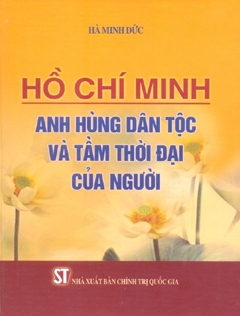
This book is another symbol of the profound respect for President Ho Chi Minh from an educator, researcher, writer, and poet who has dedicated a significant part of his life to studying Ho Chi Minh's career across many dimensions and fields: culture, ethics, literature, art, journalism, media, international affairs, etc.
More than 45 years ago, in September 1969, the people of our country from north to south, along with friends around the world, sadly bid farewell to President Ho Chi Minh as he passed away, "meeting Karl Marx, Lenin, and other revolutionary predecessors" (His Last Will and Testament). Comrade Le Duan, on behalf of the Central Committee of the Party, read the eulogy: "President Ho Chi Minh has passed away! But he left us an invaluable legacy. That is the Ho Chi Minh era, the most glorious era in the glorious history of our nation."
How was President Ho Chi Minh's era shaped and manifested in practice, leading to success and bringing about numerous miracles during the glorious period of Vietnamese struggle after World War II? Professor Ha Minh Duc approaches this major issue with his extensive and systematic knowledge, his ability to research, select, and analyze with keen insight, and his scientific synthesis of documents from various sources. Based on this, he presents his understanding and explains a series of issues.
The research work consists of three parts arranged in chronological order. It begins with the 30 years of living and working abroad, starting from the day young Nguyen Tat Thanh boarded an ocean liner as a kitchen assistant to embark on his journey to find a way to save the country, in 1911. Each chapter is dedicated to a different location where Ho Chi Minh stayed, first in the United States; then from America to England, seeking stable employment to learn the language and witness firsthand a colonial power, both an ally and a competitor of French colonialism in the struggle for colonies; a longer stay in France, marking the beginning of his revolutionary activities. Next is his time in the Soviet Union, where Nguyen Ai Quoc truly matured; and finally, his years working in China "to be closer to the Fatherland," as he suggested.
The numerous journeys across many countries over thirty years provided Nguyen Ai Quoc with a wealth of experiences and knowledge, forming the foundation for the stature of a great man of his time.
Regarding the leadership of the Vietnamese revolution - Part II, this book covers an extremely important period in the life of President Ho Chi Minh and the history of the Vietnamese nation. President Ho Chi Minh crossed the border from China and set foot in the mountainous region of Cao Bang to establish a base, enduring countless hardships, facing death many times due to enemy plots and illness in the deep forest with unpredictable weather. He led the country to achieve many successes until the day he passed away. He did not live to see the reunification of the country. Nevertheless, the Vietnamese people and many international friends, including many Americans, are certain that the day of independence and reunification of Vietnam is drawing near, because President Ho Chi Minh left behind a vision and many outstanding disciples to follow in his footsteps.
The work dedicates its final section to a global forum honoring and praising Ho Chi Minh. Essentially, this is the concluding part, analyzing many major issues, such as Ho Chi Minh's thought and wisdom, his dialectical revolutionary thinking, deeply rooted in national and contemporary identity; his noble humanism, simple lifestyle, high cultural level, and profound intellect.
The book includes an appendix featuring twelve selected articles from hundreds of writings by renowned figures from around the world who admire and honor President Ho Chi Minh – and of course, it cannot be without the Resolution of the General Assembly of the United Nations Educational, Scientific and Cultural Organization (UNESCO) solemnly honoring Ho Chi Minh – National Hero, World Cultural Figure (1990).
Closing the last page of this thick book, we imagine the image of Ho Chi Minh appearing before our eyes: a young sapling deeply rooted in the rich tradition of national struggle and culture, enduring storms and hardships yet quickly sprouting and flourishing, absorbing the essence of world culture, developing lush branches and leaves to become a mighty tree, dedicating his entire life to the nation and humanity, and finally, from the world, blossoming into a lotus flower, returning to honor the outstanding talent of Vietnam.
President Ho Chi Minh's stature was the fruit of his travels through thirty countries, whether as a hired laborer or a head of state. It inherited the integrity and selectively followed the path taken by previous patriotic figures. It was the stature of an international statesman fluent in many languages, the leader of a nation with a rich cultural heritage spanning thousands of years.
Uncle Ho was an international activist, but first and foremost, he was Vietnamese more than any other Vietnamese person (Pham Van Dong), a wise and elegant statesman with a completely Vietnamese character, demeanor, and conduct.
The pinnacle of Ho Chi Minh's legacy lies in a lifetime in which he never once considered personal gain, dedicating himself wholeheartedly to his country and people, and to all the oppressed, the working class, wherever they lived; a lifetime of unwavering commitment to one goal: the independence and freedom of the nation, and the happiness of the people.
Professor Ha Minh Duc approaches and handles the topic in his own way. Based on numerous sources from Vietnamese researchers, and even more extensively, from many renowned foreign scholars from different cultures, political viewpoints, and beliefs, they ultimately converge at one point: admiration, praise, and veneration for President Ho Chi Minh. From this practical foundation, the author presents and explains his own feelings. Sometimes, he uses the opposite method, stating his personal opinion and then developing and supporting it with various sources. Perhaps these are the factors, and also the secret, that make the work "Ho Chi Minh - National Hero and His Timeliness" a highly scientific, informative, and inspiring work, allowing readers who need it to find many avenues for deeper research into this content and other aspects.
The scope and content of Ho Chi Minh's era constitute a vast and noble field. This book review does not discuss the scientific or cultural content of Professor Ha Minh Duc's work. Respecting the People's Teacher, who is now eighty years old and continues to diligently research and create, presenting numerous excellent scientific and literary works, we boldly introduce this work to our readers, considering it a highly thought-provoking scientific endeavor.
Author:Phan Quang
Newer news
Older news

