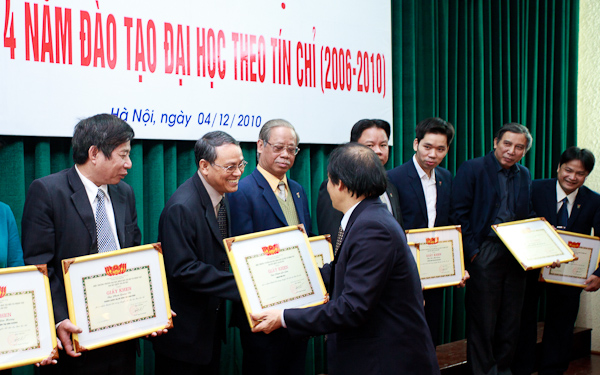
The conference summarizing four years of credit-based training at the University of Social Sciences and Humanities was held on December 4th.The conference provided an opportunity for the university to assess the successes and limitations of its four-year credit-based training program (2006-2010), thereby drawing lessons to further innovate credit-based training in the following years. Associate Professor Dr. Nguyen Kim Son – Vice Rector of the university – presented a summary report on the university's four-year credit-based training program (2006-2010). The report highlighted the significant achievements after four years of credit-based university education, including: improved awareness among faculty and staff regarding the requirements of credit-based training; a fundamental shift in curriculum development, course outlines, learning materials, textbook compilation, and assessment; ensuring conditions for enhancing students' adaptability to credit-based training and learning quality; a gradual improvement in teaching quality year by year; ensuring basic conditions for implementing the fundamental transformation of training; and student affairs beginning to keep pace with the training transformation process, as well as the effective implementation of social policies and benefits. Furthermore, the report also highlights a series of issues facing the in-depth implementation of credit-based training from 2011 to 2015. Among these, the issues of faculty, teaching methods, and proactive, comprehensive control over the quality of teaching and learning are particularly important. Granting greater autonomy to lecturers in organizing training and ensuring greater autonomy for students in specifying their training programs, such as choosing subjects and professors, are crucial in the future. Simultaneously, training programs need to be continuously adjusted to increase interoperability, international relevance, and ease of transfer with domestic and international university training systems. In addition, the report includes several specific proposals and recommendations: To achieve a breakthrough in training quality and success in the transformation process, further improvements are needed in areas such as libraries, learning materials, information technology, and other physical facilities. It is necessary to further increase the autonomy of lecturers and demand more from them, but this requires a suitable roadmap, gradually adapting to improvements in facilities and learning materials. The operational models of youth organizations and student associations need to be reformed. In particular, Vietnam National University, Hanoi (VNU) needs to find harmonious and appropriate solutions between strengthening the interconnectedness and linkages between units within VNU and increasing the autonomy of training units. The conference also heard a summary report on credit-based training from affiliated faculties/departments and offices. The report showed that 166 topics were discussed in the presentations, and 116 opinions were expressed at the conference by the units. The most discussed topics included: training programs, teaching methods, curricula, course outlines, equipment and facilities, training regulations, course management, course registration, etc. The presentations at the conference focused primarily on specific issues such as: “Teaching Quality in Credit-Based Training at the University (from the perspective of teachers and students)” by Assoc. Prof. Dr. Nguyen Chi Hoa (Center for Educational Quality Assurance). Through survey results evaluating student lectures by lecturers in credit-based training, the presentations showed that overall teaching quality has improved significantly over the years. For example, the average score for teaching from the student's perspective was 3.80 in 2007-2008, 3.95 in 2008-2009, and 4.13 in 2009-2010. Also discussing teaching, Professor Tran Thi Minh Duc (Faculty of Psychology) specifically addressed the issue of "The current state of credit-based training according to detailed syllabi in the Faculty of Psychology." Professor Tran Thi Minh Duc pointed out several limitations and difficulties in compiling course syllabi, using teaching methods, and progressing according to course duration, such as: the syllabus being longer than the actual teaching, too much knowledge being presented, a large number of students, insufficient classrooms, inadequate learning materials, and a lack of proactive innovation in teaching methods among lecturers. Therefore, according to the professor, changes and revisions to course syllabi need to be more frequent, concise, and grant lecturers a certain degree of autonomy in developing teaching procedures and organizing opportunities for teachers who wish to improve their teaching methods. Information technology is one of the important fields that fundamentally changes the way faculty, staff, and students of the university teach, learn, and work. Regarding the application of information technology in the university from a training management perspective, Mr. Dao Minh Quan (Postgraduate Training Department) spent considerable time analyzing the limitations of management software and some barriers affecting the application of information technology in the university. From the student's perspective, Ms. Vu Thi Huyen Trang stated that the credit-based learning system promotes self-reliance and dynamism among students through self-selection of subjects and self-determination of study time. However, students also face some difficulties and challenges: self-study, making friends, networking, and proactively resolving problems. Therefore, students' aspirations are: the right to choose their lecturers, a greater emphasis on the role of academic advisors, more comprehensive provision of facilities and learning materials, and increased support for students through club models…

On behalf of the leadership of Vietnam National University, Hanoi (VNU), Assoc. Prof. Dr. Pham Trong Quat – Vice Director of VNU – commended and highly appreciated the achievements the University has made in the four years of transitioning to the credit-based training method. The Vice Director emphasized that the University of Social Sciences and Humanities is one of the pioneering units in implementing credit-based training. Despite limited infrastructure, the university has built a solid foundation for training, drawing valuable lessons for the university in particular and VNU in general. On this occasion, the University also presented certificates of merit from the Rector to 13 collectives and 27 individuals who have achieved outstanding results in the four years of transitioning to credit-based training.