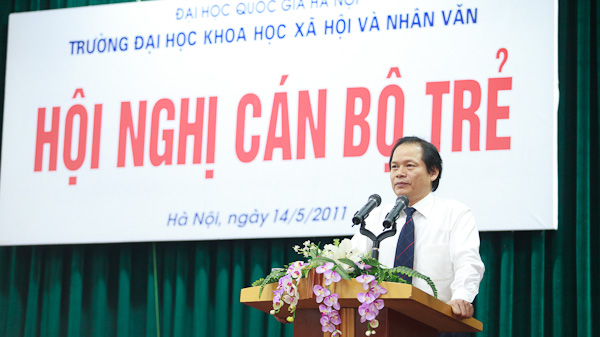
The 3rd Conference of Young Staff of the University of Social Sciences and Humanities took place on May 14, 2011. Attendees included representatives from the Vietnam National University, Hanoi, the University's leadership, and nearly 200 young staff members from across the university. The conference focused on discussing issues related to the training and development of young staff: difficulties, advantages, and specific solutions.
Building and developing a qualified young workforce.
In his opening speech at the conference, Professor Dr. Nguyen Van Khanh – the Rector of the University – emphasized: For many years, the training and development of young staff has been a top priority for the University. Currently, over 50% of the university's staff are young, and in just 5-10 years, they will become key personnel and pillars of the organization. To achieve this goal, one of the top priorities is building and developing a qualified team of young staff.

Associate Professor Dr. Dang Xuan Khang – Head of the Personnel Department – in his overview report on “The current situation and solutions for developing the young staff of the University of Social Sciences and Humanities,” clearly stated that the young staff have made significant contributions to the University's development over the years. This will be a key force in developing the University and integrating it into the ranks of leading universities in the region and internationally. To achieve this goal, the young staff needs to: - Accelerate the increase in the number of PhD holders among the faculty. 100% of young lecturers must register to take the doctoral entrance exam. If they fail to register within the stipulated time, the University will classify them as lecturers who have not completed their duties and will not provide tuition support for those who register late. - All doctoral candidates must report their progress and projected completion time for their dissertations annually. Failure to report will be considered as failing to complete their duties and will result in exclusion from regular salary increases. - Apply sanctions (rewards, penalties) to cases of early completion and cases of failure to complete the postgraduate program on time. - Continue to organize foreign language classes using different methods for different target groups. - Prioritize young staff members to attend conferences and seminars abroad. Prioritize assigning scientific research topics to young staff members. Consider organizing regular scientific conferences and seminars for young staff members. - Organize professional training courses in educational management and information technology for leaders and managers at all levels. And from now on, the school, units, and each staff member must further accelerate training and self-training to meet the tasks in the new development phase.
Staff suggestions
In his presentation "For a Sustainable Development of the History Department Today and Tomorrow," Associate Professor Dr. Nguyen Hai Ke, Head of the History Department, affirmed: The young staff is the present and the future. Training young staff and fostering the growth of the current generation is for the benefit of the present generation. However, young staff still face many difficulties in life and in developing and improving their professional skills. Drawing from his own life experiences, work, and studies, as well as those of previous generations, Associate Professor Dr. Nguyen Hai Ke believes that to nurture the next generation, the previous generation must first set an example; and training is self-training; training means creating conditions for young staff to participate in research and teaching alongside their senior colleagues. Nurturing through specific, profound, and sincere attention... Stemming from their own thoughts, aspirations, and needs, young staff members understand their own advantages and disadvantages better than anyone else, thus offering practical solutions: Mr. Dong Duc Hung (Faculty of Information and Library Science) proposed the idea of building a Young Staff Club model to connect young staff members of the University; the club could operate in the form of regular meetings, with different units taking turns leading...
MSc. Vo Minh Vu (Faculty of Oriental Studies) put forward several specific suggestions for young staff members to develop and successfully complete their professional tasks, such as: reducing administrative workload for young staff members by establishing clear quotas and assignments; supporting young staff members in their studies to improve their skills and developing research programs specifically for them; and implementing appropriate reward systems...

Ms. Nguyen Thi Nam Hoang (Faculty of Literature) offered several suggestions regarding the professional development of young staff members, including: assistance from experienced staff and management to create a structured learning program and plan with specific goals and requirements, taking into account the difficulties in their individual circumstances. Young staff members need to effectively combine mandatory training programs to obtain degrees and certificates with self-study and research based on their needs and professional orientation. After listening to the presentations and speeches at the conference, Professor Vu Minh Giang – Vice Director of Vietnam National University, Hanoi – highly appreciated the university's policy of maintaining regular conferences for young staff members. The Vice Director further affirmed the importance of social sciences and humanities to the development of the country and the role of young staff members in the future development of the university. In addition, the Deputy Director noted that a crucial and essential solution for developing and improving the capacity and quality of young staff members is for them to take initiative, strive for advancement, and seize opportunities to improve their skills. Furthermore, the school should also trust and assign tasks to young staff members, focusing on improving the quality of incoming students...