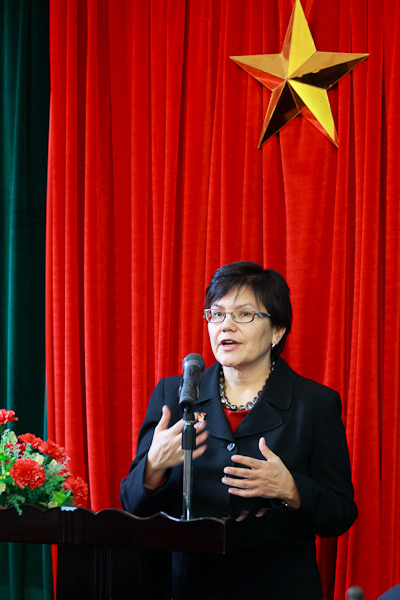
On March 24, 2011, the University of Social Sciences and Humanities and the Canadian Embassy in Vietnam jointly organized an international conference on the theme: “Canadian Education and Research in Vietnam: Opportunities and Prospects”.The workshop was attended by representatives from Vietnamese international education and research institutions such as the Diplomatic Academy of Vietnam, the Institute of American Studies, the Institute of African and Middle Eastern Studies, Hue University, Da Nang University of Foreign Languages, the University of Social Sciences and Humanities, Vietnam National University Ho Chi Minh City, Ho Chi Minh City University of Education, Dong Do University, etc. Notably, the workshop was attended by the Ambassador Extraordinary and Plenipotentiary of Canada to Vietnam, Ms. Deborah Chatsis, and officials from the Canadian Embassy in Hanoi and the Canadian Consulate General in Ho Chi Minh City. The main purpose of the workshop was to answer two questions: Why and How can we enhance education and research on Canada in Vietnam?

In their reports, delegates affirmed that Canada is a worthy subject for attention and study. Domestically, Canada is a multi-ethnic, multicultural nation with a democratic, stable, and transparent political system, and is considered one of the happiest countries in the world. Externally, Canada pursues an open, peaceful, and constructive foreign policy, and is a member of many prestigious regional and international organizations such as the G8, the North American Free Trade Area (NAFTA), the Francophonie, and the United Nations peacekeeping forces. In its relations with Vietnam, the two countries officially established diplomatic relations in 1973. During the war, Canada participated in the International Control and Supervision Committee of the Geneva Accords in 1954 and 1973. Currently, Canada is an important partner of Vietnam in development cooperation and poverty reduction programs, and a trusted destination for Vietnamese students. However, understanding of Canada remains limited, and training and research on the country are fragmented and unsystematic. In Vietnam, to date, only the Faculty of International Studies at the University of Social Sciences and Humanities offers a course on Canada. Reports consistently affirm that to enhance training and research on Canada, Vietnamese educational and research institutions must strengthen coordination, share personnel and materials, learn from the experiences of other countries, effectively utilize Canadian assistance, and develop an appropriate roadmap to build a training and research strategy on Canada that suits Vietnam's conditions. On behalf of the university's leadership, Associate Professor Dr. Nguyen Van Kim, Vice Rector, thanked the Canadian Embassy for its effective assistance over the past period, highly appreciated the idea of collaborating with the university to organize the first seminar on training and research on Canada in Vietnam, and committed to working with partners to form a network for training and research on Canada in Vietnam. In her remarks, Ambassador Deborah Chatsis also expressed her gratitude to the University of Social Sciences and Humanities, and especially the Faculty of International Studies, for readily organizing this conference. The Ambassador emphasized that Vietnam and Canada are two important partners, both members of many important regional and international forums, and have a solid foundation for developing comprehensive cooperation, especially in the fields of training and research. In her presentation, Political and Information Counselor Joya Donnelly provided useful information about programs supporting the study and research of Canada, helping Vietnamese partners better understand opportunities to access Canadian research. In conclusion, Associate Professor Pham Quang Minh affirmed the importance of Canadian training and research in Vietnam and expressed his hope for continued cooperation from Vietnamese partners and the Canadian Embassy. To enhance training and research on Canada, the following immediate steps are necessary: Firstly, developing and expanding a comprehensive resource of materials, including fundamental and specialized books, and professional journals on the history, culture, economics, politics, society, and foreign relations of Canada. Secondly, building a workforce and training a team of highly qualified experts in various Canadian fields. Thirdly, establishing a network and fostering cooperation between Canadian training and research institutions in Vietnam and with partners in the region and globally. The best approach is to facilitate regular interaction and exchange between Vietnamese experts and foreign scholars, and participation in Canadian research associations. In particular, the Canadian Embassy should act as a bridge to help Canadian and Vietnamese research and training institutions establish cooperative relationships, exchange teachers and students, coordinate training, and conduct joint research projects.