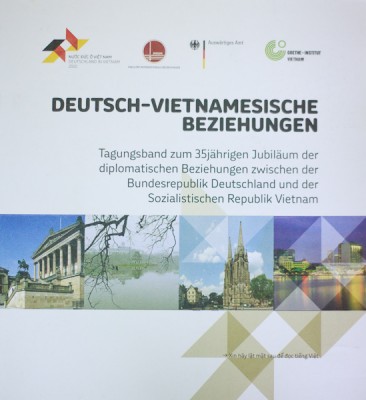
In 2010, the Socialist Republic of Vietnam and the Federal Republic of Germany celebrated the 35th anniversary of the establishment of diplomatic relations (1975-2010). The book you are holding is a commemorative work for this important event. It is the result of continuous cooperation between the two institutions: the Goethe Institute Hanoi and the Faculty of International Studies, University of Social Sciences and Humanities, Vietnam National University, Hanoi. This idea certainly would not have become a reality without the contributions of scientists from both Germany and Vietnam.

The book comprises nine articles, including four by German scholars and five by Vietnamese scholars, with the overarching theme being a look back at Vietnam-Germany relations to guide the future. Undoubtedly, the German-Vietnamese relationship is unique. Its uniqueness lies in the fact that both countries were divided into opposing fronts and became hotspots during the Cold War. Both later reunified, albeit through different paths. Since the end of the Cold War, both countries have participated in regional integration and played important roles in that process. However, these similarities do not make the relationship between the two countries as easy and smooth as one might think; in reality, it is quite complex, intertwined, and often sensitive in the context of a volatile regional and global landscape. This work raises many questions for discussion among scholars, aiming to provide a more comprehensive and in-depth understanding of Vietnam-Germany relations. These include: How did the Vietnam War transform from a national struggle to a class struggle (Assoc. Prof. Dr. Pham Hong Tung, Vietnam National University, Hanoi); What was the relationship between the Federal Government of Germany and the Saigon government (Dr. Gerhard Will, German Institute for International Political and Security Studies); Was the proletarian internationalist movement in Germany during the war entirely for Vietnam's benefit (Dr. Joerg Wischerman, Institute for Asian Studies, Hamburg, Germany); How should the proletarian international nature of cooperation between the German Democratic Republic and Vietnam be understood (Dr. Bernd Schaefer, Woodrow Wilson International Center, Washington DC); Who were the Vietnamese people in Germany (Dr. Martin Grossheim, Institute for Asian and African Studies, Humboldt University, Berlin)? Why did Vietnam passively and unsystematically adopt German philosophy? (Assoc. Prof. Dr. Nguyen Quang Hung, Department of Philosophy, University of Social Sciences and Humanities); how do cultural factors and intercultural communication influence Vietnam-Germany relations? (Assoc. Prof. Dr. Pham Quang Minh, Department of International Studies, University of Social Sciences and Humanities); what can Vietnam learn from Germany's social market economy model? (Dr. Le Dang Doanh, Central Institute for Economic Management Research and Dr. Luong Van Ke, Department of International Studies, University of Social Sciences and Humanities)? Actually, this is only a part of what the authors want to convey to readers. On the occasion of the book's publication, we would like to express our gratitude to all the silent efforts and deep affection that everyone has dedicated to this project. Thank you to the Goethe Institute Hanoi for sponsoring the conference and organizing the publication. We look forward to receiving your feedback. Thank you very much.