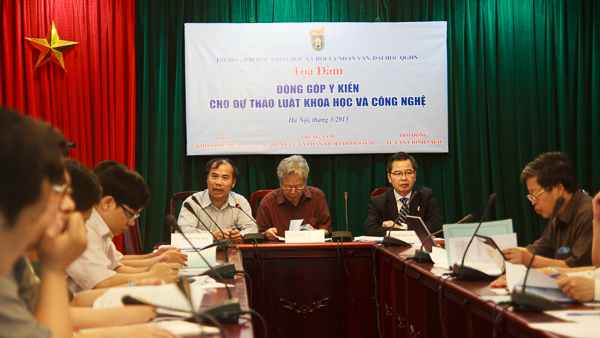
A seminar to contribute opinions on the Draft Law on Science and Technology was organized by the University of Social Sciences and Humanities on March 25, 2013. The seminar was attended by experts and managers in the field of policy science from within and outside the university.At the seminar, experts unanimously affirmed that after 12 years of implementation, the 2000 Law on Science and Technology (S&T) has revealed aspects that are no longer suitable and do not meet the requirements of state management of S&T in the current period. This reality demands the amendment of the law to create momentum for S&T activities to take a new step forward. The contributions to the Draft Law on S&T were quite specific, ranging from clarifying the concepts defined in the Draft Law to unreasonable points in the S&T operational process; the role and responsibilities of the Ministry of Science and Technology in managing S&T activities; identifying the subjects and roles of subjects in scientific research activities; and issues of investment and finance for scientific research activities… According to Assoc. Prof. Dr. Vu Cao Dam - Director of the Center for Policy Research and Analysis: “there are many gaps in the draft law on S&T.” According to UNESCO's definition, S&T activities include four activities: research and development; knowledge transfer; Technology development; science and technology services. When referring to science and technology activities, the Draft Law completely lacks content on technology development in the sense of "post-research activities aimed at mastering, perfecting, and expanding the application of new technologies." In addition, the Draft Law's statement that scientific research activities include basic research and applied research is inaccurate, completely omitting the section on "experimental implementation" in the sense of "experimental activities aimed at transforming theories obtained from basic research and principles obtained from applied research into practical applications." Regarding the subjects of science and technology research activities, Associate Professor Dr. Vu Cao Dam argues that the Draft Law is deficient in that it does not mention the role of individuals/organizations and businesses in the civilian sector, but only refers to the science and technology activities of state agencies. Furthermore, there are some inconsistencies in the regulations regarding investment capital and financing for science and technology activities… Other opinions suggest that overly detailed and specific regulations should not be included in the Law on Science and Technology, such as: removing Article 9 of Chapter II on the Planning of the Science and Technology Organizational System; reviewing the content of regulations on the responsibility of the Ministry of Science and Technology in planning the development of the country's science and technology human resources; Chapter IV on "identifying and organizing the implementation of science and technology tasks" should be issued in the form of a circular, consistent with the authority of the Ministry of Science and Technology; and regulations on registration of science and technology activities should not be as detailed as in the Draft Law…

At the seminar, Associate Professor Pham Quang Minh (Vice Rector) affirmed that the seminar is an important activity, demonstrating the responsibility and mission of the University of Social Sciences and Humanities – the country's leading center for training and research in social sciences and humanities – in advising on policy development for state policy-making agencies. It is expected that further consultations on the draft law will be organized in the coming time to gather broad opinions from scientists inside and outside the university, contributing to the timely improvement of the draft Law on Science and Technology before its submission to the National Assembly in May.