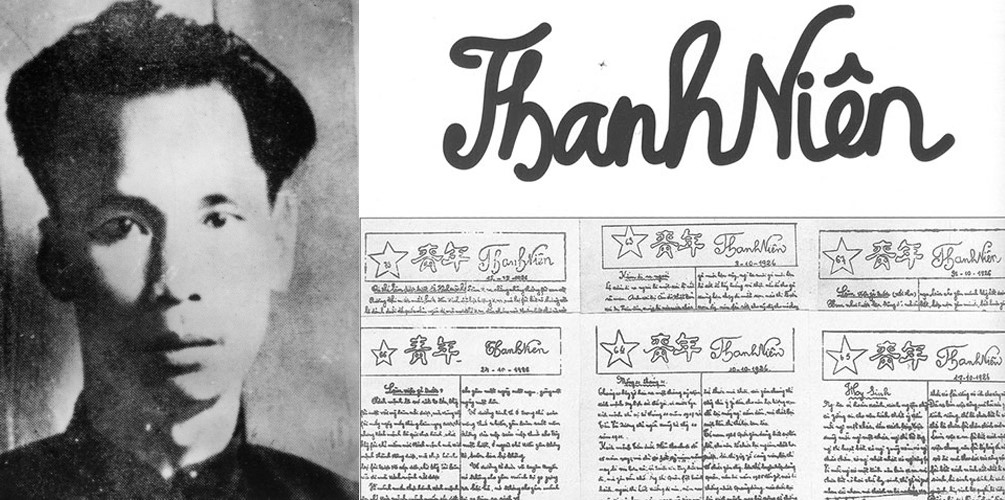
In 1925, Nguyen Ai Quoc founded and was the editor-in-chief of the Thanh Nien (Youth) newspaper.
Regarding the role and mission of journalism and journalists.
Considering himself deeply connected to journalism, throughout his revolutionary life dedicated to saving the nation and its people, President Ho Chi Minh used journalism as a sharp weapon to fight the enemy while simultaneously propagating and mobilizing the people for the national liberation revolution and the socialist revolution. He wrote over 2,000 articles of various genres for more than 50 newspapers and magazines both domestically and internationally, in many languages, expressing revolutionary ideology, patriotism, love for the people, and lofty morals. His writing was simple, accessible, and diverse in style, captivating the hearts and minds of hundreds of millions worldwide. Furthermore, his teachings on journalistic work constitute an invaluable treasure trove of revolutionary Vietnamese journalistic theory.
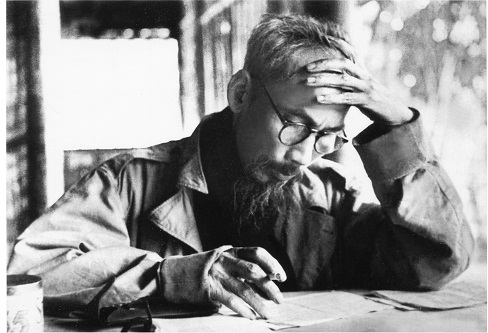
Throughout his revolutionary life, President Ho Chi Minh always considered the press a sharp weapon for propagating revolutionary ideology and fighting against invading enemies (Photo courtesy).
In late 1924, Nguyen Ai Quoc returned to directly lead the Vietnamese revolution, establishing the "Vietnam Revolutionary Youth League," the precursor to the Communist Party of Vietnam. Besides organizing training courses and recruiting members, the Vietnam Revolutionary Youth League published the newspaper Thanh Nien (Youth), with the first issue appearing on June 21, 1925, and continuing until the end of 1929 when the League concluded its historical role. The mission of revolutionary journalism from its inception was explained simply yet profoundly: to propagate "the Party's objectives to an ever-increasing number of people."
[1].
At the Second Congress of the Vietnam Journalists Association (April 16, 1959), President Ho Chi Minh instructed journalists: “All those working in journalism must have a firm political stance. Politics must be in control. Only with the right political line can other things be done correctly.”
At the Third National Congress of the Vietnam Journalists Association, he clearly stated: "The task of the press is to serve the people and the revolution. That is the task of the entire Party and the entire people, and also the task of our press."
[2].
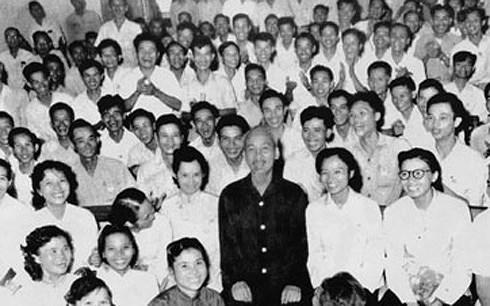
President Ho Chi Minh pictured with delegates attending the 3rd Congress of the Vietnam Journalists Association (1962) (Photo courtesy of the archives)
The press is an important component of the Party's overall ideological and cultural work. President Ho Chi Minh emphasized: "Our Party is strong because our Party has ideological unity and unified action from top to bottom. The Party's newspaper has the task of ensuring that thought and action are consistent and unified."
[3].
The Politburo's resolution of December 8, 1958, affirmed: Journalists are also revolutionary fighters. Their pens and paper are their sharp weapons. To fulfill their glorious mission, President Ho Chi Minh taught, "...journalists need to cultivate revolutionary ethics, strive to improve their ideology, professional skills, and culture; focus on studying politics to firmly grasp the Party's guidelines and the Government's policies; delve into reality, delve into the working masses..."
[4].
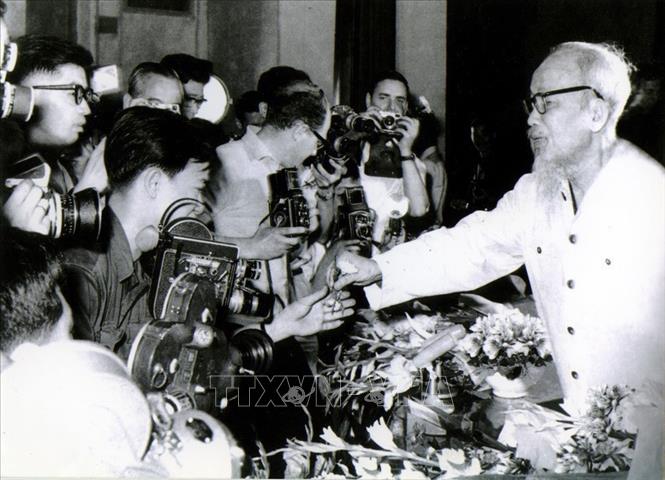
President Ho Chi Minh meets with reporters from domestic and foreign press agencies in Hanoi (May 1968) (Photo: VNA)
The Party newspaper is like a simple, practical, and widespread training course. It teaches us what we need to know about propaganda, organization, leadership, and work. Every day it helps to improve our political understanding and work productivity. If we just work without reading or studying the Party newspaper, it's like walking in the dark with our eyes closed; we will inevitably be confused, stumble, and fail.
[5].
President Ho Chi Minh considered the honesty of journalists to be a very important ethical standard in journalistic practice.
A true journalist must be professional, honest, objective, and respectful of the truth. President Ho Chi Minh taught: "If you don't know or understand clearly, don't speak or write. When there is nothing to say or write, don't speak or write recklessly" and "If you haven't investigated, researched, or known clearly, don't speak or write."
[6]At the same time, he also demanded that journalists, in all cases of praise or criticism, do so with pure and objective motives, and could not write for personal gain, selfishness, or self-interest. He believed that "a newspaper that is not desired by the vast majority of the people does not deserve to be called a newspaper."
Revolutionary journalists must not only fulfill the responsibilities and duties of a revolutionary but also set an example in complying with the law, fulfilling their civic duties, performing their social responsibilities well, and constantly honing their propaganda skills so that their message spreads widely among the public.
Regarding the art of propaganda
In the article "The Propagandist and the Methods of Propaganda" published in the newspaper.
TruthIn issue number 79 (from June 26, 1947 to July 9, 1947), President Ho Chi Minh wrote: "Propaganda is about explaining something to the people so they understand, remember, follow, and act upon it. If that goal is not achieved, then the propaganda has failed."
President Ho Chi Minh pointed out the method of propaganda to achieve effectiveness: "A propagandist must always ask themselves: Who am I writing for? Who am I speaking to? Otherwise, it is as if they intentionally do not want people to hear or see it."
[7].
President Ho Chi Minh's purpose in speaking and writing was to make theory accessible and easy to understand for everyone. He used a simple, concrete, and practical style of speaking and writing, and criticized the tendency towards "boasting," the style of "often speaking one-sidedly and sometimes exaggerating achievements, while rarely or never mentioning our difficulties and shortcomings." He taught: "When mentioning good things, one must do so in moderation, not exaggerate. Say things as they are."
[8].
President Ho Chi Minh often wrote concisely but with profound meaning. In just nine words – “The French fled, the Japanese surrendered, Emperor Bao Dai abdicated” – he summarized three turbulent periods in the country's history. Many of his sayings were condensed into proverbs: “The nation is founded on the people,” “Nothing is more precious than independence and freedom,” “For the benefit of ten years, plant trees; for the benefit of a hundred years, cultivate people”… Therefore, his great ideas became easy to remember, quickly resonated with the masses, and guided their actions.
Former Prime Minister Pham Van Dong once wrote: "Throughout his life, Ho Chi Minh was a writer who fought on the cultural and journalistic fronts with a diverse and nuanced writing style, the most prominent feature being its popular nature, its folk-like way of thinking and expressing ideas, easily understandable, deeply resonating in people's hearts, inspiring great ideas, promoting good deeds, with rich imagery, saying great things with small words."
[9].
The practical experience of the Vietnamese revolution over the past century has proven that, under the leadership of the Party, the Vietnamese revolutionary press has made remarkable progress in all aspects, making enormous and important contributions to the victory of the Vietnamese revolution.
President Ho Chi Minh's views on the function, tasks, and nature of revolutionary journalism; on the role, duties, and ethics of journalists; and on the art of "writing" to create a journalistic work and newspaper that resonates with the public remain highly relevant to journalists today.
|
On February 5, 1985, the Secretariat of the Central Committee of the Communist Party of Vietnam issued Decision No. 52-QD/TU designating June 21st as Vietnam Press Day to enhance the role and social responsibility of the press, strengthen the relationship between the press and the public, and reinforce the Party's leadership over the press. On June 21, 2000, on the occasion of the 75th anniversary of Vietnam Press Day, at the request of the Vietnam Journalists Association, the Politburo of the Central Committee of the Communist Party of Vietnam agreed to rename Vietnam Press Day as Vietnam Revolutionary Press Day.
|
[1]Resolution of the Central Committee of the entire Congress on the current situation in Indochina and the urgent tasks of the Party (October 1930).
Party documents, 2002. Volume 2. National Political Publishing House.
[2] Complete Works of Ho Chi Minh, 2005. Volume 10. National Political Publishing House, p. 613.
[3]The article "We Need to Read the Party Newspaper". Newspaper
PeopleIssue No. 197, from June 22 to 24, 1954.
[4]Ta Ngoc Tan, 1995.
Ho Chi Minh on the issue of the pressPublishing Department, Hanoi.
[5]The article "We Need to Read the Party Newspaper". Newspaper
PeopleIssue No. 197, from June 22 to 24, 1954.
[6] Complete Works of Ho Chi Minh, 2005. Volume 5. National Political Publishing House.
[7] Complete Works of Ho Chi Minh, 2011.
Speech to journalists on August 17, 1952Volume 7. National Political Publishing House.
[8] Complete Works of Ho Chi Minh, 2011.
Speech to journalists on August 17, 1952Volume 7. National Political Publishing House.
[9]Pham Van Dong, 1990.
Ho Chi Minh: A man, a nation, an era, a legacy.. Truth Publishing House.