|
|
Associate Professor Pham Xuan Thach
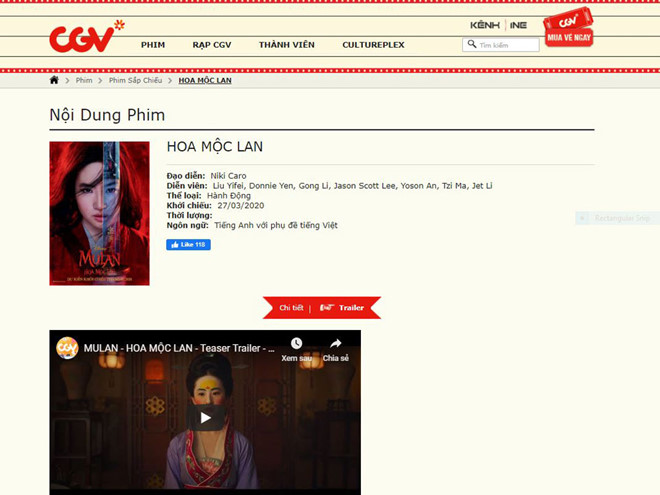
According to the CJ CGV website, the film Mulan is scheduled to be released in Vietnam in March 2020. The film stars Liu Yifei, who is among dozens of Chinese celebrities who have publicly expressed support for China's "nine-dash line" map used to claim illegal sovereignty in the South China Sea.
* Do you think Vietnamese audiences should welcome films starring Liu Yifei? Why or why not?
- Within every artist, there are always two halves: the artist and the citizen, and these two halves don't always go hand in hand. This isn't just true for Liu Yifei or Chinese artists. Remember that during the Vietnam War, while Jane Fonda visited Hanoi to support North Vietnam, John Steinback supported the American war against the Vietnamese people.
Of course, it is necessary to distinguish political naivety from a cognitive paralysis and blind obedience to an institution regardless of its wrongdoing, which Hannah Arendt says leads to the trivialization of evil.
In my opinion, Liu Yifei is just a mediocre actress (in every sense of the word). She makes films as an artist, and her films have nothing to do with Beijing's wrongdoings in the South China Sea. But when she supports those wrongdoings, we also need to engage in cultural self-defense.
Cultural self-defense means that if the Chinese use soft power to influence and spread false views about our territory, we also need to have "soft" measures to respond. This includes boycotting products with false content or those associated with individuals who support these false views. In addition, we need to severely punish those who smuggle "illegal and harmful goods" into the country.
* If someone argues that Liu Yifei participated in Mulan as an actress, not a politician, then the film might not support the "nine-dash line" and therefore shouldn't be banned or boycotted. What are your thoughts on that opinion?
- It's important to remember that Liu Yifei supported Beijing's unreasonable demands as an artist, not as an ordinary citizen. Therefore, as Vietnamese people, we need to resist that stance, at least within our own territory, so that she cannot use her status as an artist to repeat similar actions.
This is a way to send a message to those who want to "embed" sinister purposes into seemingly harmless products: that we are aware of their malicious intentions and we do not tolerate them.
That's also a way to neutralize Beijing's ambitions. I believe our actions can become a model for behavior in the region. Look at how the Philippines and Malaysia reacted to China's film with the nine-dash line after Vietnam's reaction. And when our behavior becomes a model, its power will increase.
|
|
* Unofficial information suggests that CJ CGV may be the distributor of Mulan. This distributor is also the one that made the mistake of releasing Operation Red Sea and Everest: The Little Snowman in Vietnamese theaters. What do you think CJ CGV should do in Mulan's case?
- I believe the recent punishment for CJ CGV is too lenient. A media outlet that violates press laws can be suspended for a period of time, or even have its license revoked. So, why is a business that disregards Vietnamese law and subtly and systematically insults the national spirit of the Vietnamese people only fined? Why can't it be banned from doing business for a period of time? If it's true that this business planned to import films...MulanThis further reinforces my belief that this company shows a complete lack of respect for Vietnamese people and that our penalties are far too lenient!
* Recently, there have been too many instances of the "nine-dash line" appearing in Vietnam. What are your thoughts on these "soft" campaigns aimed at instilling misinformation about borders and territory?
- The "soft" campaigns to instill misinformation about borders and territories are a long-term, systematic, and large-scale plan by China. It's encouraging that Vietnamese people's awareness of this issue has shown positive changes. The Party's thematic resolutions on culture from 1998 to the present have consistently emphasized the need for each individual and society as a whole to strengthen its cultural resilience in order to resist negative ideologies and tendencies. At least in the area related to sovereignty, we have begun to do so.
The problem is that our legal system and penalties for this issue seem too lenient. I am horrified to learn that in some universities, both department heads and lecturers nonchalantly import textbooks containing maps depicting the "nine-dash line" and then, when discovered, claim ignorance or a lack of competence to detect it, without facing any consequences. Only by increasing the severity of penalties can we further enhance society's ability to defend itself against erroneous ideologies and neutralize Beijing's schemes related to sovereignty and territorial integrity.
| In July 2016, the Permanent Court of Arbitration (PCA) in The Hague issued a ruling rejecting China's claim of sovereignty over the "nine-dash line" map in the South China Sea. At that time, the Chinese news site Sina reported that dozens of Chinese entertainment artists had posted messages opposing the PCA ruling. These artists even defiantly asserted that the "nine-dash line" map affirmed China's complete and inseparable territory. Among them were artists such as Liu Yifei, Li Yifeng, Fan Bingbing, Li Chen, and Dilraba Dilmurat… |
According to thanhnien.vn
Author:Ngu Yen
Newer news
Older news



