
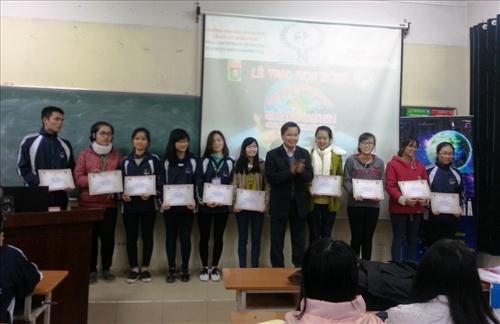
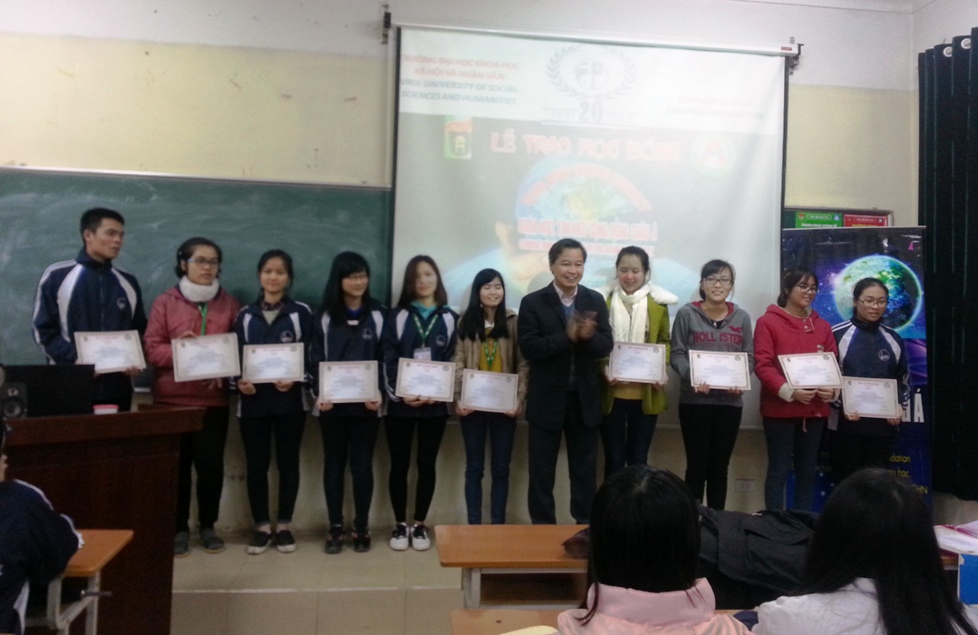
Associate Professor Pham Quang Minh awarded scholarships to 10 students from the Faculty of Oriental Studies.
Attending the closing ceremony were Assoc. Prof. Dr. Pham Quang Minh, Vice Rector of the university, Dr. Nguyen Tran Tien, Deputy Head of the Faculty of Oriental Studies, and Assoc. Prof. Dr. Le Dinh Chinh, Head of the Asian Community Research Program.
The 21st century is considered the Asia-Pacific era. Recognizing the importance of understanding the Asian community for young people, the One Asia Foundation has for many years sponsored the Faculty of Oriental Studies, University of Social Sciences and Humanities, Vietnam National University, Hanoi to organize the course "Understanding the Asian Community". (2015 marked the third year the course was held.)
This is a special course for first-year students of the Faculty of Oriental Studies. The course is taught by leading experts from both within and outside the country in all fields.
The purpose of this course is to provide learners with a clearer understanding of the Asian community. From there, learners will have the opportunity to learn about the difficulties, advantages, opportunities, and challenges faced by countries in the region, especially Vietnam, in its journey towards a higher level on the regional and global stage in today's era of globalization.
Following the opening remarks, Associate Professor Pham Quang Minh, Vice Rector of the University, awarded scholarships to the 10 students with the highest academic results in the course.
This year's course has 13 modules:
|
Topic 1 |
Assoc. Prof. Dr. Pham Quang Minh The role of science in maintaining and preserving cultural heritage – sustainable tourism development in Asia
|
Associate Professor Pham Quang Minh presented the current situation and the preservation of cultural heritage in several Asian countries, and from there proposed some solutions for sustainable tourism development in Asia. The main content of the presentation included:
|
|
Topic 2 |
Prof. Dr. Mai Ngoc Chu Preserving Asian Indigenous Languages: Theory and Practice
|
This paper presents a comprehensive overview of ethnic languages in Asia from the perspective of both their ancestral relationships and structural types. Professor Mai Ngoc Chu delves into an analysis of the situation of language extinction in Vietnam and the measures that have been and are being implemented to save languages at risk of extinction. |
|
Topic 3 |
Assoc. Prof. Dr. Le Dinh Chinh International Relations in Asia: History and Prospects
|
International relations are understood as the totality of economic, political, ideological, diplomatic, military, and other relationships between nations and systems of nations, between classes, social forces, and primarily international and political organizations operating in the international arena. Throughout history, the world has experienced many ups and downs with unpredictable changes. However, in the complex circumstances of the current global situation, peace, cooperation, and development remain a major trend; globalization is an objective trend that is increasingly attracting more countries to participate. Vietnam is also keeping pace with this general trend of the times. |
|
Topic 4 |
Prof. Dr. Pham Hong Tung Foreign policies of some "major powers" in Asia
|
The main purpose of this lecture is to introduce students to current international relations in the Asia-Pacific region. The foreign policy and international strategies of each country will be approached and analyzed from multiple perspectives, allowing students to develop their own interests and continue to explore international relations in each region independently. |
|
Topic 5 |
Assoc. Prof. Dr. Hoang Anh Tuan "Regionalization" of national history: Vietnam's position in the East Asian maritime trade network in the pre-modern period.
|
Historians specializing in empires, when studying the sea or coastal regions, tend to view their subjects from a land-based perspective, assuming that coastal and maritime areas should be treated as an integral part of the mainland. Therefore, the sea is often seen as a peripheral element and, functionally, dependent on the political and cultural centers of the mainland. Maritime historians, however, employ their own unique approach. Metaphorically speaking, maritime historians position themselves at sea to observe coastal areas; they look from the sea toward the shore, not from the shore toward the sea. |
|
Topic 6 |
Assoc. Prof. Dr. Nguyen Tuong Lai Religion and its role in building Asian communities.
|
The lecture provides students with basic knowledge about religion and its history, as well as the characteristics of major religions around the world. Furthermore, and this is the main content of the lecture, it outlines the religious foundations for guiding the development of an Asian community. These foundations are based on the similarities between religions and their roles in social, political, economic, environmental, and peace-related aspects. With these similarities and their significant roles, religions can certainly contribute positively to the development, stability, unity, and peace of the Asian community. |
|
Topic 7 |
Assoc. Prof. Dr. Nguyen Thuy Van The Role of Institutions and Political Ideologies in Building an Asian Community: A Philosophical Perspective
|
This module provides learners with fundamental knowledge about the organizational structure of the current political systems of Asian countries and the ideologies that govern their development. Based on this, we can identify common goals and similarities to build an Asian community in solidarity and for shared, sustainable development. |
|
Topic 8 |
Assoc. Prof. Dr. Pham Van Quyet Population of Asia and Vietnam: Issues related to changing trends.
|
From around the 1950s, the population of Asia entered a period of dramatic increase, often referred to as a "population explosion." With the aim of highlighting Asian demographic issues within the context of global demographics and Vietnam's demographic progress within the context of Asian demographics, this article seeks to clarify Vietnam's connection with the region in the current process of globalization through demographic variables.
|
|
Topic 9 |
Assoc. Prof. Dr. Nguyen Thi Kim Hoa Structural and functional changes in Asian families
|
The family is the basic unit of society, playing a decisive role in its formation and development. The positive values and norms of the family, when embraced and developed, contribute to building, enhancing, and glorifying the national cultural identity. This module helps students understand some concepts about family, its structure and function, and changes in family structure in some Asian countries. |
|
Topic 10 |
Professor Ahnkyonghwan The Korean Wave (Hallyu) and its influence in Asia
|
The story of the Hallyu wave (Korean cultural wave) has sparked lively discussions among Vietnamese and Korean researchers, journalists, and young people who are fans of Hallyu. This module will give us a better understanding of the Korean Wave (Hallyu) that is spreading across East Asia, including Vietnam, and its influence on many fields. Students will gain a comprehensive perspective to selectively embrace this cultural wave, contributing to the promotion and preservation of Vietnamese culture. |
|
Topic 11 |
Dr. Nguyen Tran Tien Building the ASEAN Community: A Regional Learning Approach
|
The 21st century is considered the Asia-Pacific era. The strong rise of China, India, and the United States is seen as a leading factor in this development. Along with this, the trend towards multipolarization of the global security structure in general, and the Asia-Pacific region in particular, is shifting from a strategic orientation to a more defined structure. Against this regional and international backdrop, the ASEAN Community will officially be established on December 31, 2015. This is a significant milestone in ASEAN's history. The specialized topic "Building the ASEAN Community: A First Approach to Area Studies" helps students gain a general understanding of regional studies; theoretical issues related to area studies such as the Eastern cultural region; and some fundamental and prominent issues of countries and territories in the region such as economics and economic integration, culture and society... through specialized and interdisciplinary studies in Area Studies.
|
|
Topic 12 |
Dr. Nguyen Quang Lieu Employment for Vietnamese students in the Asian community: Opportunities and challenges.
|
The Asian community is a dynamic and diverse continent. The region has achieved significant economic growth in recent decades, but has also witnessed an increase in inequality and the persistent presence of low-quality jobs. This thesis provides an overview of labor market trends and the impact of the Asian Community on labor markets through simulation models and practical policy analysis, with the aim of providing evidence-based policy recommendations for better employment opportunities for graduates. |
|
Topic 13 |
Assoc. Prof. Dr. Pham Hong Thai The cultural industry in Japan and South Korea and its international impact. |
Currently, the cultural industry is becoming a key economic sector, even considered a "pillar" of the economy in many countries around the world. Therefore, studying the current state of development of the cultural industries of Japan and South Korea, their economic, cultural, and political significance and roles, as well as their international impacts, is a truly significant theoretical and practical issue. It not only enhances understanding of these two countries, which play important economic and cultural roles in Asia, but also provides important insights for learning from their experiences in developing the cultural industry in Vietnam. |
Author:Dinh Hau
Newer news
Older news

