

This page commemorates the 80th anniversary of the school's tradition and 30 years of development.University of Social Sciences and Humanities


With a history that began with fate and continues through passion!
As a recipient of the "Glory of Vietnam" award, Professor, could you share some of your thoughts and feelings?
- I was truly surprised to receive the news that I was included in the list of 15 collectives and individuals honored in the "Glory of Vietnam 2015" program of the Vietnam General Confederation of Labor. While surprised, I also felt happy and honored, and somewhat felt that I was given more preferential treatment than many other colleagues in the field of higher education and scientific research in the country.
What led Professor to the field of history, and why has he remained so passionate about it until now?
- When I took the university entrance exam, I didn't even know what the Law major was like, because I planned to study medicine. But right before the exam, I unexpectedly received an acceptance letter to the University of Hanoi. At first, I wasn't happy, but the more I studied, the more interesting I found it, and gradually I developed a passion for the subject.
Among the many major issues in history, which topic particularly interested the professor and prompted his in-depth research?
- The topic I've been most passionate about and dedicated to researching for the past 30 years is the Vietnamese intellectual class. Before the Doi Moi (Renovation) period, the assessment of the intellectual class in Vietnam was rather cautious. Some opinions suggested that elevating intellectuals was tantamount to diminishing the role of the working class. During the Doi Moi years, the atmosphere of academic freedom in the country has increasingly developed, and the role of intellectuals is assessed more realistically and objectively. What I wholeheartedly affirm is that intellectuals have always been a representative force of the nation's intellect, initiating and proposing new ideas on politics, culture, and academia… and I have dedicated myself wholeheartedly to this ideology, yet sometimes I am still judged unfairly and inadequately.
According to the professor, what is the mission of the legal profession in the development of the country, especially in the current context?
My view is that people must know their roots; otherwise, they will lose their way, not knowing who they are, where they are going, or where they belong. For Vietnam, Vietnamese people need to understand their national history to know what their traditions, identity, and strengths are. Studying history is about understanding oneself and others, nurturing and cultivating love for one's homeland and country, and fostering national pride. Understanding history will help one understand the present and guide the path forward, towards the future, in the clearest and most confident way.
"Underestimating the importance of history is dangerous!"
It's a rather disheartening reality that many students are not enthusiastic about history, and quite a few have even turned their backs on a subject considered too dry. What are your thoughts on this, Professor?
- In my opinion, firstly, it's due to a misunderstanding of the role of history in the holistic education of individuals, fostering character and national consciousness. Teaching history is often seen as simply teaching about the country's past. Students need to understand history in its comprehensive development, encompassing various dimensions and fields. Secondly, the teaching of this subject is unscientific, failing to engage and inspire interest and passion for learning history in students. This poses a significant risk to the younger generation. Not knowing who they are, what their strengths and weaknesses are, will put them at a disadvantage in their development.
With the general policy of reforming education and, in particular, reforming higher education, what notable changes has the University of Social Sciences and Humanities undergone, Professor?
- As a member of the Vietnam National University, Hanoi, the university has implemented a policy of reforming its admissions methods through competency-based exams. This is one of the important reforms. Secondly, the university has reformed its governance, evaluating the work performance of faculty members based on output rather than administrative time management. Work is evaluated based on output at the end of the month, the end of the semester, and the end of the year.
Thank you very much, Professor!
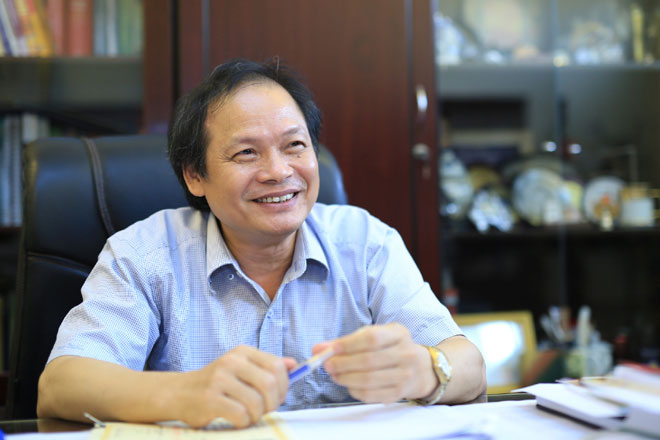
Professor Nguyen Van Khanh, born in 1955 in Hai Duong, is currently the Rector of the University of Social Sciences and Humanities (Vietnam National University, Hanoi). His main research areas include the socio-economic history of Vietnam during the colonial period, Vietnamese intellectuals in history, and agricultural land and rural areas in Vietnam during the modern and contemporary periods. He has published (as an author, editor, and co-author) over 20 books and 100 articles in domestic and international scientific journals; and has trained hundreds of undergraduates and dozens of PhDs and Master's degree holders for many universities. Notably, he has been honored with three scientific awards: the Outstanding Scientific Work award from Vietnam National University, Hanoi in 2009 and 2012, and the Silver Award for Best Book from the Vietnam Publishers Association in 2013.
Author:Duong Ha (according to Lao Dong newspaper)