The Party Committee of the University of Social Sciences and Humanities is preparing to hold its 28th Party Congress, aiming to evaluate the results of leadership in implementing the Resolution of the 27th Party Congress of the University for the 2015-2020 term and to determine the direction and tasks for leading the University in the 2020-2025 term.
The Congress took place precisely on the occasion of the 25th anniversary of the founding of the University of Social Sciences and Humanities (1995 - 2020) and the 75th anniversary of the Faculty of Literature (1945 - 2020). The Congress held special significance not only in summarizing the work of the 5-year term (2015 - 2020), but also as an opportunity to look back on a quarter-century of building and growth of the University's Party Committee, thereby setting directions for the development of the University of Social Sciences and Humanities in the coming decades.
Significant results have been achieved in political and ideological education.
During the 2015-2020 term, the University Party Committee thoroughly understood and focused on directing and organizing the implementation of the Resolution of the 27th Party Congress of the University, the Resolution of the 5th Party Congress of Vietnam National University, Hanoi, and the resolutions and directives of Party committees at all levels in a systematic, decisive manner, achieving good results. The Party Committee regularly updated, disseminated, and thoroughly understood the Party's guidelines and resolutions on Party building, internal political security, Party discipline, and combating corruption and abuse of power… while guiding and requiring Party branches to ensure the effective implementation of Party activities, supplementing self-criticism and criticism in the evaluation of grassroots Party organizations and Party members; grasping the political and ideological situation, promptly resolving concerns and difficulties of staff, faculty, and students; and actively defending the Party's viewpoints, guidelines, and policies, as well as the State's laws and regulations.
 |
| Expressing gratitude to teachers during the celebration of Vietnamese Teachers' Day, November 20, 2018. (Photo: USSH) |
The Party Committee has seriously implemented the regulations on grassroots democracy. The Party Committee Secretary regularly schedules meetings with citizens. Annually, dialogues are organized between the school's leadership and staff, faculty, and students; public and transparent reporting of all aspects of the school's activities is implemented; and policies and directives are formulated to develop regulations to ensure the rights and gradually improve the living standards of staff, faculty, and students.
The work of educating and fostering political and ideological awareness is carried out in many rich, practical, and lively forms. The Party Committee of the University of Social Sciences and Humanities has become a reliable address, chosen by higher-level Party and Youth Union organizations for work, surveys, forums, and summarizing experiences on political and ideological education, and implementing policies and resolutions related to students.
Overall, political and ideological education has achieved significant results. The vast majority of cadres, Party members, and students have firm ideological viewpoints and stances, maintaining moral qualities and playing a pioneering and exemplary role in fulfilling their responsibilities and duties. As a result, the University's Party Committee has achieved many accomplishments in various areas of work, consistently maintaining its title as a model clean and strong grassroots Party organization for many years. The University's Youth Union and Student Association have been recognized as outstanding units for many consecutive years. The University's Trade Union has consistently received the title of strong grassroots trade union for many years.
Innovate the organizational model and build a team of staff in the direction of a modern research university.
Aiming to build a research-oriented, multidisciplinary, and multi-field university model, stemming from practical requirements, the Party Committee directed the establishment of the Department of Religious Studies; the Center for Marine and Island Studies; the Center for Research and Promotion of Cultural Resources; the restructuring of the Journal of Social Sciences and Humanities; the establishment of the Specialized High School for Social Sciences and Humanities; and the establishment of two new units under the Faculty: the Department of Public Policy (under the Faculty of Management Science); and the Center for Applied Research and Development of Social Work (under the Faculty of Sociology).
The Party Committee directed the streamlining of the organizational structure and reorganization towards improving capacity and efficiency in accordance with Resolutions 18 and 19 of the Central Committee. As part of a pilot program to transform the research and training institute model within the university, the Institute of Journalism and Communication Training was established in 2018. The university reviewed and evaluated the effectiveness of its units from the departmental level, and based on this, developed a plan to restructure, integrate, and merge some departments to meet new requirements. Many units have implemented the plan according to the set schedule.
The Party Committee has implemented the policy of appointing leading and managerial cadres according to the regulations and criteria of Vietnam National University, Hanoi and the University; directed and implemented the planning of key cadres of the University and its units for the period 2020-2025 and the next term; directed units to review planning periodically; directed the rational use and creation of interconnected human resources between units, ensuring the stability of the organizational structure; directed the implementation of training and professional development of cadres, achieving the standards for titles and academic degrees, exceeding the targets set by the 27th Congress.
During the past term, the work on organization and personnel has basically fulfilled the targets and tasks, with some core targets being met or exceeded. Some tasks not set out in the Resolution were promptly added and completed ahead of schedule through the leadership and guidance process.
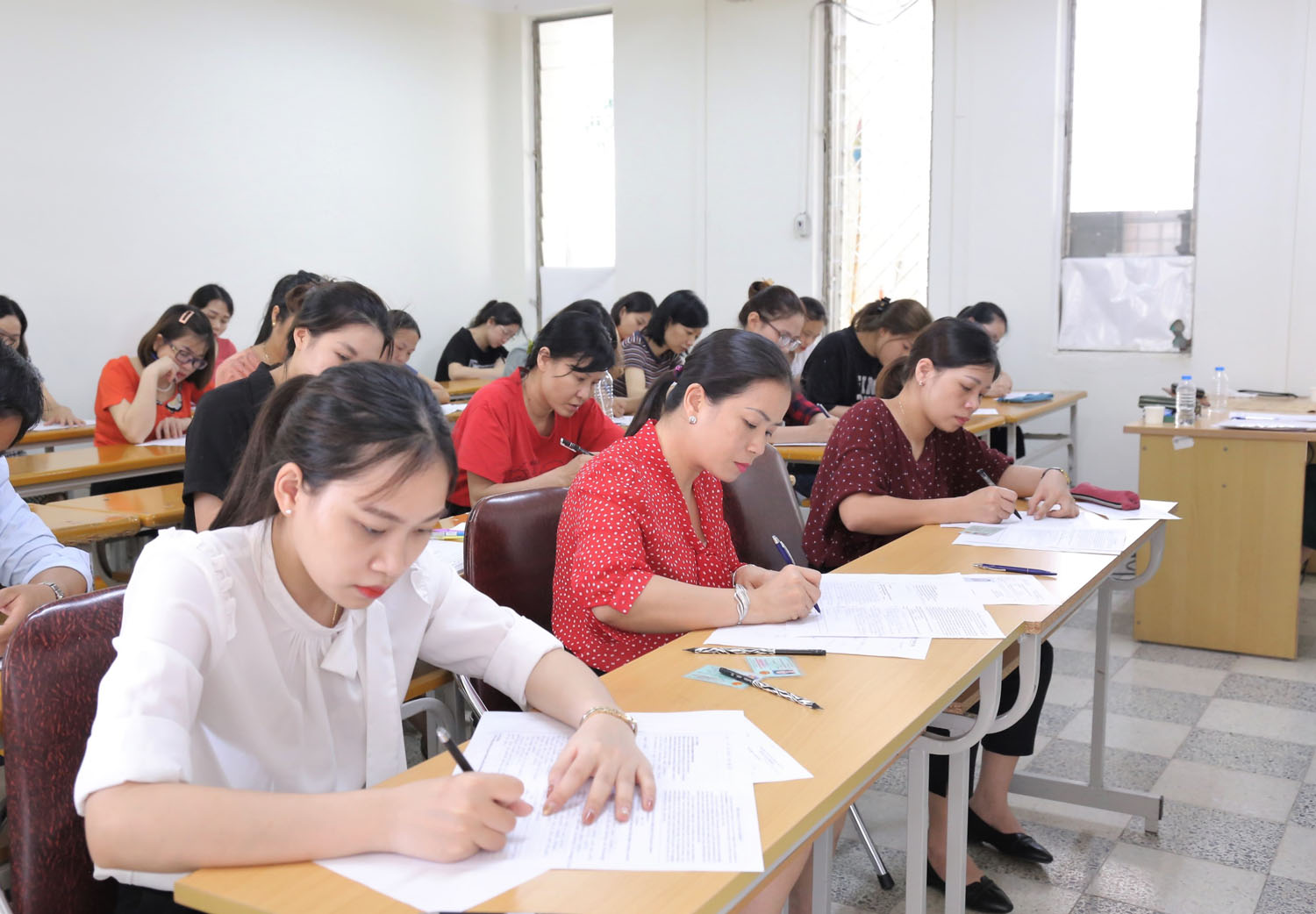 |
| Candidates participating in the first round of the 2020 graduate entrance exam (Photo: USSH) |
Innovate admission methods and improve training quality.
University admissions and training during the 2015-2020 period underwent many changes, presenting both opportunities and challenges. In this context, the University Party Committee directed the implementation of several timely and comprehensive solutions: establishing a specialized admissions department within the Training Department; diversifying forms of promotion and admissions counseling; standardizing the management and organization of training; adjusting the planning of majors and specializations to develop new, appropriate training programs; supporting the development of the teaching staff; increasing investment in training facilities; and strengthening relationships with agencies, businesses, political and social organizations, etc.
Training has achieved some positive results: university enrollment attracted many applications, from 17,478 (2015) to 39,980 (2019); the number of admitted and enrolled students increased from 1,439 (2015) to 2,186 (2019); postgraduate enrollment, although declining, still maintained a level of 85% for master's students and 90-100% for doctoral students compared to the assigned targets. Other training systems saw a slight decrease following the general trend of society but remained relatively stable.
Training activities have undergone many innovations and yielded positive results, including the development of 6 new undergraduate programs; 4 undergraduate programs with a socialized orientation; 12 master's programs; 3 doctoral programs; adjustment of undergraduate programs to be compatible with training regulations and the new situation of the labor market; and the development and improvement of the learning materials system.
Training organization and management have undergone many innovations, ensuring compliance with regulations and maximizing flexibility in planning and organizing training; promoting the application of information technology platforms; strengthening positive interaction between lecturers and learners; managing and organizing training data in a standardized, open, and transparent manner; improving the efficiency of coordinating training organization between units within the School and within VNU; strongly innovating teaching and assessment methods; and initially applying online teaching and learning software systems in reforming training and assessment.
 |
| Awarding prizes for the 4th Outstanding Youth Union/Student Association Cadre Competition, academic year 2018-2019 (Photo: USSH) |
Under the leadership of the Party Committee, student affairs have seen many improvements and achieved positive results, including the successful implementation of the one-stop service model, facilitating students in handling administrative procedures. The role of the university's alumni network has also begun to be promoted.
Quality assurance in training has been emphasized and has achieved many positive results, meeting the development needs of higher education in the new situation. Inspection and legal work in the field of training has yielded many positive results, contributing to maintaining good discipline and order in the school, scientific research, and other activities of the University.
Creating high-quality scientific products and strengthening international integration.
The resolutions, conclusions, and thematic reports of the Party Committee have made significant contributions to guiding scientific research towards creating high-quality scientific products, strengthening international integration, and gradually developing the University towards a research-oriented university.
The university has maintained and enhanced its position and prestige as a leading research university in the social sciences and humanities in Vietnam, with international recognition. The university's scientific staff has led and implemented numerous scientific projects at various levels; many experts have been assigned as project leaders for component tasks within major national scientific programs. The university's research has contributed to consolidating the fundamental theoretical framework on the path to socialism in Vietnam; building, developing, and preserving Vietnamese culture; national defense strategy and international integration; promoting democracy, building the political system, and establishing a socialist rule of law state in Vietnam; and building and reforming the Party, etc.
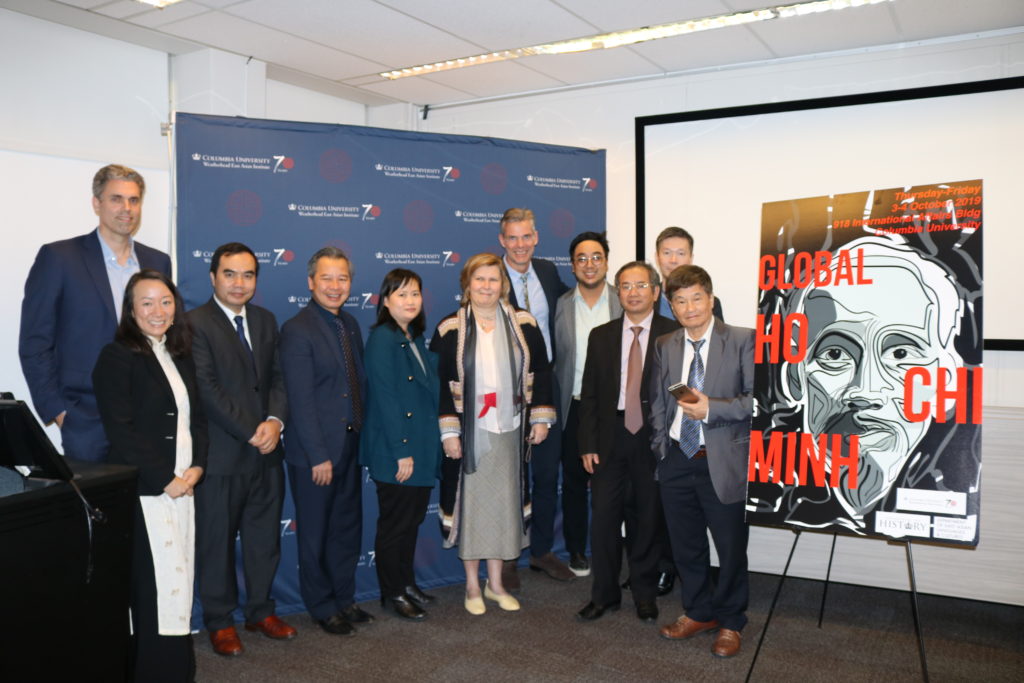 |
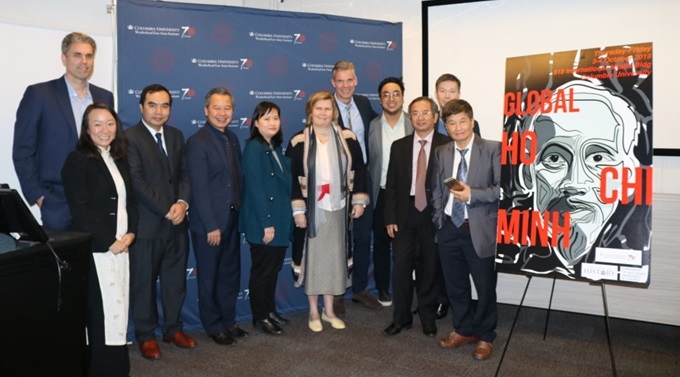
| Scientists at the "Global Ho Chi Minh" international conference in New York (USA), October 2019. This event commemorated the 50th anniversary of the implementation of President Ho Chi Minh's Testament (1969-2019) and was part of a cooperation program between Columbia University (New York) and the University of Social Sciences and Humanities, Vietnam National University, Hanoi. (Photo: USSH) |
Scientific research is gradually becoming internationalized, especially in the areas of organizing scientific conferences and publishing international papers. Over the past five years, the university has organized more than 50 international scientific conferences, published 6 monographs in prestigious international publishers, 68 articles in ISI/SCOPUS journals, and 250 articles in other international journals. Many student research projects have won scientific research awards at the ministerial, VNU, and Central Youth Union levels.
Under the leadership of the Party Committee, cooperation and development work has achieved many successes, contributing to enhancing the prestige of the University. In recent years, the University has established and signed cooperation agreements with more than 100 domestic and international partners, including many prestigious universities, research institutes, and scientific organizations; and continues to maintain and develop cooperation with funding foundations.
Along with the implementation of many important international cooperation programs and projects, the University has welcomed more than 170 foreign experts to teach and conduct research. Many staff members have been sent to study, teach, and participate in exchange programs at advanced universities around the world; hundreds of students have received scholarships from international and domestic organizations; and many students have also had the opportunity to study, exchange, and interact with universities and partners abroad.
In the coming period, the international and domestic situations present both advantages and disadvantages, opportunities and challenges intertwined, posing more demanding and challenging tasks and requirements for the University's Party Committee. Inheriting the tradition, prestige, and social standing, and leveraging comprehensive domestic and international resources, the University's Party Committee is determined to unite, proactively and creatively prepare the necessary conditions, clearly define objectives and tasks to continue innovating and developing the University in the 2020-2025 term, with a vision to 2035, worthy of its glorious tradition, fulfilling the expectations of generations of staff, students, and society, and the trust of the Party, the State, and Vietnam National University, Hanoi.
According to the online newspaper of the Communist Party of Vietnam.
Author:Devotion

