
According to the Ministry of Education and Training's guidelines, educational institutions must announce the results of the first round of admissions before 5 PM on August 13th. The current trends in university admission scores for 2026 show notable shifts in field choices: STEM, engineering, and strategic technology are becoming more attractive, while applied social science fields are attracting candidates with comprehensive thinking skills.
Applied Social Sciences welcomes students with excellent math skills.
In 2026, the University of Social Sciences and Humanities (Vietnam National University, Hanoi) will enroll students in 29 training programs. According to Assoc. Prof. Dr. Dang Hong Son - Vice Rector of the University, the admission scores are concentrated in the range of 21.00-26.00 points, with a median of 24.00 points. Two majors have an admission threshold of 19.00 points set by Vietnam National University, Hanoi.
Compared to previous years, this year there are no majors with cut-off scores at or near 29 points. Associate Professor Dr. Dang Hong Son stated that the results are within the university's forecast of admission scores ranging from 22-26 points. According to him, the national average Literature score decreased compared to previous years, while all 29 majors at the university use a subject combination that includes Literature, thus impacting the admission scores. In addition, this year the university did not recruit students using the C00 subject combination in 14 out of 29 majors, causing a slight decrease in the overall average score.
Although the average score for combination C is lower than that for combination D, the university still maintains a 1.5-point difference between C00 and combinations A and D. According to Associate Professor Dr. Dang Hong Son, this is part of a strategy to recruit students from the top 10% of high school exam candidates, aiming to train elite students in line with the general orientation of Hanoi National University.
Notably, the number of candidates achieving a score of 8.0 or higher in Mathematics in the admission combinations including Mathematics was 431 out of 810 candidates. The group of candidates excelling in Mathematics is concentrated in several highly applied fields. Among them, Psychology (QHX21) had 86 candidates achieving a score of 8.0 or higher in Mathematics, with an average score of 8.40 and a single perfect score of 10 in Mathematics. Multimedia Communication (QHX29) had the highest percentage of candidates achieving a score of 8.0 or higher in Mathematics, with 14 out of 15 candidates, equivalent to 93.3%, and an average score of 8.52. Public Relations (QHX15) and Journalism (QHX01) had 48 and 36 candidates respectively achieving a score of 8.0 or higher in Mathematics.
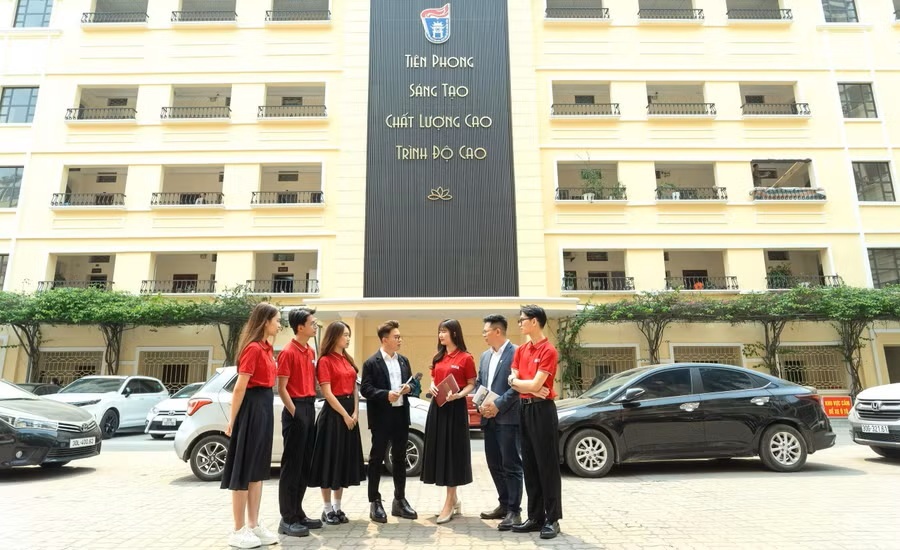
In 2026, the University of Social Sciences and Humanities (Vietnam National University, Hanoi) will enroll students in 29 training programs.
Associate Professor Dr. Dang Hong Son highly appreciated the 2026 admissions results, especially the performance of new students in subject combinations including Mathematics and Foreign Languages. According to him, this result shows a positive shift in the choice of majors, with applied social sciences, communication, and management increasingly attracting students with comprehensive thinking abilities.
Meanwhile, traditional and fundamental majors continue to attract high-quality candidates. History and Literature, both majors that still accept the C00 subject combination, have C00 admission scores of 25.50 and 25.41 points respectively, ranking first and second in the entire university. The D subject combination admission scores for the two majors are 24.00 and 23.91 points respectively, both placing them in the top 5 of the entire university.
According to Associate Professor Dr. Dang Hong Son, the admission results are consistent with the orientation of shifting the structure of admission criteria and training elite students at Hanoi National University. Improving the quality of incoming students in logical thinking and foreign languages is expected to create a foundation for the university to continue innovating teaching methods, promoting scientific research, and internationalizing its training programs.
STEM, a strategic technology, is gaining increasing appeal.
Hanoi University of Science and Technology announced the admission scores for 68 programs based on high school graduation exam scores, ranging from 20.06 to 29.54 points. According to the university's announcement, 3 programs scored above 29 points, 14 programs above 28 points, 30 programs above 27 points, and 53 programs above 24 points. The advanced program in Data Science and Artificial Intelligence achieved the highest score at the university, at 29.54 points.
Professor Vu Van Yem, Vice Director of Hanoi University of Science and Technology, said that admission scores have increased compared to 2025, especially in STEM fields. This attractiveness is driven by the demand for human resources in the labor market and policies encouraging training in science and technology fields.
Dr. Tran Khac Thac – Head of the Training Department at the Water Resources University – stated that the 2026 admission scores for technology and engineering majors at the university are trending upwards, continuing the positive trend from 2025. This result stems from the university's investment in infrastructure, laboratories, practical training facilities, amenities, and the learning environment for students, as well as the impact of new government policies regarding technology and engineering fields.
Notably, the current cutoff score for this group of majors is among the highest at the Water Resources University, a change from previous years when other groups of majors had higher cutoff scores. This is a positive sign for the university to continue investing in and developing majors serving science and technology in the future.
Assessing the university entrance exam cutoff scores for 2026, Professor Nguyen Dinh Duc – former Chairman of the University Council of the University of Technology (Vietnam National University, Hanoi) – commented that in some fields prioritized by the State, especially strategic technologies, cutoff scores may increase. Fields such as artificial intelligence (AI), robotics, and automation are likely to attract more applicants thanks to investment policies and student support policies. This is a factor that could significantly impact the choice of majors and the quality of incoming students.
Policies are influencing people's choices of majors.

The total number of applications to STEM programs is approximately 2.3 million, accounting for nearly 33% of the total number of applications.
In relation to the field of pedagogy, Professor Nguyen Dinh Duc observed that, before the implementation of tuition fee support policies and other policies related to the teaching staff, the field of pedagogy was not truly attractive to candidates. When these support policies were implemented, the attractiveness of the field increased, leading to improved admission scores and entrance quality.
Based on this reality, Professor Nguyen Dinh Duc believes that similar policies are impacting the natural sciences and technology sectors. However, specifically for information technology, this year's admission scores tend to be lower than in previous years. One of the reasons is the impact of the job market and the rapid development of AI. AI is now capable of performing some tasks that previously required human labor, including programming-related operations, thus having a certain impact on students' choices of majors.
Nevertheless, Professor Nguyen Dinh Duc noted that the State's preferential policies and investments will continue to create important momentum for the development of engineering and technology fields. Therefore, this year's enrollment figures once again demonstrate the crucial role of the State's policies, orientations, and investment levels in the development of the higher education system.
Based on the 2026 university entrance exam results, Mr. Nguyen Tien Thao – Director of the Higher Education Department (Ministry of Education and Training) – observed a clear shift in candidates towards basic science, STEM, key engineering, and strategic technology fields. This is a positive sign, especially considering that these fields are eligible for government scholarships under Government Decree No. 179/2026/ND-CP.
The cutoff scores for majors and training programs in these groups also show a clear difference compared to 2025. Universities have announced higher cutoff scores for these groups of majors compared to 2025 and previous years. This is a positive sign, because candidates are not only interested in applying for admission, but those with good abilities, academic results, and high school graduation exam results have chosen majors in STEM fields to apply for admission in 2026.
In addition, some programs and majors in the fields of AI, semiconductor technology, and other disciplines have relatively high admission scores. Preliminary data shows that over 60 training programs have announced admission scores above 27 points. "We are currently continuing the review," said Mr. Nguyen Tien Thao, adding that business administration and economics remain attractive fields in recent times. These are also the fields of study that students prepare for since grades 10 and 11, or even choose 3-4 years in advance.
These fields remain attractive to society. In particular, training programs involving computation, data analysis, and statistics in business administration, economics, and finance are still popular choices for applicants. For these fields, universities maintain high admission scores and remain highly appealing to the public.
Besides the breakthroughs and developments in the science and technology sectors, other sectors also need attention. Talent is not limited to a few fields but serves all sectors. A nation can only develop when technology becomes a driving force contributing to socio-economic development.

Choosing an international joint program: Don't just look at the degree.
In 2026, nearly 874,500 eligible applicants will participate in the online admissions process, with a total of over 7.1 million applications; on average, each applicant will register approximately 8.21 applications. Compared to 2025, the number of applicants will increase by more than 25,000. By the time applicants register and are admitted, about 90% of the quotas will be filled. Of the 90% of eligible applicants, about 90% will confirm their enrollment. This shows that the expected ratio of universities to the number of applicants who actually want to attend university does not always reach 100%.
Education and Times Newspaper:University entrance exam cutoff scores 2026: STEM fields become more attractive, math-savvy candidates flock to social science majors.
Author:According to the Education and Times newspaper.
Newer news
Older news

