
Attending and directing the training course were Ms. Mai Thi Anh, Director of the Legal Department, and Mr. Nguyen Nhu Ha, Deputy Director of the Legal Department.
In the context of the increasing application of artificial intelligence (AI), especially generative AI, in management and professional activities, leveraging AI in the drafting, evaluation, and refinement of legal documents is opening up many new opportunities. However, this is also a field that demands a particularly high level of accuracy, verifiability, information security, and legal accountability.
Based on this requirement, the training module focuses on approaching AI as an assistant in processing information and creating drafts, rather than viewing AI as the primary entity in drafting legal documents or a tool that can replace human assessment and decision-making. The overarching principle of the module is: AI support - professional staff review - legal units or assessment entities perform their functions within their authority - the competent authority makes the final decision and the agency is responsible for the final product.
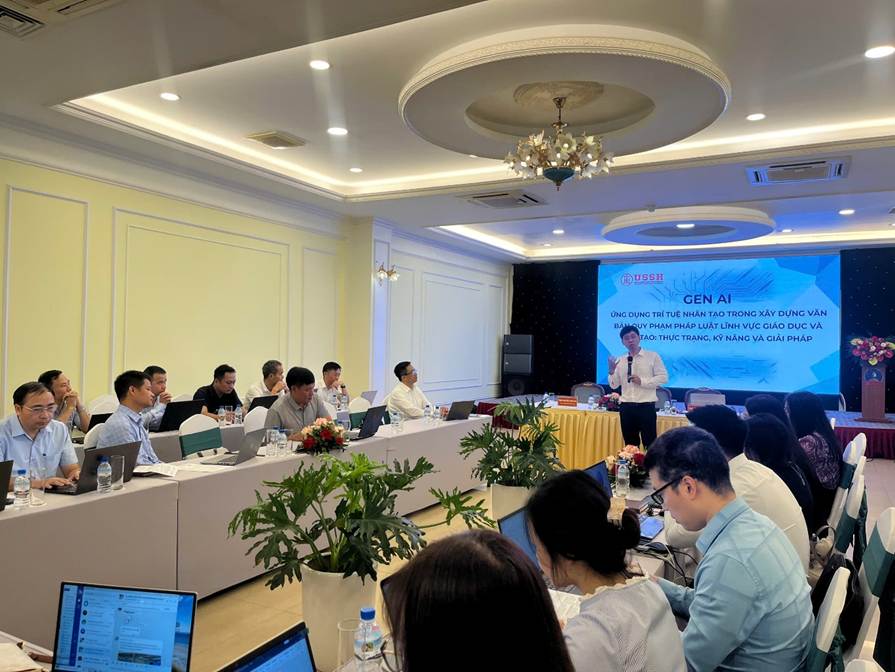
Dr. Dao Minh Quan - Deputy Head of the Department of Information Management, Faculty of Social Sciences and Humanities, Vietnam National University, Hanoi, participated in teaching at the training course.
Organize a controlled workflow for working with AI.
During the program, Dr. Dao Minh Quan discussed with the faculty members the changing approach to AI in the development of legal documents. Instead of posing general questions and directly using AI answers, users need to clearly define the context, input data, processing limits, verification criteria, and output format; shift from using model training data to working with selected and validated legal source data and specialized data; and organize a multi-stage process including draft creation, peer review, verification, revision, and approval.
One of the key focuses of the training course is to help teachers correctly identify tasks that can be delegated to AI support and those tasks that humans must directly perform and be responsible for.
AI can assist officials in tasks such as summarizing and extracting information from records; classifying documents; creating comparison tables; grouping and synthesizing feedback; suggesting structures; creating draft reports or clauses; and detecting potential conflicts, duplications, misreferences, or inconsistencies.
Conversely, issues related to defining policy objectives, selecting policy options, scope of regulation, conclusions on constitutionality, legality, consistency, and feasibility; decisions on whether or not to accept feedback; as well as the approval, promulgation, and accountability for the final document must belong to the individuals and entities with authority.
Practical application of AI in the development of legal documents.
In addition to providing foundational knowledge, the program is designed to be closely linked to practical tasks in the process of drafting legal documents.
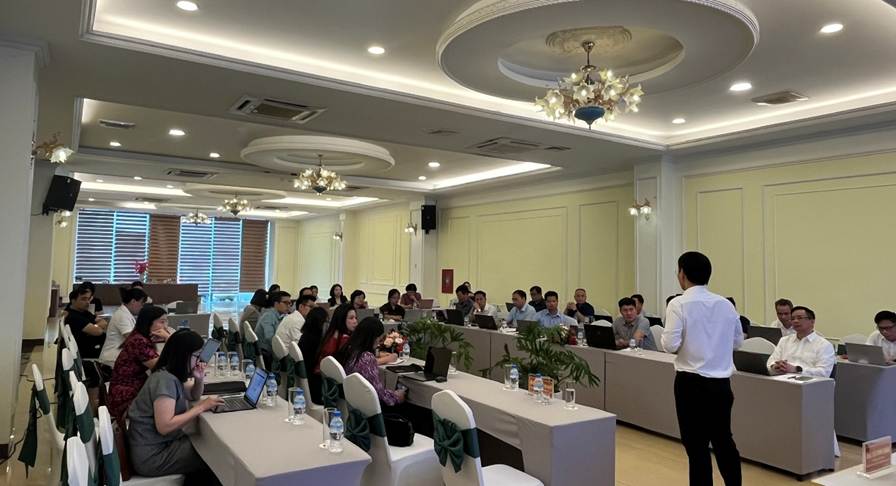
Teachers from the Ministry of Education and Training participated in the training course.
Teachers were guided on how to design a structured business prompt, including six basic components: role; context; input; task; constraints and verification requirements; and output format. In particular, when performing legal tasks, AI must be required to work on defined sources, not generate its own data or legal basis, must flag issues lacking sufficient evidence, and clearly indicate the location of information within the source document.
This module also introduces a multi-step workflow for working with AI: data extraction - criteria-based analysis - peer review - verification - refinement - testing. This approach helps to limit the tendency to immediately accept a complete answer generated by AI and increases control over each step of information processing.
The practical content is placed within specific tasks of the process of developing and refining legal documents, such as legal research and comparative policy documents; supporting policy impact assessment; developing outlines, glossaries, and clause matrices; supporting the drafting and review of clauses; technical review, referencing, and consistency; supporting appraisal; developing appraisal reports; summarizing, explaining, incorporating feedback, and revising drafts.
Six-layer verification - a key principle when applying AI.
One topic that received significant attention at the training course was the method for verifying AI-generated results across six layers, including:
(1) Source and originality;
(2) Validity and time;
(3) Jurisdiction and legal hierarchy;
(4) Logic and unity;
(5) Feasibility, impact and equity;
(6) Approval and responsibility.
The results generated by AI cannot be used directly in official records without prior verification. Verification is also not a formality; each layer needs to create evidence that others can review and verify the process.
This also forms the basis for building an AI application process that both leverages the advantages of the technology in processing large volumes of information and ensures traceability and accountability of professional staff.
Identifying risks for responsible AI use.
Besides the opportunities, the training course also focused on analyzing the risks of using AI in the process of drafting legal documents, including information and legal basis illusions; data bias; risk of inequality; data leaks and unpublicized drafts; changes in legal content during language editing; prompt bias; intellectual property issues; and the risk of over-reliance on AI.
In particular, AI is capable of generating very coherent and seemingly convincing answers, but it can still miscite text, misinterpret validity, create data, or base information on non-existent facts. Therefore, fluency in writing cannot be considered evidence of the accuracy of the content.
In the field of education and training, this requirement is even more significant when a legal regulation can directly impact learners, teachers, educational institutions, access to education, equity between regions, personal data, and the responsibilities of management agencies.
Towards an effective collaborative model between humans and artificial intelligence.
Through scenarios and practical exercises, the program aims to develop in teachers a proactive yet cautious, effective yet controlled approach to using AI. AI users not only need to know how to build prompts, but more importantly, they must know how to select the right tasks, prepare the right data sources, identify the tool's limitations, verify results, and explain their professional decisions.
In line with the theme, AI proficiency is not judged by the quantity of documents that can be produced in a short time, but rather by the ability to assign the right tasks to the AI, identify the tool's limitations, verify the results, and still take responsibility for each professional choice in the final product.
The training course on August 7, 2026, in Ninh Binh is a practical activity in updating knowledge, skills, and methods for applying AI for officials involved in developing and refining policies and laws in the field of education and training. At the same time, the program demonstrates the potential connection between strengths in information and data management, artificial intelligence, and digital transformation with the practical requirements of state management – one of the research, training, and community service directions that the University of Social Sciences and Humanities is particularly interested in promoting.
The University of Social Sciences and Humanities hopes to continue to receive the trust of the Ministry of Education and Training and be assigned the task of implementing further training courses.

Author:Department of Information Management
Newer news
Older news

