
The quality of education is verified by a leading university system.
One of the outstanding achievements of the 4th cohort is the presence of students at many leading higher education institutions.
Among the 139 students admitted to domestic universities, the Foreign Trade University had the highest number with 29 students; followed by the Diplomatic Academy with 19 students, the National Economics University with 18 students, Hanoi Law University with 16 students, and 19 students admitted to universities under the Vietnam National University, Hanoi, including 10 students admitted to the University of Social Sciences and Humanities. These five groups of universities alone accounted for 73% of the total number of students admitted to domestic universities.
Not only is the number of students impressive, but the breadth of their choices is also noteworthy. Students in the 4th cohort selected 30 higher education institutions nationwide, spanning various fields such as economics, diplomacy, law, social sciences and humanities, foreign languages, medicine, natural sciences, technology, electronics, arts, and interdisciplinary disciplines.
This shows that students at the High School for Gifted Students in Social Sciences and Humanities are not limited to a single group of disciplines associated with the school's traditional strengths. Building upon their foundation in social sciences and humanities, they have the potential to further develop in various fields of study, from economics, law, and diplomacy to natural sciences and technology.
This is also an important indicator showing that the school's comprehensive training capacity is not simply aimed at helping students achieve high results in the high school graduation exam, but also at creating a foundation for them to continue learning and developing in various educational environments.
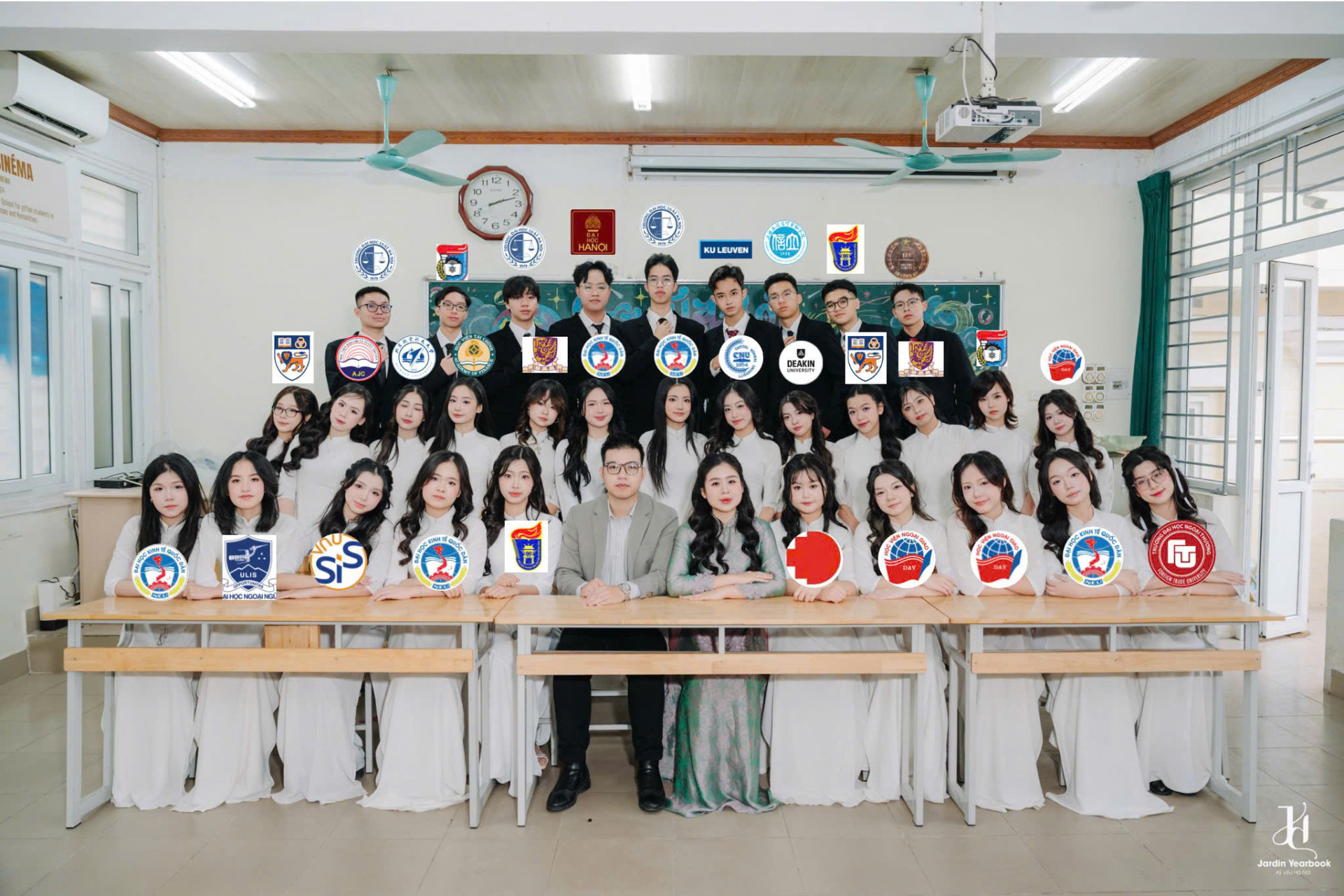
The students of Geography Class K4 proudly showcase their achievements in the recent university entrance exam.
Outstanding integration skills of students
Besides domestic admission results, international integration capabilities are a notable highlight in the output of students from the 4th cohort of the High School for Gifted Students in Social Sciences and Humanities.
Out of a total of 182 students in the school, 43 students chose to study abroad, equivalent to 24%. They chose to study in 15 countries and territories, spread across 4 continents.
Of these, China has 14 students and the United States has 8 students. These two countries alone account for 22 out of 43 students, equivalent to 51% of the total number of students studying abroad. The remaining destinations are spread across the UK, Belgium, the Netherlands, Finland, South Korea, Switzerland, Italy, Singapore, Germany, Japan, Australia, Hungary, and the UAE.
It is noteworthy that the choice to study abroad is not limited to just a few classes. Class 1 Literature has 13 students studying abroad, accounting for 33.3%; Class 1 Geography has 11 students, accounting for 34.4%; Class 2 Literature has 11 students; Class 5 History has 5 students; and the High-Quality Class has 3 students.
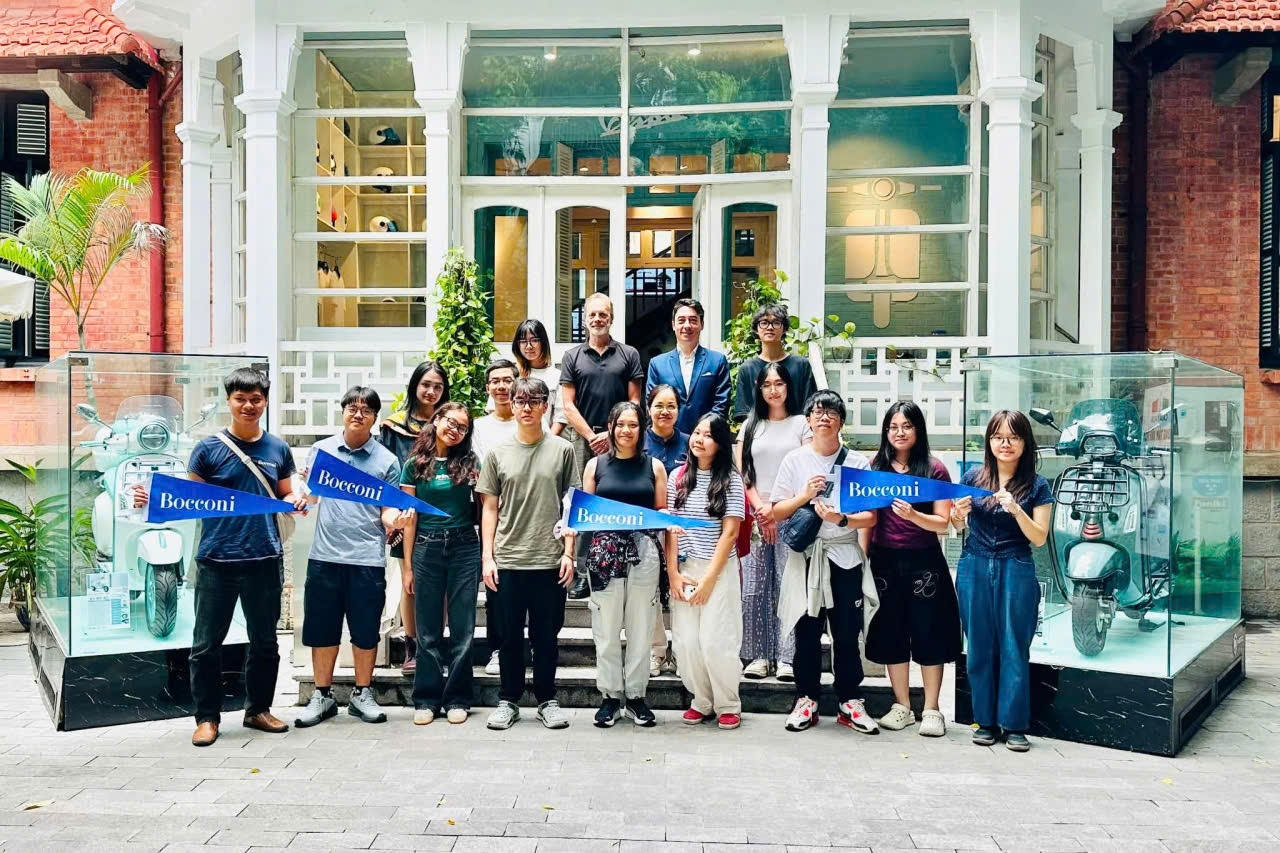
Student Nguyen Vu Hong Anh (K4 History class) and her classmates at Boconi University (Italy)

Tran Khoi Nguyen, a 12th-grade geography student, has been accepted into many universities.
This distribution shows that international integration capacity is not a characteristic unique to one class or one training model. In many different groups of students, foreign language ability, adaptability, and an international learning orientation have become a clear part of the school's output quality.
Students have access to top universities in various countries and regions with high scholarship amounts, from 50% or more, such as the University of Sheffield, Texas State University, Chapman University, Minerva University, Boston College, Mount Holyoke College, Bocconi University, University of Amsterdam, Università della Svizzera Italiana, Tokyo International University, Deakin University, KU Leuven, National University of Singapore, Chinese University of Hong Kong, Shenzhen University, etc.
If 100% of students admitted to university reflects the overall quality of the 4th cohort, then the fact that nearly a quarter of students chose to study abroad reveals another dimension of the training results: the ability to proactively choose their learning environment and adapt to diverse educational spaces.
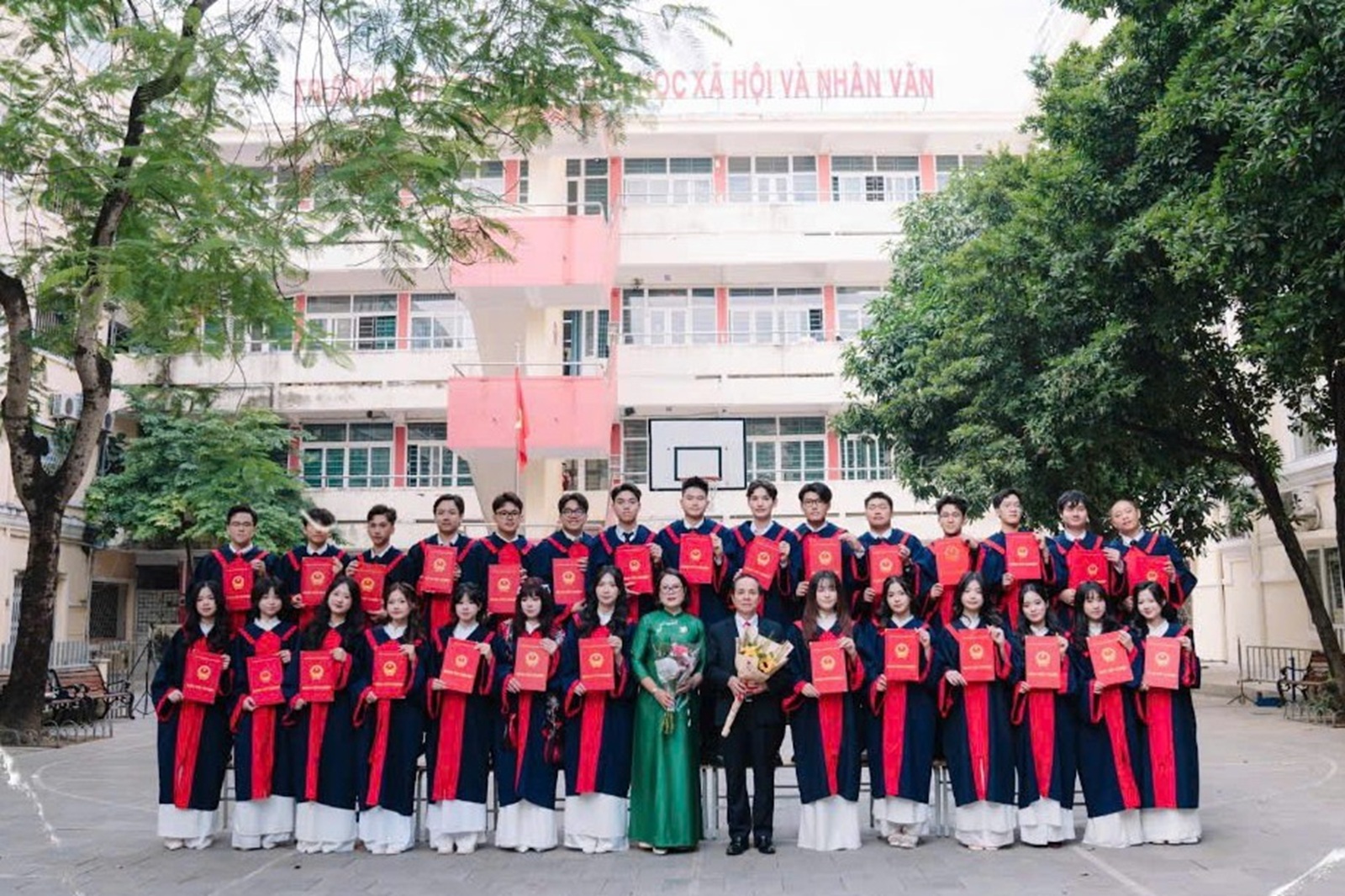
The K4 History class took a photo with Principal Nguyen Quang Lieu and homeroom teacher Hoang Hong Nga.
The 2026 university entrance exam results for the 4th cohort of students demonstrate the quality of the school's education in three aspects: outstanding academic achievement, diversity of educational choices, and international integration capabilities.
With 139 students admitted to domestic higher education institutions and 43 students studying abroad, the students of Batch 4 have access to a diverse range of educational institutions, including many highly competitive universities. Notably, nearly a quarter of the students chose international educational environments in 15 countries and territories, demonstrating their growing ability to learn, adapt, and integrate into the global community.
From top university destinations within the country to study abroad in many countries around the world, the results of Cohort 4 reflect a consistent training orientation of the High School for Social Sciences and Humanities: not only focusing on exam achievements but also emphasizing the holistic development of learners with a strong knowledge base, the ability to make choices, adaptability, and a desire to reach high-quality educational environments both domestically and internationally.
Author:Thuy Dzung - USSH Media
Newer news
Older news

