
Breaking free from the stereotypes of traditional libraries, the training program at the Faculty of Information Management, University of Social Sciences and Humanities, Vietnam National University, Hanoi, has made a strong breakthrough into modern fields such as data management, digital libraries, and digital communication. This is the ideal launching pad for young people who are passionate about technology, creativity, and want to master digital resources in a modern environment.
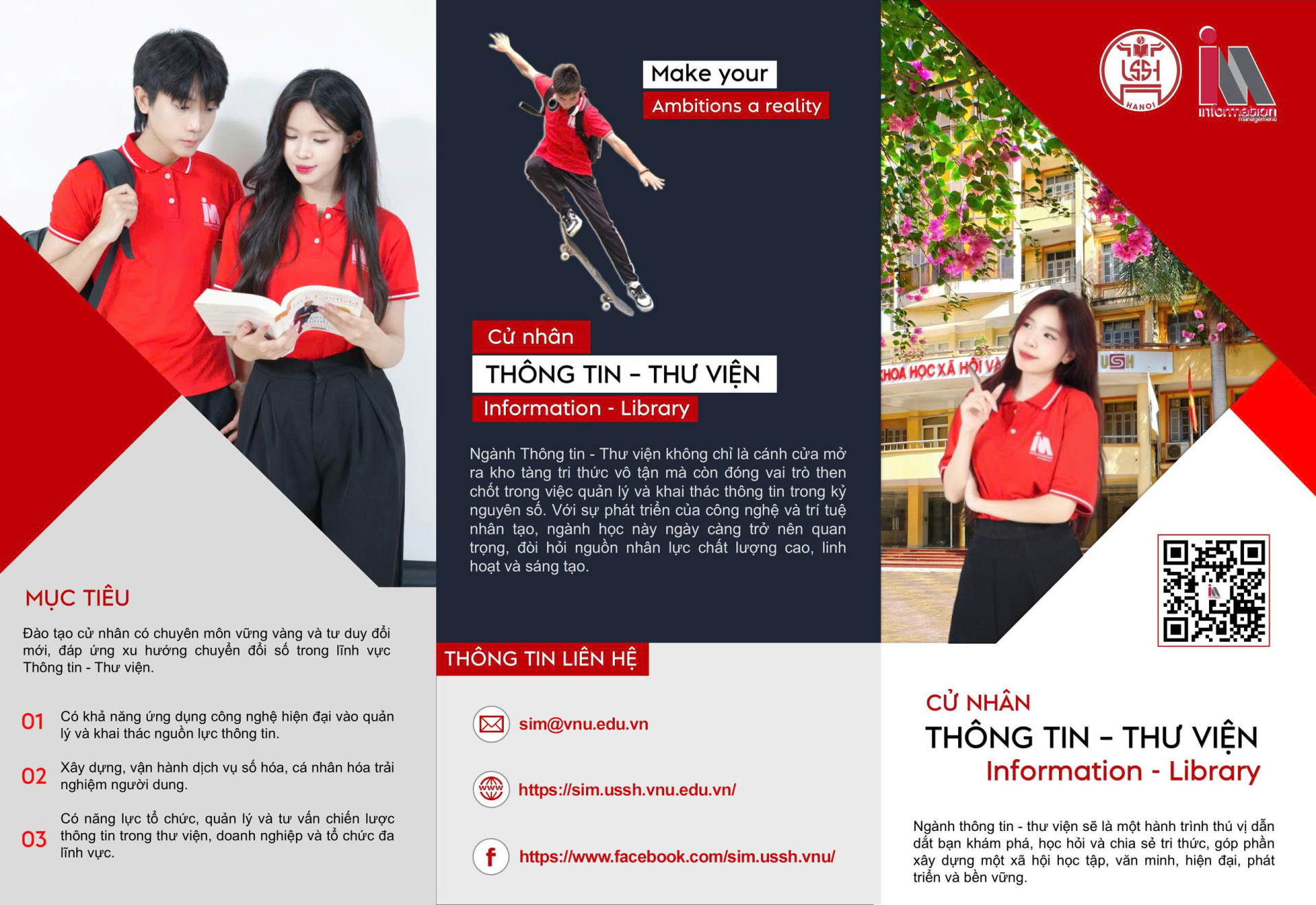
Admissions for Information and Library Science in 2026
1. Admission Information
- Name of the training program: Library and Information Science
- Training program code: 7320201
- Level of education: University
- Qualification: Bachelor's degree
- Language of instruction: Vietnamese
- Admission combinations: C00, D01, A01, D09, D10, D11, D14 and D15
In this era of booming technology, information no longer exists solely in paper form but also appears on digital platforms, data systems, websites, social networks, and many other online environments. Therefore, students in the Information and Library Science field not only work with books but also have access to:
- Digital data
- Information management system
- Digital media content
- Data management technology
- Information intelligence and knowledge management
- Electronic library
This field of study is suitable for those who enjoy a dynamic environment, love creating content, have organizational skills, are passionate about technology, and aspire to work in a modern field connected to digital transformation.
By studying Information and Library Science at the Faculty of Information Management, students will be equipped with a comprehensive system of knowledge, from foundational to advanced levels, combining theory and practice.
Students will learn:
- Information organization and management
- Building and managing a digital library
- Data and database management
- Cataloging and document processing
- Information system design
- Digital content management
- Communication and development of reading culture
- Extracting and analyzing information for research purposes.
- Application of technology in information and library activities
In addition, the curriculum is updated with the latest trends related to:
- Digital transformation
- Big Data
Artificial intelligence in information management
- Modern library technology
In addition to acquiring specialized knowledge, students also develop many essential skills:
- Information searching and processing skills
- Teamwork skills
- Communication and content creation skills
- Event organizing skills
- Scientific research skills
- Skills in using technology and data management software.
- Communication and presentation skills
To meet the demand for high-quality human resources in the context of digital transformation and the rapid development of a knowledge-based society, the Information and Library Science sector is offering two specialized training programs: Digital Humanities and Digital Knowledge Services, and Digital Libraries and Artificial Intelligence. These two specialized orientations are built on new development trends, combining the foundations of information and library science with digital technology, contributing to the training of human resources capable of managing, exploiting, and disseminating knowledge in the digital environment.
The Digital Humanities and Digital Knowledge Services specialization focuses on training human resources capable of applying digital technology in preserving, promoting, and disseminating the cultural, historical, heritage, and knowledge values of the community. Students are equipped with interdisciplinary knowledge between humanities, information science, and digital technology; and are trained in skills in digitizing, organizing, and managing heritage data, and developing digital knowledge products and services to serve the learning, research, and information access needs of society.
In addition to specialized knowledge, the program also focuses on developing creative thinking, data analysis and processing skills, digital content management skills, and the implementation of digitalization projects in the fields of culture, education, and knowledge. After graduation, students can work in digital libraries, digital museums, archives, cultural agencies, research institutes, media companies, or participate in digitalization projects and the development of digital knowledge services.
The Digital Library and Artificial Intelligence specialization aims to train a workforce capable of applying digital technology and artificial intelligence in managing, organizing, and exploiting modern information resources. Students are equipped with knowledge of digital libraries, data management, knowledge management, information processing and analysis, and are introduced to AI tools and solutions in library operations and information services.
The training program helps students develop the capacity to design and operate smart library systems, build digital information products and services, and enhance data analysis skills, critical thinking, and adaptability to technological changes. Upon graduation, students can work in digital libraries, data centers, information and documentation centers, educational institutions, technology companies, or participate in information system development, knowledge management, and digital transformation projects.
One of the highlights of the Information and Library Science field today is the diverse range of job opportunities. Graduates can work not only in libraries but also in various other positions in the fields of data, content, and communication.
Graduates can work at:
- Information and Data Center
- Universities, research institutes
- Publishers, press agencies
- Technology companies
- Media company
- State administrative agencies
Businesses need to manage data and knowledge.
- School libraries, public libraries, specialized libraries.
In the context of rapid digital transformation, the demand for personnel capable of managing and utilizing information is increasing, opening up many career opportunities for students in this field.
USSH provides a rich learning environment with numerous academic, skills-building, and student movement activities. Students not only learn in the classroom but also have the opportunity to develop holistically through extracurricular activities.
The program is designed to be practical and aligned with current digital transformation trends, helping students gain early access to technology and real-world work environments.
Students learn from a team of highly qualified and enthusiastic lecturers who are always supportive in their studies and career guidance.
Students can enroll in a double major or a second major to broaden their knowledge and increase their job opportunities after graduation.
Besides professional skills, students also have the opportunity to:
- Participate in scientific research
- Practical training
- Academic exchange
- Developing soft skills
- Building a professional networking
The school has many scholarship policies for students:
- Academic achievement scholarships
- Scholarships for students from disadvantaged backgrounds.
If you are looking for a field of study that is both socially relevant and closely linked to technology, data, and communication in the digital age, the Information and Library Science program at the Faculty of Information Management, University of Social Sciences and Humanities, VNU Hanoi, will be a worthwhile option to explore on your university journey and future career path.
Admission information can be found at:
Newer news
Older news

