In an episode of the Cafetek Future Life program, broadcast at 8 PM every Sunday on HTV9 - a program specializing in technology, the production team decided to try having the artificial intelligence application ChatGPT write a script on the topic "Trends in the development of artificial intelligence in Vietnam".
The resulting product has the advantage of ensuring a well-structured content, providing sufficient information for a technology news report, and taking only 8 minutes to produce compared to nearly an hour for a typical editor.
Journalist Ngo Tran Thinh, a member of the ChatGPT application research team at Ho Chi Minh City Television, commented that the text generated by ChatGPT is close to the result of an editor with 1 to 2 years of experience.
This result raises many questions about the crucial value of journalism that artificial intelligence cannot replace. How can newly graduated journalism students avoid job competition from AI?
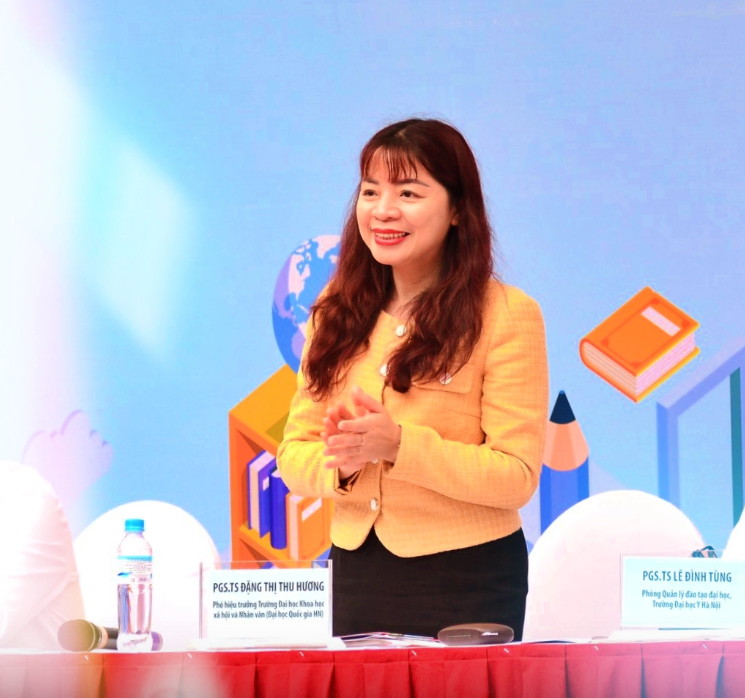
To answer these questions, the Journal of Citizenship and Education listened to the shared opinions of Associate Professor, Dr. Dang Thi Thu Huong – Vice Rector of the University of Social Sciences and Humanities, Vietnam National University, Hanoi.
Associate Professor, Dr. Dang Thi Thu Huong – Vice Rector of the University of Social Sciences and Humanities, Vietnam National University, Hanoi. Photo: Provided by the interviewee.
Emotional intelligence and human values – things that technology cannot replace in humans.
Citizenship and Education Promotion Magazine:Artificial intelligence is now capable of generating news articles. Does this pose a risk of journalists and reporters being replaced, Professor?
Associate Professor, Dr. Dang Thi Thu Huong:Big data sets enable artificial intelligence in general, and ChatGPT in particular, to provide information that is very broad, diverse across various fields and industries, and possesses considerable depth.
Therefore, from a certain perspective, we can also see that the information and knowledge value that ChatGPT brings to the public is very meaningful and practical.
In the workplace, ChatGPT can support reporters in many activities. However, to produce a complete journalistic product, in addition to compiled information and data, it needs to contain the emotional intelligence of the journalist and elements related to human values.
This is something that artificial intelligence systems may not be able to achieve. Furthermore, our audience is also human, possessing both intellectual and emotional intelligence. Certainly, artificial intelligence cannot replace reporters and journalists.
Citizenship and Education Promotion Magazine:What is your assessment, Associate Professor, of the impact of artificial intelligence on journalism training today?
Associate Professor, Dr. Dang Thi Thu Huong:In fact, artificial intelligence is impacting education and training in general, not just the field of journalism.
Many questions arise: with ChatGPT already full of knowledge, data, and information, is it really necessary for students to go to school? What will teachers teach?
We see that in educational technology, there are many changes that help make educational activities more effective and of higher quality.
However, teachers not only impart knowledge to their students, but also develop their abilities and foster a balanced physical and mental development.
Therefore, ChatGPT cannot replace teachers and schools, not to mention that the tool's data system is still only updated to 2021.
With its mission to guide, direct, and develop the comprehensive abilities and qualities of learners, school-based education today remains the foundation for optimal student learning.
However, educators also need to change their teaching methods and content to not only adapt but also grasp and leverage the advantages of technology in their training activities. Educators also need digital competence to be able to guide and equip students with digital skills in the context of today's rapidly developing technology.
Artificial intelligence – a challenge for journalism students?
Citizenship and Education Promotion Magazine:Recently, a television channel in Ho Chi Minh City used ChatGPT to create a television program, and the text generated by this application was considered equivalent to that of an editor with 1 to 2 years of experience. Is this a challenge for recent graduates, having to compete with artificial intelligence, Professor?
Associate Professor, Dr. Dang Thi Thu Huong:As I just shared, in terms of data processing, ChatGPT can potentially replace some of the tasks that recent graduates have to perform.
But I maintain that ChatGPT cannot replace newly hired reporters because ChatGPT lacks the experience and emotion needed for articles that can touch the hearts of the public, understand public needs, and have a humane impact on people's emotions.
However, the emergence of artificial intelligence motivates students to strive harder, equipping and integrating their abilities to perceive information, analyze, and interpret problems. This helps them to freely explore, accumulate knowledge, and maximize their creativity, rather than learning rote, rigid knowledge.
In addition, students need to master technology skills so they know how to utilize and exploit technology, including artificial intelligence, to reduce their own labor and create higher quality and more efficient products.
Citizenship and Education Promotion Magazine:Is this too much pressure for students to have to learn so many things, in addition to professional skills, cultural and social knowledge, and also to keep up with and master artificial intelligence technology for their work?
Associate Professor, Dr. Dang Thi Thu Huong:In a university environment, students are taught how to think, not just the content of their thoughts; they are guided on how to learn, not just what they need to learn. Students need to know how to "stand on the shoulders of giants."
The key is active learning, not rote memorization. Technology can store vast amounts of information and data, while our brains have limited memory capacity.
If we rely on rote learning and passive learning, humans can never compare to artificial intelligence. However, with methodical learning, students will acquire research skills, work skills, the ability to master knowledge, self-reliance, life skills, and lifelong learning skills.
Thank you, Associate Professor, Dr. Dang Thi Thu Huong, for your insights!