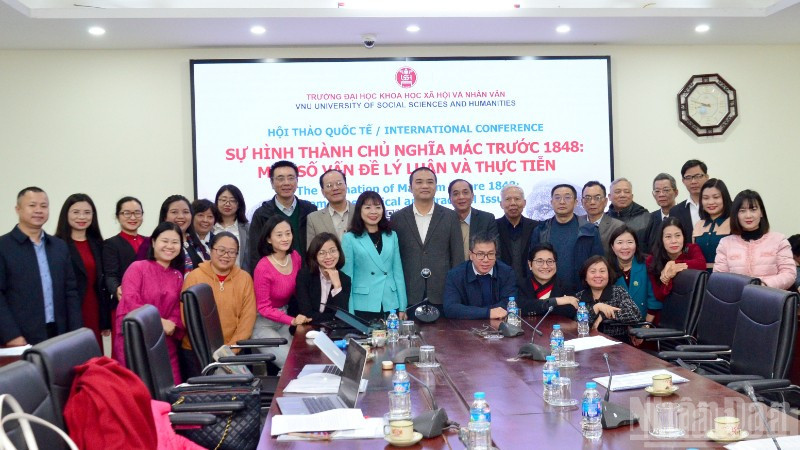
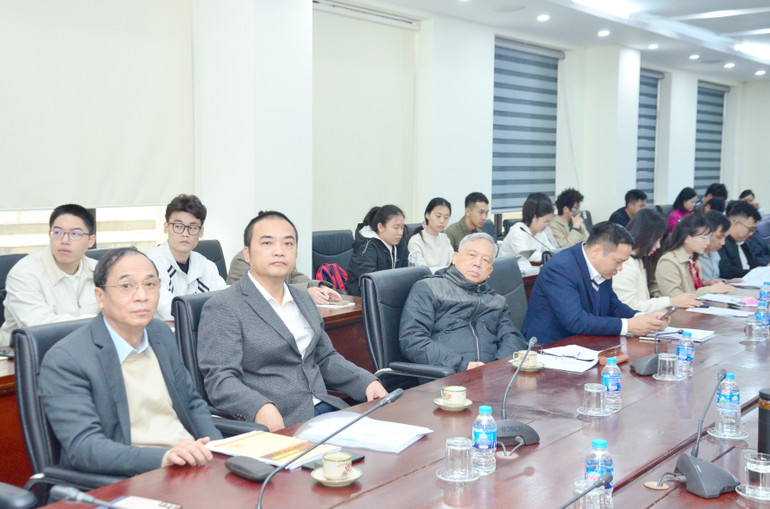
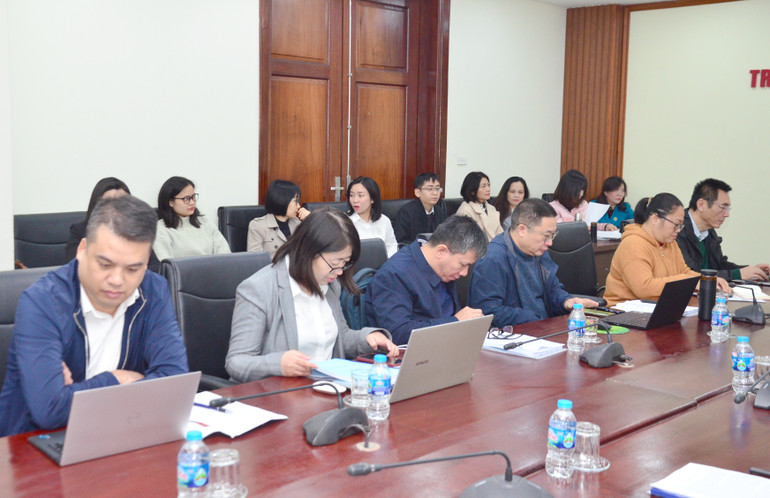
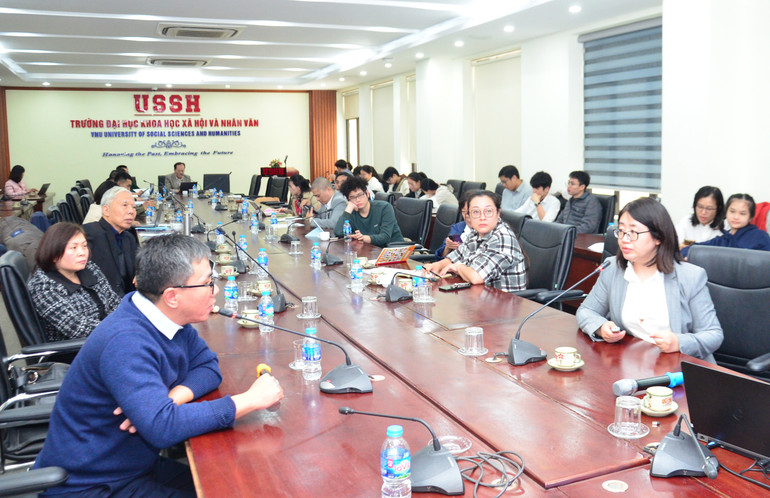
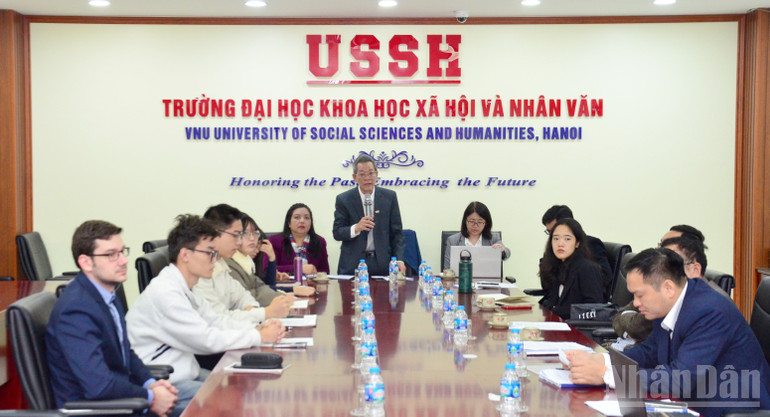
International conference “The Formation of Marxism Before 1848 – Some Theoretical and Practical Issues”. (Photo: PHAM CUONG)
The workshop was attended by Associate Professor, Dr. Dang Thi Thu Huong, Vice Rector of the University of Social Sciences and Humanities; Dr. Pham Hoang Giang, Head of the Philosophy Department, University of Social Sciences and Humanities; scientists, administrators; lecturers, trainees, and students from universities and research institutes in Vietnam and some universities in China and France.
According to the organizers, the conference attracted more than 90 papers from scholars both domestically and internationally. The conference discussed a special period in the development of Marxism as well as in modern Western history.
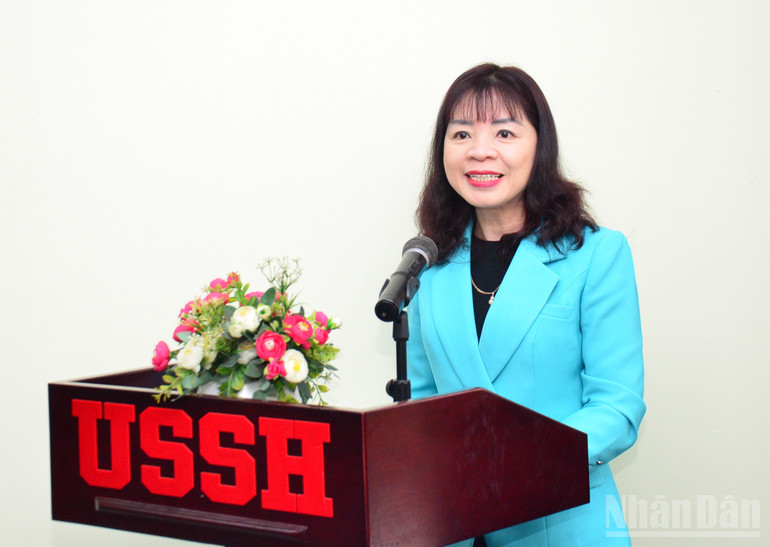
In her opening remarks at the conference, Associate Professor, Dr. Dang Thi Thu Huong, Vice Rector of the University of Social Sciences and Humanities, stated that the period 1838-1848 was a vast theoretical "laboratory" for Western thinkers and social activists. Within the confined space of a decade, we witnessed a compression of historical events and an explosion of world-shaping ideas.
Associate Professor, Dr. Dang Thi Thu Huong, Vice Rector of the University of Social Sciences and Humanities, delivered the opening remarks at the workshop. (Photo: PHAM CUONG)
Marxism emerged in such a revolutionary context. The formation of Marxism was not a linear, smooth accumulation of ideas, but rather a series of dramatic transformations, decisive breaks with the Young Hegelians to establish a completely new epistemological foundation. This was the arduous journey of Marx and Engels as they stepped out of the shadow of idealism and their role as democratic intellectuals to become radical materialists and committed proletarian revolutionaries.
According to Associate Professor, Dr. Dang Thi Thu Huong, Marx and Engels, like all other great philosophers, were not born with a pre-existing materialist or idealist stance; their cognitive and practical concerns led them to solutions that tended towards either materialism or idealism to varying degrees.
The shift in the positions of Marx and Engels was the result of reflections imbued with a humanitarian spirit and realistic political struggles.
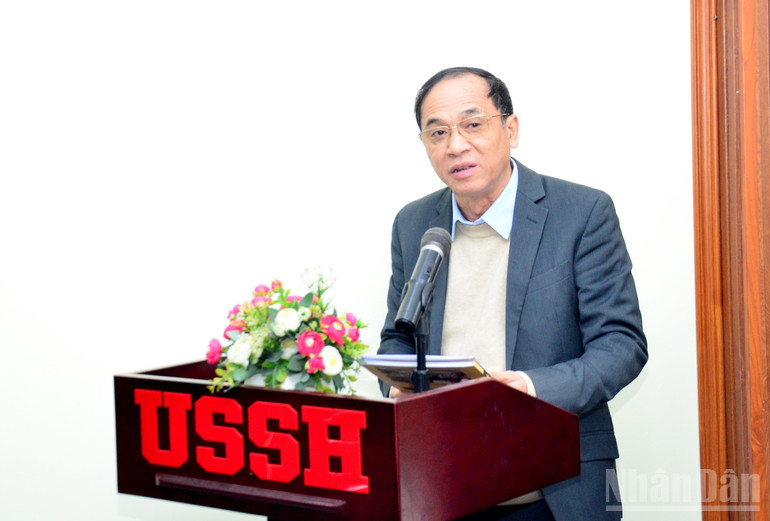
Professor, Dr. Nguyen Quang Hung, University of Social Sciences and Humanities, delivered the opening remarks at the conference. (Photo: PHAM CUONG)
Associate Professor, Dr. Dang Thi Thu Huong hopes that the conference will lead to a more dialectical view of Marx and Engels as "realistic individuals," "realistic philosophers" in their dynamic concerns, movements, and transformations. This conference will clarify how social reality and workers' movements from England to France and Germany provided empirical data for Marx and Engels to construct their scientific theories...
In his opening remarks at the conference, Professor Dr. Nguyen Quang Hung from the University of Social Sciences and Humanities outlined the contemporary context of Marx's legacy, stating that it is now vastly different from what humanity experienced in the 19th century. The conference provided an opportunity to assess and re-examine all of Marx's legacy, particularly that of his youth.
The workshop attracted a large number of scientists, managers, lecturers, trainees, and students from universities and research institutes in Vietnam, as well as some universities in China and France. (Photo: PHAM CUONG)
Reviewing some of Marx's early works, Professor and Doctor Nguyen Quang Hung clearly outlines Marx's path from following the Young Hegelian school to standing on his own two feet. In particular, the "German ideology" officially confirms that Marx and Engels truly stood on their own two feet, where historical materialism is most fully expressed, and where their worldviews and philosophies of life are clearly demonstrated.
Professor, Dr. Nguyen Quang Hung highlighted several indispensable points in the legacy of Marx's youth. The most noteworthy aspect of the legacy of Marx and Engels in their youth is the expression of humanism and humanitarianism in their writings. Marx and Engels emphasized human dignity and worth, fighting for fundamental human rights and social justice. This is one of the reasons why Western studies pay so much attention to the legacies of these two men in their youth.
Professor and Doctor Nguyen Quang Hung affirmed that, over the past century, few thinkers in the history of human thought have received as much attention and research as Marx's legacy. However, Marx's legacy is inevitably somewhat outdated compared to the times, not only due to changes in the economy and political institutions, but also because of the achievements of science and technology. Despite different approaches, the spirit of Marx's early life, as demonstrated by the conference, must be clarified to be relevant to the current context, given the challenges facing philosophy in the age of artificial intelligence.
Delegates from universities in China present their papers at the conference. (Photo: PHAM CUONG)
The workshop, with its two subcommittees, discussed and clarified issues surrounding the formation of dialectical materialism and historical materialism; and the formation and development of Marxist philosophy before 1848 in relation to the formation of Marxism.
The conference unanimously agreed that the formation of Marxism before 1848 was not a sudden outburst, but rather a arduous journey of self-development, criticism, and transcendence. Marx made decisive transitions from the philosophy of a young Hegelian to that of an independent thinker.
Within the context of scientific socialism, the reports and presentations at the conference addressed Marx's ideas regarding the significance of building the workers' movement; the historical mission of the working class; human liberation linked to the development of the Vietnamese people today; and the role of the digital economy and socio-economic development in Vietnam.
Associate Professor, Dr. Nguyen Anh Tuan, University of Social Sciences and Humanities, chaired the discussion in Subcommittee 2 on the contents of scientific socialism and other issues at the conference. (Photo: PHAM CUONG)
In his concluding remarks at the conference, Associate Professor, Dr. Nguyen Anh Tuan emphasized that the conference had deciphered the enduring vitality of "Young Marx" – a pivotal period marked by great shifts from Hegelian philosophy to dialectical materialism and historical materialism. In particular, the conference clarified the intellectual journey from Marx's initial concerns to its culmination in the Communist Manifesto.
Associate Professor, Dr. Nguyen Anh Tuan emphasized that the conference affirmed that the dialectical spirit and method, the materialist worldview, and the humanist ideals in Marx's works before 1848 remain invaluable assets. Studying this period helps to correctly understand the roots of Marxism, aiming to protect the scientific validity of the doctrine against distortions by hostile forces; and at the same time, to seek new ideological resources for the struggle for sustainable development, continuing to illuminate Vietnam's path to socialism.