
Training based on regional studies
The Faculty of Oriental Studies, University of Social Sciences and Humanities, is responsible for training bachelor's degree holders in five specializations: Japanese Studies, Korean Studies, Chinese Studies, Indian Studies, and Southeast Asian Studies.
Associate Professor Dr. Le Dinh Chinh stated that students trained at the Faculty of Oriental Studies must complete 14 mandatory English credits and 47 credits of specialized foreign languages relevant to each student's field of study.
Compared to other training institutions, students in the Faculty of Oriental Studies not only receive foreign language training but also have a solid foundation in regional studies. Each student in the Faculty of Oriental Studies must complete 138 credits divided into 5 program blocks. These program blocks, designated M1 to M5, include general subjects of the Social Sciences and Humanities as well as regional studies specific to the major. Specifically:
- Blocks M1 and M2 are general courses prescribed by Vietnam National University, Hanoi for the Social Sciences and Humanities group;
- Block M3 consists of foundational courses for the Department of Oriental Studies;
- The M4 and M5 courses are specialized subjects on the East – equipping students with an overview of the region in Oriental studies.
“With those five blocks of knowledge, graduates have both a general university knowledge base and regional studies knowledge. That is a characteristic of the Faculty of Oriental Studies,” shared Associate Professor Dr. Le Dinh Chinh.
Modern, up-to-date, and systematic are the main features of the Faculty's training program. Not only does it have a standard curriculum, but the Faculty also continuously receives support in terms of textbooks and research materials from universities in the region. Speaking about the Faculty's teaching staff, Assoc. Prof. Dr. Le Dinh Chinh affirmed:These are PhDs and Master's degree holders who are former students of the Faculty, trained abroad, and then returned to become lecturers, so they are highly qualified and experienced professionals."
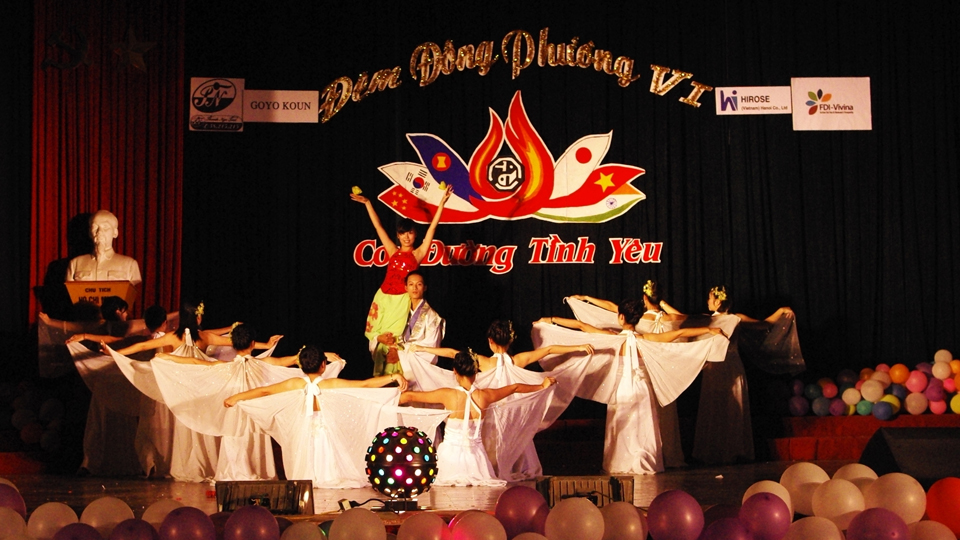
A cultural performance by students of the Faculty of Oriental Studies, University of Social Sciences and Humanities.
Many study abroad opportunities
Scholarships, study abroad programs, and overseas internships are a major attraction of the department. The Department of Oriental Studies is one of the leading departments in terms of collaborative relationships with prestigious universities in the region and around the world. Every year, students of the Department receive scholarships from partner universities, embassies, or foreign businesses such as the Japan Foundation, Korea Foundation, Toshiba Foundation, etc.
In addition, students of the Faculty of Oriental Studies have the opportunity to participate in exchange programs, study abroad scholarships, and internships in many advanced countries relevant to their field of study.In our training program, we design many courses that are compatible with the curricula of other countries, allowing students to earn credits during their exchange program."—Associate Professor Dr. Le Dinh Chinh added.
After graduation, students of the Faculty of Oriental Studies can further enhance their professional skills and receive scholarships to pursue Master's and Doctoral degrees in countries such as China, Thailand, Japan, South Korea, India, Iran, Singapore, etc.
100% employment rate after graduation.
When we expressed our concerns about the industry's manpower needs, Associate Professor Dr. Le Dinh Chinh confidently stated:For the field of Oriental Studies, it can be said that 'supply does not meet demand'. According to the latest statistics, 100% of students graduating in the 2013 cohort (K54) have found employment."
Graduates from the Faculty of Oriental Studies have many opportunities to choose from a variety of job positions. With their foreign language skills and specialized knowledge, students in this field can work in Vietnamese state agencies and organizations such as: diplomatic agencies, foreign representative offices, teaching at universities, social science research institutes, news agencies, central and local radio and television stations. In addition, graduates in Oriental Studies can also work at foreign embassies, international organizations, tourism companies, and private and foreign businesses located in Vietnam.
Author:Huong Giang
Newer news
Older news

