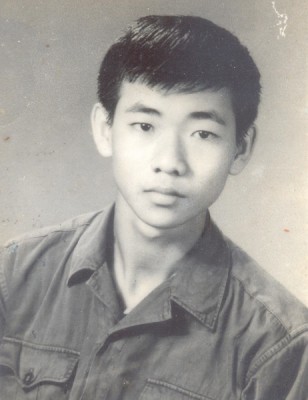
Associate Professor Pham Thanh Hung - Vice Dean of the Faculty of Literature, a student of the 15th cohort of the Faculty of Linguistics and Literature - was one of hundreds of students from Hanoi University who donned military uniforms and went to the front lines to fulfill their civic duty when the country was under enemy attack. Even now, the impression of the ferocity and tragedy of war remains in his heart as a lingering, unceasing sorrow…
- Could you please share your experiences of enlisting in the military while you were a student at Hanoi University?I and hundreds of students from Hanoi University set off in the autumn of 1971. September of that year was also the flood season. Hanoi was on red alert because the Red River dike might break. Before leaving, I even participated in flood relief work for the Faculty of Literature. The work was simple: just carrying library books from the first floor to the fourth floor, in case the dike broke, the school was flooded, and the books were damaged. Carrying the heavy textbooks up each step of the stairs, my heart was filled with mixed emotions: Was I protecting these books for myself or for someone else? After the war, would I live to return and read these textbooks? Vietnamese poetry has some very beautiful lines about the departure of Hanoi soldiers during the nationwide resistance war:
I remember the night I left, the sky and earth ablaze / The entire city engulfed in flames behind me...." or "
The one who leaves does not look back / Behind them, the sunlit steps are covered with fallen leaves....". In 1971, we set off, with no fire behind us, no sunlight on the doorstep. Behind us, the student soldiers, were vast stretches of silvery water. Water flooded the potato fields in the suburbs, submerged the entire Yen Vien train station, and many rice warehouses preparing to be transported to the battlefield were submerged meters deep. We gave our unfinished notebooks to our girlfriends. Paper was very scarce then, so we had to write in small letters, carefully and sparingly saving each page. Friends didn't have much time to say goodbye, to shed tears. Some went to the battlefield, others went to help with the floods. The North was hastily preparing ammunition, rice, and new recruits. The South was silent, without the sound of gunfire. But that was a very suspicious silence of war. The country was like a soldier, silent because it needed to hold its breath to prepare to pull the trigger: the 1972 campaign was about to begin."
- At that time, what was the impression of the war so intense for a young intellectual like you?My most vivid memory of war was my first battle as a soldier. An enemy bullet grazed my ear, my helmet spun halfway, and I felt dizzy… When crossing the Ben Hai River, I thought to myself, "No matter what, I must become a hero in battle, or at most, a poet." But when I was hit by the first bullet, I felt a chill down my spine and thought to myself: "Perhaps my nerves aren't suited to being a hero. And I'm already trembling like this; even writing poetry would be difficult!"

But
Back then, those soldier-students going to war must have had certain differences compared to their comrades?Students who enlisted in the army were usually assigned to technical units or given tasks requiring mathematical skills. For example, the martyr Nguyen Van Thac, a mathematics student who trained in the same company as me, was assigned to the infantry division (F 325), but was tasked with using a 2W radio. He died with that 2W radio on his shoulder. Generally, the number of student soldiers who fought in close combat, directly against the enemy, was not large. What set student soldiers apart was perhaps their spiritual need: they craved experience more than victory. They fought and tried to understand the nature of the war. They tried to gather information to understand the campaign's situation, predict the battlefield conditions, and international news. They pondered and reflected more deeply. Every student soldier going into battle had a diary or a notebook for recording notes. Why? It wasn't necessary to know yet. But they needed to record, because everyone had a feeling that it might be their last written record. The students of the Literature and History faculties at that time took notes for another reason: they needed to accumulate资料 (information/documents), because they felt it was their duty to be witnesses to a rare and tragic era. Their time spent in university had transformed them into intellectual warriors.
- So far, what has the time you spent as a soldier fighting directly on the battlefield meant to your life?In mid-July, I joined a group of veterans from the University of Social Sciences and Humanities in Quang Tri. Almost every year, I go to Quang Tri, visiting the Highway 9 Cemetery to light incense for my comrades and friends from my company who are resting peacefully in their scattered graves. Returning from the cemetery, I feel more at peace, more appreciative of life, and consider myself fortunate and happy. I am also proud to have fought alongside the martyrs lying silently beneath those tombstones. They sacrificed themselves like heroes, like innocent, pure, and noble young men; they fell without needing recognition for their sacrifices. I remind myself not to "dwell on the past," to try to erase the haunting memories of war, and to strive towards the future, but clearly, the wartime past has become a kind of asset, a kind of "savings." Whenever I feel sad, I take it out, savoring it and comforting myself: in my youth, I did something meaningful in life. By savoring those memories, I became more generous, more forgiving of others and of myself.
- How has the "military spirit" or soldier-like character influenced your work as a scientist and lecturer today?I think the concept of "soldierly spirit" is very general, sometimes vague. There are many types of soldiers: peacetime soldiers, wartime soldiers, office workers, technical soldiers, infantry soldiers. Perhaps we are talking about, and should be talking about, the spirit of a combat soldier. Actually, in my opinion, the lifestyle of a combat soldier negatively impacts scientific activity. Because victory is imminent, because death can strike unexpectedly, combat soldiers often don't have the habit of thinking or considering things for long. Their recklessness, freedom, daring, and disregard for life are inherent traits of soldiers. This personality isn't entirely negative. It's precisely this rebellious style and adventurous spirit that creates the charm and beauty of a soldier. But that beauty, that style, benefits art, not science. However, when discussing teaching, the classroom activities of a lecturer, the "soldierly spirit" can become a positive catalyst. Whenever I remember that I am a soldier, a wounded veteran from the Quang Tri battlefield in 1972, I feel closer to my students. Many students, after interacting with me and listening to a few of my lectures, realize that I am a soldier. They are so intelligent and perceptive. Of course, this is partly because they see me as resembling their fathers and grandfathers – people from a generation that wielded guns more than pens.
- Having been a soldier and now a lecturer, what message do you want to convey to your students through your lectures?My familiar annual appeal to students is: spend less time idling around and more time learning and mastering a foreign language. Our generation's memory was once used to record weapons and identify different types of bombs and mines. The war is over; there's no need to waste our memory anymore. Take advantage of your young brains. And a foreign language will unlock the door to the world, allowing you to go further and deeper into life.
Thank you, teacher, for your insightful sharing!