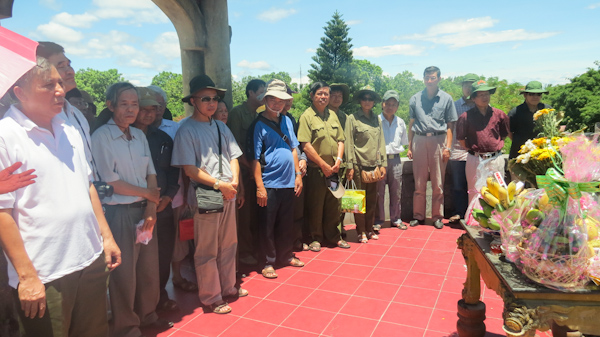
From July 11th to 15th, 2012, a group of veterans from the University of Social Sciences and Humanities, Hanoi, embarked on a meaningful "homecoming": a trip to the ancient citadel of Quang Tri and the Truong Son National Martyrs' Cemetery. This return was even more significant as, in 2012, the entire nation solemnly commemorated the 81-day and 81-night battle at the citadel, a historical turning point in our nation's resistance war against the US. Among them were those who had directly fought and left a part of their youth there. The veterans' notes will help us better understand this meaningful journey...
The 11th...As is customary, every July, when the summer heat descends, veterans from the Hanoi University of Social Sciences and Humanities gather to return to their old battlefields. This year's return is scheduled to take place at two familiar locations that evoke excitement in everyone: the Truong Son National Martyrs Cemetery and the Quang Tri Citadel. The Quang Tri Citadel holds particular significance for this trip: this year, the entire nation is solemnly commemorating the 40th anniversary of the liberation of Quang Tri province; the 40th anniversary of the 81-day and 81-night battle, an unprecedentedly fierce conflict in the history of the Vietnam War: in just over 10 hectares, the Quang Tri Citadel endured 325,000 tons of enemy bombs and bullets; and in those 81 days and nights, thousands of beloved sons and daughters of the Fatherland forever rest beneath the sacred soil of the Fatherland. Some of these sacrifices have become legendary. The 81-day and 81-night Battle of Stalingrad in Vietnam... In less than ten days, I made two trips back to lands once steeped in legend. The group was meticulously prepared by two members, now the president and vice-president of the Veterans Association of the University of Social Sciences and Humanities: Mr. Nguyen Chi Hoa and Mr. Pham Dinh Lan. The group chose an incredibly logical route: starting from Thang Long Boulevard, connecting to the historic Ho Chi Minh Trail, crossing Highway 1 along the sacred land of Nghi Xuan, the birthplace of the great national poet Nguyen Du; passing through the Ngang Pass, the "twilight" of Mrs. Huyen Thanh Quan's poem, to Dong Hoi city, once considered a bomb-laden area during the war against America. A tiring but exhilarating day of travel...
The 12th...Our return to the Ancient Citadel would have been somewhat less meaningful if we hadn't dedicated an entire day to visiting Thien Duong Cave, a natural wonder within the Phong Nha-Ke Bang cave system of the war-torn land of Quang Binh. I believe there is no other place in the world that possesses such a magnificent wonder. A Halong Bay on land? Or perhaps even more magnificent, because along its 31-kilometer length, every space here, under the skillful hand of nature, has become a "miniature paradise." Standing before this breathtaking beauty, all our imaginations proved futile... Throughout the journey along the Truong Son mountain range, now the Ho Chi Minh Trail, looking at the vast, endless, and pure green forests, we rediscovered our fervent love for our country. Coming here, living amidst the vast green of nature and mountains, one truly understands that the dream of a peaceful and happy life is actually quite simple: happiness doesn't require skyscrapers, gray concrete structures, or noisy, bustling streets. For example, even in the scorching summer heat of 38°C, upon reaching the entrance to Thien Duong Cave and witnessing the magnificent creation of nature, the temperature suddenly dropped to 20°C, just like in Sa Pa or Da Lat. I felt immense admiration and gratitude for the British explorer who discovered this wondrous cave system...
The 13th...It wasn't until the 13th that we truly set off for our destination. The driver, seemingly very familiar with these kinds of trips, suggested an incredibly logical itinerary. Our journey began early in the morning. Our first stop would be Hien Luong Bridge, the Ben Hai River, and the once-famous 17th parallel. We stopped to take some commemorative photos. How dear and beloved our country is! It turns out this is where Le Ba Duong, a soldier from Co Thanh, wrote those incredibly moving poems about the Thach Han River, and where he once wrote the lines of "divine writing": "One gun holds two skies, North and South / One footprint imprinted on the land of two regions." Before coming here, I had heard a lot about Quang Tri: a poor land, every inch of it bearing the marks of bombs, bullets, and poverty. Now, a real Quang Tri was unfolding before our eyes. Nearly 40 years after liberation, this land still bears the scars of poverty. The endless green of the Truong Son forest no longer lingers here; instead, the fields are barren, the rice plants stunted and short like grass. Even now, I haven't gotten over my embarrassment at seeing the patches of rice along the road in Quang Tri, when I confidently told veteran Nguyen Ba Thanh that they were grass. Veteran Vu Thanh Tung, who must have traveled through this area many times, knew I was mistaken and just smiled without immediately correcting me. In any case, my naivety reveals one thing: I still feel I have wronged Quang Tri and must do something for it...

This trip to the Ancient Citadel also gave me many insights, allowing me to better understand the people I've lived alongside all this time, people I hadn't fully known before. For example, without this trip, how would I have known that veteran Bui Duy Dan, usually quiet and reserved, the son of our teacher Bui Duy Tan, was once a brave warrior in the battle to capture Tri Buu Church and shed blood there? I also wouldn't have known that veteran Nguyen Van Thong once fought on the Quang Tri front. This time, he didn't forget to bring his HD handheld camera with him, explaining that it would help him record images so that his life in old age would be less monotonous. For veteran Pham Thanh Hung, this trip was even more meaningful. The Route 9 Southern Laos battlefield is where he fought during his military service. Many scars still remain on this veteran's body. But for him, there was an even deeper "wound": many of his comrades had fallen here. Throughout the journey, finding a quiet spot at the back of the bus, he resolved to "shake off" the group upon reaching Quang Tri, to go alone to the Highway 9 cemetery, "to light an incense stick for my five or six friends," with a plea, hoping that his country would have fewer bad people and "more good people" like them. Veteran Pham Dinh Lan, although not directly fighting on the Quang Tri battlefield, had marched through it. The poems he wrote for the beloved sons of the Fatherland, which the tour guide read aloud to the group at the foot of the Ancient Monument, brought tears to our eyes.
Walk softly and speak quietly.
Let my comrades rest peacefully under the grass.
The sky was also clear and breezy.
Even if it's noisy, don't shake the trees too hard.
Walk softly and speak quietly.
The ancient citadel is vast, yet my comrades lie cramped within its confines.
Every inch of land holds a real life.
I came here today with a lump in my throat.Before entering Quang Tri Ancient Citadel, we did something incredibly meaningful. The whole group visited Vinh Linh Cemetery, where martyr Tran Nhat Dinh, the older brother of Tran Nhat Chinh, who was also in the group, was laid to rest. At this cemetery, we coincidentally met and heard a fascinating and touching story from the female cemetery caretaker, whose name I didn't have time to ask. I also didn't have the chance to hear her short, moving story firsthand. But veteran Luong Van Ke, who had taken a vibrant photograph of this woman and heard her touching life story, insisted that I write something about this quiet, lovable female caretaker. I promised Luong Van Ke that if I had the opportunity, I would fulfill his request. But for now, I don't want the small notes of the group to be interrupted by a story that should be on the scale of a novel. There are many more stories worth documenting from our trip. This is the story of veteran Ngo Van Hoan. Although he retired a year ago, his return to the Ancient Citadel still fills him with excitement. Ngo Van Hoan confided that his family recently found the remains of his beloved younger brother, who fought on the Quang Tri battlefield years ago. This time, he will return with his wife, also a veteran, to the very land where his brother lies, to light an incense stick and pray for eternal peace for this land. Only when standing on the land of the Ancient Citadel, witnessing every inch of land and blade of grass, looking back at the photographs taken by military photographer Doan Cong Tinh, and reading the words in the letter written by martyr Le Van Huynh to his loved ones before his sacrifice, did I truly understand the price of the national peace we enjoy today, a price that young soldiers of my generation had to pay. Looking closely at the green of each patch of grass reaching up in the scorching summer sun of the Ancient Citadel, I seemed to have understood more than what the poet Thanh Thao wrote in his epic poem "Those Who Go to the Sea":
Eighteen, twenty years old, vibrant like grass / Thick like grass / Weary and strong like grass / We go without regretting our lives / (But how can we not regret our twenties?) / But if everyone regrets their twenties, what will be left for the Fatherland? / The grass is so vibrant and warm, isn't it, my dear?"Just beneath the soft grass inside the Ancient Citadel, in the clear waters of the Thach Han River, thousands of remains of young soldiers lie intertwined and crowded together. Surely, decades from now, the pain of the Ancient Citadel will still speak. The crumbling fragments of the Bodhi School wall that we visited later spoke volumes..."
 The 14th...
Leaving Quang Tri on the morning of the 14th, we again took the Ho Chi Minh Trail towards the Truong Son National Martyrs' Cemetery. I still have the feeling that nowhere else in our country's 63 provinces and cities has as many martyrs' cemeteries as Quang Tri. It seems that the greatest pain and loss of the war have all converged here. Almost every commune, district, and piece of land in Quang Tri holds within it the remains of beloved sons and daughters of the nation. When we arrived at Truong Son Cemetery, we understood this even more deeply. Nevertheless, we found some comfort in knowing that those who are here today have done something meaningful for those who have passed away. Truong Son Cemetery today is no less beautiful than Père Lachèse Cemetery in Paris, where I also had the opportunity to visit. I don't know exactly how many soldiers fell on the battlefield during the recent war, but visiting Truong Son Cemetery these days, the sorrow is evident on every inch of land.
My comrades lay dead, the entire regiment / In neat rows and columns.“That’s what soldier and poet Doan Trung Hoi wrote when he arrived at Truong Son Cemetery. To avoid wasting time, we assigned each of us to light incense at the graves of our respective provinces. There’s a touching story from veteran Nguyen Ba Thanh that I can’t help but tell. After searching the graves of soldiers from Ha Tinh, he discovered the name of a soldier from his village buried there. Out of gratitude, he immediately called his relatives in his village to inform them, only to learn that the soldier no longer had any living relatives. What could we do? At Truong Son Martyrs’ Cemetery, and countless other cemeteries throughout the South, there are still countless remains of soldiers whose names and addresses remain unknown. Vu Thanh Tung and Pham Thanh Hung went to the Ninh Binh graves to light incense for their loved ones. Le Van Sinh and I went to the Thanh Hoa graves. Everyone was rushing against time to try and find a familiar name. Finally, we realized,” That is no longer necessary, because all the soldiers here, near or far, nameless or unknown, aren't they our loved ones? They shed their blood and lay down their lives here so that we could have truly peaceful days...
 The 15th...
Leaving Quang Tri Ancient Citadel and Truong Son Martyrs' Cemetery, we followed the Ho Chi Minh Trail back to Hanoi. Looking back on the journey, though only a short five days, we had truly meaningful moments. Five days living together like a family: "Sharing a meal means being a family," as the former Truong Son soldier Pham Tien Duat once wrote. Female member Tang Huyen Oanh, though quite young, took care of us, preparing our meals like an older sister in the family. The team leader and deputy leader, Nguyen Chi Hoa and Pham Dinh Lan, constantly reminded us to avoid any unfortunate incidents. Veteran Nguyen Long was like a true war correspondent, always present to capture the most recent images of the group. Nguyen Van Thong diligently and quietly recorded every image with his HD video camera. Veterans Vu Quang Hien, Nguyen Huu Thu, Trinh Duc Hien, Tran Nhat Chinh, Nguyen Van Mao, Tran Van Nhue, Tran Huu Huynh, Tran Thuc Viet, Vuong Kha Dung... each carry their own memories of the war. All of them seemed rejuvenated after returning to the Ancient Citadel... Stopping by Cua Lo, finding a little coolness in the blue sea; unexpectedly meeting a large family from Kim Boi, Hoa Binh in a restaurant in Ngoc Lac - Thanh Hoa, a stranger yet so familiar; gazing at the endless green of the Truong Son forest, we truly understood the value of these days "away from the city." Thank you to the veterans of the University of Social Sciences and Humanities for thoughtfully organizing this extremely meaningful trip. Having only traveled less than a fifth of the country, we've already seen how beautiful our country is; felt less burdened by petty worries in daily life; felt a pang of sadness because our country should be "bigger, more beautiful, and more dignified." I felt that everyone living today needs to be responsible for those who have passed away... On Monday morning, returning to my daily work, I received a message from veteran Pham Thanh Hung (who had already taken a trip to Singapore with his family): "I'm standing here admiring the spaceship-shaped building in Singapore, but I'm still thinking about the Quang Tri Citadel from yesterday, sir." I assured the delegation leader, Nguyen Chi Hoa, that the trip to the Ancient Citadel by the veterans' delegation from the University of Social Sciences and Humanities had been a great success. He had contributed to that...
Quang Tri,Hanoi,July 11-15, 2012