
As a rule, life is full of memories, but the most memorable and unforgettable are those of the arduous years, the life-or-death situations, the bullets and bombs, the green grass and red chests, the journeys from which there was no return… Memories of my time in the military, when I was a naive young man, just entering school, answering the call of the sacred spirit of the mountains and rivers, I innocently volunteered to join the army like many of my peers. Joining the army, going to the battlefield of Quang Tri, the 81 days and nights of fierce fighting at the Ancient Citadel, I didn't participate fully because I was wounded early (July 18, 1972), but the memory of one battle remains vivid in my mind for the past 35 years – the battle at Tri Buu Church, a difficult, inaccessible stronghold, the bloodiest and most sacrificial battle behind the Thach Han River.
It would be absolutely inappropriate, before reminiscing about the battle, to forget to thank Viettel a thousand times over, the unit that fully sponsored the magnificent trip "A Time of Fiery Flowers." Viettel gave us the opportunity to revisit the old battlefield, something we thought we would never be able to do until the day we die. The trip was full of joyful and sad memories, reuniting with comrades who had been "missing without a trace" for the past 35 years. Now each of us has a different fate and position. We shook hands and shared stories of battles, the lives of those who suffered misfortune, and finally, pieced together a great epic written in blood and tears. Joy and nostalgia for the old scenes and stories were the shared feelings of all of us. As if foretelling the arrival of "favorable timing, location, and human harmony," that night, the ancient, barren land of Thần Cổ poured down rain. The harsh, dry land of the past welcomed us back with our comrades, filled with the sentiment of "Life sheds tears, the heavens shed rain." We wept, the earth and sky wept too, our tears mingling with the rain, soaking our comrades and permeating the earth where they rest in eternal peace.
From Dong Ha, the Viettel vehicles traveled through the villages, across the Quang Tri Bridge, and over the Thach Han River, bringing us to Quang Tri Ancient Citadel. The destination, the Ancient Citadel, now seemed so vast and easily accessible. Sitting in the vehicle, we wished it would slow down so we could reflect, listen to the marching footsteps, and imagine the chases against the enemy years ago. But what was meant to be was what happened; the Ancient Citadel appeared before our eyes, leaving behind countless memories we hadn't yet fully grasped. Getting off the vehicle, I and the veterans of Company 10—Bang, Diep, Luy, Hung, Duc…—spread out and hurried to Tri Buu Church to see firsthand the site of the fierce battle of the past.
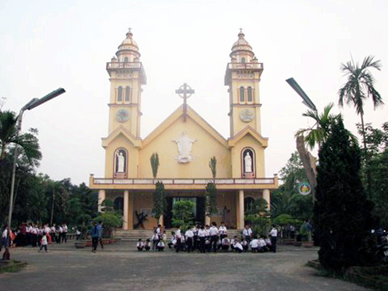
Tri Buu Church today
The group of veterans from Phu Ly – Ha Nam arrived at Tri Buu with mixed emotions. The saddest was Hung, whose younger brother had died there (his grave still undiscovered). He lit incense, wept uncontrollably, and vaguely prayed for his brother's soul in his despair. For me, Tri Buu was a vague image before, because in 1972, it was a place of shelter during the day and battles at night; the trees were bare, bricks and stones were scattered everywhere, and both our and the enemy's ancient citadels were mixed together – how could I remember? Now, having the opportunity to visit during the day, coupled with the flood of old memories, gave me a complete picture of Tri Buu. Tri Buu today is beautiful, peaceful, a symbol of the blending of religion and life. Around Tri Buu, the villages are bustling, covered in greenery, and the road remains, unnamed, yet it is a vast, open obstacle that we must overcome to reach the church. In July 1972, the Tri Buu church stood as a challenge between our forces and the enemy. Within the church were both enemy soldiers and civilians; eliminating the enemy meant eliminating civilians as well. Fighting for the people—how could we possibly do that? Despite various approaches to disperse the population and minimize bloodshed, the enemy refused to listen, stubbornly defending their position to the very end. Many times, units tasked with attacking the church encountered fierce resistance from the enemy. Both sides suffered considerable losses and casualties. Each time, upon withdrawal, we would gather up any remaining soldiers who returned to the battle, regardless of their unit. This voluntary fighting and sacrifice was a source of morale-boosting strength for our officers and soldiers. At times, we didn't even know who our commander was because they had all been killed or wounded.
On the night of July 18, 1972, orders came from above: the 9th Battalion was to engage. As night fell, my comrades and I went into battle, just like in previous battles, with our positions already set up. We, the soldiers, went wherever our superiors told us to go, attacked whenever they told us to; the entire company, perhaps more than a platoon, was deployed. I followed the unit led by Deputy Battalion Commander Kieu Ngoc Luan. After a difficult and arduous approach, we encountered fierce resistance. Flares flew overhead, planes circled overhead, and on the ground, bullets, mortars, and long-range artillery rained down. Our unit encountered a machine gun nest firing from a second-floor window of the church, making it impossible to advance. We took shelter in a small, deep bomb crater, waiting for orders from above, a momentary lapse between life and death – it was truly terrifying! That night, I was assigned to fire a B40 rocket launcher (in those days, handling firearms meant certain death), aiming at the second-floor window of the machine gun emplacement. I crouched, adjusted my aim, and pulled the trigger. The B40 rocket flew, leaving a trail of light and smoke behind. After firing, I dove into the trench, and immediately several grenades fired from some direction exploded around me. Fortunately, I was safe, but suddenly I felt a sharp pain in my temple, and when I touched it, I found blood gushing out. It was a small wound, but it was in a critical spot, so it bled profusely… Someone bandaged my head completely white and took me to the rear. A battle was still raging in front; I didn't know if I had hit anything or not. But after the B40 rocket, the enemy's machine gun fire ceased (I was later awarded the Third Class Military Merit Medal for this battle). I was transferred to the Governor's bunker. That night, we suffered many casualties; the bunker was littered with wounded soldiers, each with a different injury. The following evening, I was transferred by boat across the Thach Han River to Vinh Linh for treatment. After several months of wound treatment and recuperation, I returned to the battlefield and participated in the Battle of Cua Viet before the ceasefire stipulated in the Paris Agreement on January 27, 1973.
Recalling the old days, and the stories of soldiers, there are still so many that no ink or paper can possibly write them all down. As a veteran, I would like to once again thank the Liaison Committee of Regiment 64, Division 320B, for giving me the opportunity to share the feelings of a soldier at the end of the great patriotic war.
Author:Bui Duy Dan
Newer news
Older news

