

Humans remain at the center of an artificial intelligence society.
Reporter:Artificial intelligence and robotics are increasingly penetrating many aspects of human life. What is your assessment of the risks to employment in the coming years?
Assoc. Prof. Dr. Hoang Anh Tuan:Robots, in their simplest form, have long been present in several manufacturing sectors, and are becoming increasingly sophisticated, especially in the context of current artificial intelligence research and applications.
In recent years, in developed countries, robots are no longer limited to the manufacturing sector but are also becoming common in service industries such as reception, hotels, and libraries. Robots have even begun performing tasks previously thought to be only possible for humans: medical surgery, legal advice, lectures, and even preaching Buddhist scriptures in place of monks.
Even in Vietnam, robots have replaced the functions of library staff. This shows that the prospect of robots completely replacing humans in some technical fields is not far off.
A large number of jobs are being completely replaced by robots, especially in simple labor fields. This means that low-skilled labor markets (like Vietnam) will no longer be a competitive advantage in Society 4.0.
But that doesn't mean robots can replace every field. No matter how intelligent and advanced artificial intelligence becomes, it remains merely a tool to serve humanity.
Humans will remain at the center of an artificial intelligence society, but each individual will have to work harder to keep up with technological advancements.
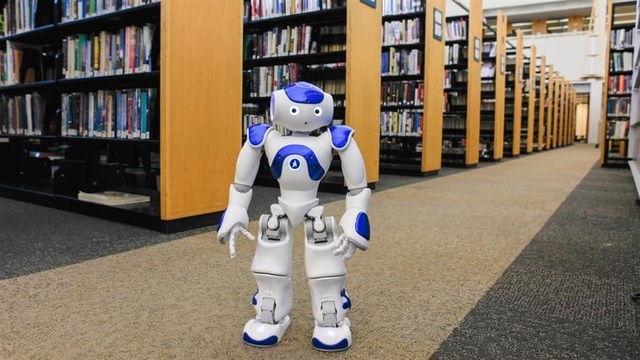
Robots replace library staff (source: internet)
Education and training: From STEM to STEAM
Reporter:This means that science and technology are playing and will continue to play a major role in an artificial intelligence society. So, what is the position of the social sciences and humanities in education, training, and the workforce, sir?
Assoc. Prof. Dr. Hoang Anh Tuan:It is a fact that in recent years, the science and technology aspect has received significant investment in education and training activities worldwide.
The STEM (Science, Technology, Engineering, Mathematics) education model best exemplifies this trend.
According to 2016 statistics, the countries with the strongest STEM development have the following annual graduation rates: China (4.7 million), India (2.6 million), the United States (0.568 million), Russia (0.561 million), Iran (0.335 million), etc. In Vietnam, the STEM education model has been popular for about a decade, especially in schools in urban areas.
However, in recent years, the STEM model has revealed its imbalance due to its "technological" tendency. People are moving towards a more balanced and comprehensive STEAM (or STEMA) model. STEAM is simply STEM + Arts (arts and humanities).
With the addition of social sciences and humanities knowledge (philosophy, ethics, history, languages, literature, etc.), the educational and training content of STEMA becomes more comprehensive and superior, because we all know that any science and technology system is built and coordinated to serve humanity.
The World Summit on Innovation in Education (WISE) and the World Economic Forum (WEF) have been leading numerous discussions related to the role of social sciences and humanities in the comprehensive development of education and careers in the future.
In Vietnam today, many educational institutions, from primary to university level, have begun to focus on transitioning to the STEAM model… This shows that the balance between science and technology with humanities and arts is and will continue to be a prevailing trend in global education in the future.
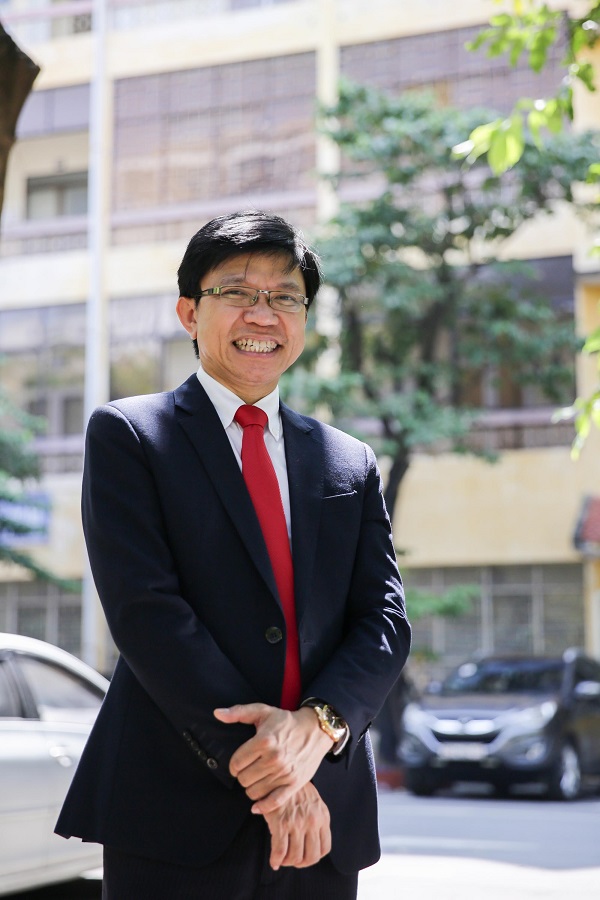
Assoc. Prof. Dr. Hoang Anh Tuan
"Digital society" demands "Digital humanism"
Reporter:So, the humanities are now recognized by the global education system as very important, with many opportunities for development in the context of the explosion of artificial intelligence?
Assoc. Prof. Dr. Hoang Anh Tuan:It is true that the fields of social sciences and humanities have very clear opportunities within the overall context of education and social activity today.
However, opportunities are just opportunities. To turn these opportunities into reality, training institutions need to be determined to innovate, integrate, and grasp current trends in order to meet the very new and different demands of the labor market in the context of the Fourth Industrial Revolution, which is changing many professional standards.
Simply put, a "digital society" requires a compatible "digital humanistic" foundation in order to coexist and develop harmoniously.
Reporter:So, what exactly is "digital humanism," and what are the challenges in innovating to embrace it, sir?
Assoc. Prof. Dr. Hoang Anh Tuan:Digital humanities is a relatively new concept in Vietnam.
Simply put, digital humanities is a social science and humanities discipline that meets the standards of the current digital age. It requires groundbreaking innovation in harmonizing traditional scientific values with modern, interdisciplinary research methods, applying modern technology, and utilizing data processing software.
For example, history and heritage preservation apply digital humanistic methods to increase accuracy and appeal.
The "Venice Time Machine" project in Italy is a vivid example of the superiority of digital humanities. This project collects and connects all information, documents, cultural heritage, etc., about the city of Venice into an open online database.
In other traditionally specialized fields such as Literature, Linguistics, Anthropology, or Philosophy, the application of digital humanities to research, training, and publishing has also yielded impressive results.
In fact, rudimentary forms of digital humanities have been used by social science and humanities experts for many years (computers, presentations, graphics, network data, etc.).
However, in the context of the rapid development of digital science today, those applications have become outdated. The rapid and powerful development of the digital humanities today necessitates that every individual working in the social sciences and humanities fields be aware of the need to update and apply new methods to their research, teaching, publishing, and other activities.

“Venice Time Machine”: a digital humanitarian project that has achieved unexpected success, not only in its historical value and heritage preservation…but also in promoting the tourism industry (Photo: Internet)
Human Resources Standard 4.0: Replace KAS with KASH
Reporter: TAccording to your assessment, the digital humanities is clearly an irresistible trend. So, from the perspective of students, what conditions do students in the social sciences and humanities fields at the university need to meet in order to succeed in the digital society?
Assoc. Prof. Dr. Hoang Anh Tuan:I've had the opportunity to discuss human resources in the context of Society 4.0 and have emphasized the importance of the KAS model, which has been widely adopted by international labor markets. KAS is a system of three main criteria for measuring the quality of human resources: knowledge, attitude, and skills.
For many decades, higher education in Vietnam typically focused solely on imparting knowledge to students. It must be acknowledged that knowledge is undeniably crucial in higher education today.
However, knowledge is only one of the components that contribute to a learner's success, especially in the context of digital knowledge, which has created an environment for self-learning and knowledge acquisition that is almost limitless through open educational resources on the internet.
Furthermore, modern occupational criteria are increasingly interdisciplinary, cross-sectoral, and technologically advanced, requiring complex skill sets and high adaptability from workers.
Simultaneously, a positive attitude and critical thinking are considered the foundation for promoting innovation and creativity based on existing knowledge and skills, and are the driving force behind social development.
Recently, global education experts have been discussing the fourth component, habits, which forms the KASH model, replacing the previous KAS model.
A system of good habits greatly determines a person's long-term success (from everyday habits like tidiness, discipline, exercise habits... to habits of reading and lifelong learning).
In some advanced education systems in Europe and America today, there is an emphasis on teaching students the habits of success, rather than just focusing on imparting knowledge. Experts believe that habits of success will help people learn throughout their lives and adapt to changes in knowledge and careers.
Therefore, I believe that graduates with KASH certification not only secure career opportunities in today's highly competitive and ever-changing job market, but also have a solid foundation for long-term success.
Universities, therefore, need to grasp this trend in order to develop appropriate training and support strategies for students.
Author:Thuy Duong (VNUMedia)
Newer news
Older news

