
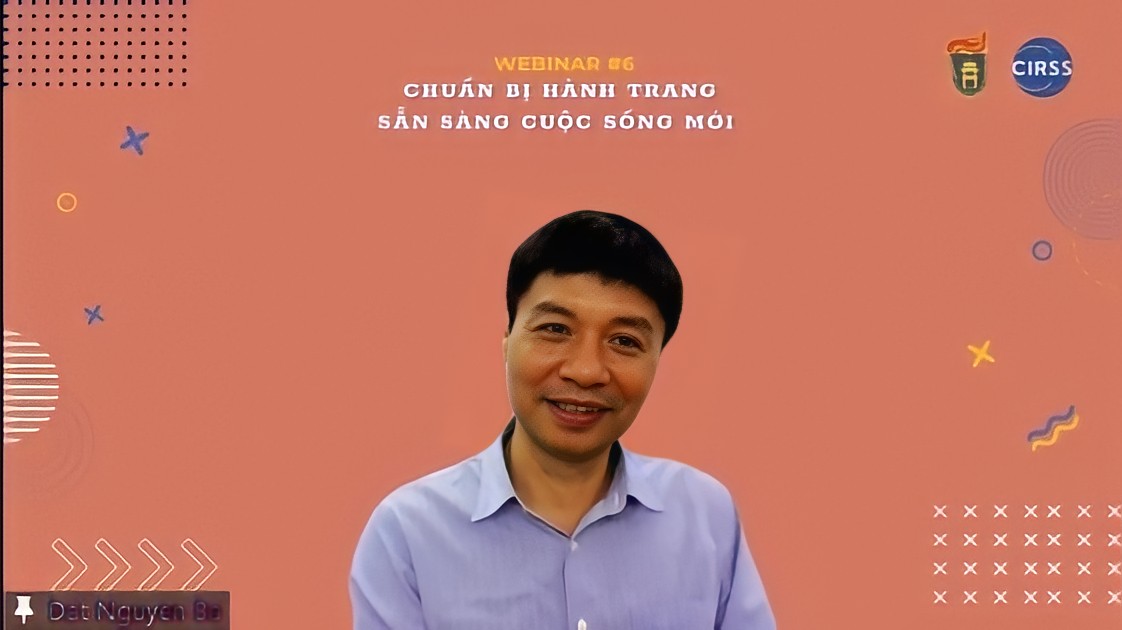
“What do young people need to prepare for when entering the labor market?”, “What skills are highly valued in the 21st century?”, “What is the secret to impressing recruiters?”... along with many other questions were answered by the speaker - Dr. Nguyen Ba Dat, Head of the Counseling Psychology Department, Faculty of Psychology, University of Social Sciences and Humanities, in the Webinar.
Opening the program, Dr. Nguyen Ba Dat shared with young people about the transition of adulthood. Everyone goes through different stages of life, associated with learning, working, and career development… Among these, the age range of 18-23 is a crucial transitional period, when we have many thoughts about ourselves and our lives, about our future paths and how to organize our lives. From there, Dr. Nguyen Ba Dat provided interesting knowledge, information, and useful skills to help young people develop themselves and become more mature in their careers.
The speaker helped the audience differentiate between the two concepts of "occupation" and "employment." An occupation is a field of labor, where individuals acquire knowledge and skills through training to produce material or intellectual products that meet the needs of society. Employment, on the other hand, is an income-generating activity not prohibited by law (according to Article 13 of the Labor Code). Importantly, a person who studies one profession can work in many different jobs, which may be more or less related to their field of study. For example, a psychology professional can work in various sectors of the labor market such as commerce, education, human resource development, healthcare, and social welfare.
To answer this, we need to address a few questions:
- What profession did you study?
- What can you do with the degree you received?
What is your purpose in entering the job market?
- What career path will you take?
Where will you look for a job?
- What abilities, qualities, and skills do you possess, and what are your shortcomings?
Furthermore, before officially entering the labor market, it is essential to equip ourselves with the knowledge, skills, and attitudes relevant to our trained profession. However, with the rapid development of science, technology, and the Internet, workers constantly need to update their abilities and skills to work in the digital space of the ever-changing 21st-century society.
Dr. Nguyen Ba Dat shared with the audience a very recent study on digital competency groups. According to the study, there are seven competency groups: Operating equipment and software; Information and data exploitation; Communication and collaboration in the digital environment; Digital safety and security; Digital content creation; Learning and developing digital skills; and Utilizing digital competencies for professional work.
Along with that, there are four highly valued professional skills in the 21st century, according to the analysis of Joseph A. Riosab and colleagues (2020): Oral communication, Written communication; Collaboration skills and Problem-solving skills.
The speaker suggested that to impress recruiters, two key elements are essential: preparation for the interview and a confident demeanor when answering questions. To best prepare for an interview, candidates should first thoroughly research common interview questions and information about the organization/company they wish to apply to. Next, candidates need to identify their own value (this is crucial for salary negotiations). Dr. Nguyen Ba Dat also offered helpful suggestions to help young people project a positive image and make a good impression on recruiters: dress appropriately, always be confident, and don't forget to showcase your unique personality!
In the final part of the sharing session, Dr. Nguyen Ba Dat expressed his views on the meaning of work and profession. For each individual, work holds unique meanings. However, generally speaking, work provides income, helping us maintain our lives, connect with society, relieve stress, and consolidate and learn new knowledge and skills. When we study and develop ourselves in a profession, we also have better job opportunities, increased income and social connections, the chance to demonstrate our individuality and gain recognition, thereby increasing our sense of happiness.
Concluding his presentation, the speaker offered advice on adapting to work and career. In this regard, the speaker particularly emphasized the importance of time. "Time is key," he said, "We need sufficient time to hone our professional skills, test our work endurance, and only then can we achieve excellence in our work and reap the rewards."
Through insightful yet relatable and simple sharing, along with the attentive responses from Speaker Dr. Nguyen Ba Dat to the submitted questions, Webinar #6 helped many young people equip themselves with more useful knowledge and skills to confidently move forward on their learning and career journey.

Webinar #6: “Preparing for a New Life” concluded the first phase of the “Psychological and Social Support for the Community” webinar series organized by the Center for Interdisciplinary Studies in Social Sciences (CIRSS). With the support of the attendees, the Center is now planning more diverse and enriching service activities in the future to continue achieving its goal of contributing positively and improving mental health for the community.
Author:Reishi
Newer news
Older news

