
One morning, half an hour before work, there was a knock on the door. I opened it, invited him in, and asked, "Why are you here so early?" He replied, his voice trembling, "There's an urgent matter I need your guidance on, Professor." I said, "What's so urgent that your voice is so shaky and shaky? It's probably not like a house fire or a dam breaking. Please sit down and have some water; we can work things out together."
He sat down, poured water for both of us, still trembling and speaking in a shaky voice, "It's better than that, Principal!" I said, "Drink some water first," then lit a cigarette and said, "Uncle Ho said that in handling work, 'Adapt to changing circumstances while maintaining core principles' and 'Make major tasks into minor ones, and minor tasks into minor ones' (let me add, this doesn't mean 'sweeping things under the rug' like today!), we still have serious and effective solutions, you know."
After finishing my second strong cup of tea, I said, "Please, sir, but don't get so emotional."
He recounted: "Last night, Ms. K from office… came to my house to ask if her child could get a job in office X, bringing a bag of grapes and apples for the children." He replied, "Just tell your child to submit an application, according to the standards and the recruitment committee will evaluate their professional skills like everyone else." He paused for a moment and raised his glass of water. I quickly said, "What's the problem? It's normal."
He hastily placed the cup of water down on the table with a slight jolt, causing the porcelain and glass tabletop to clatter loudly and angrily, saying, "If that's the case, why would I report it to the Principal?!" I remained calm and replied, "Yes, please continue. What is it that's so offensive to you?" He explained that when the colleague left, his eldest granddaughter, while putting away the fruit, found an envelope in her bag and exclaimed, "Why is there another envelope, Dad? Please give it back to her!" (To add a side note, his eldest granddaughter is a martial arts student with a black belt, taught by her martial arts master to be pure-hearted and virtuous throughout her training. Once, a thief stole a bicycle and sped off down Lo Duc Street. She saw him, chased after him, caught up, and with a martial arts move, subdued him and took him to the police station, while a neighbor looked after the bicycle.) So she was surprised to see the envelope and exclaimed like that. Hearing his daughter's words, he said, "Don't worry, I have to give it back and find a way to make them happy. This is an insult to me, my dear."
Knowing that the boss would arrive early, I came early today to confide in him and ask for his guidance on how I should handle this situation. He paused and poured himself another glass of water.
It was my turn. I lit a cigarette, then said: "Okay, it's simple, but first, you should be serious about your language and address her as 'comrade,' and from that language, I guess you already have a specific plan, so I won't elaborate. I'll just give you a general direction, based on the principle of handling this matter, and presenting it to the Party branch is the right thing to do. But is there any other way to make her feel less embarrassed? After all, it's a mother's worry. But we have to be strict, otherwise they might try to recover their investment, which would ruin the school. The important thing is to make her realize that if she feels embarrassed, she should feel embarrassed only to herself. The important thing is to reform the person. I said that, what do you think?"
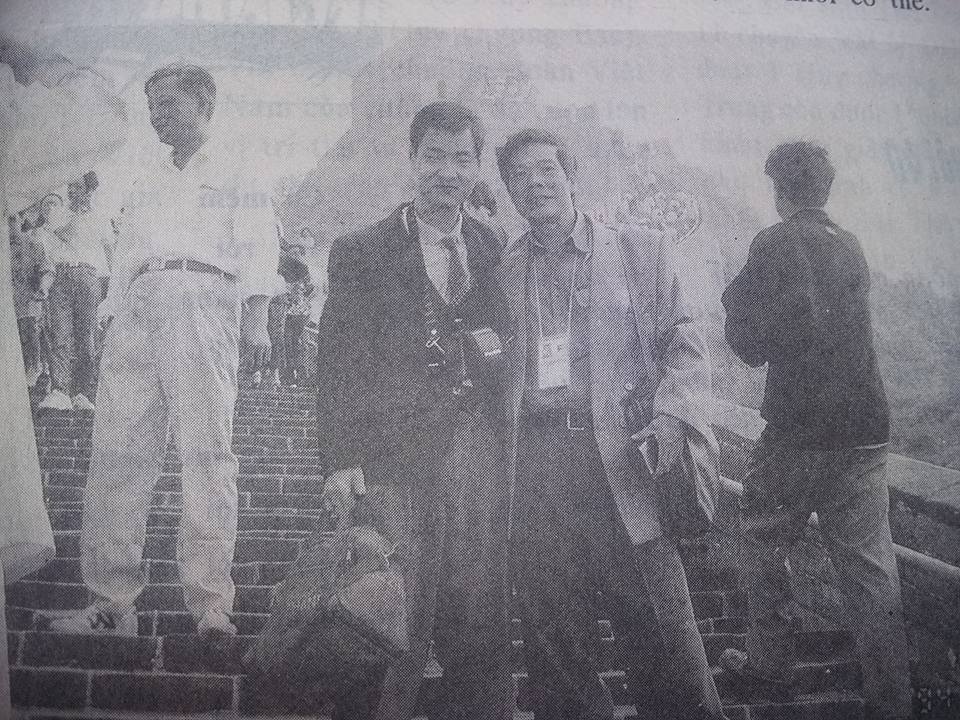
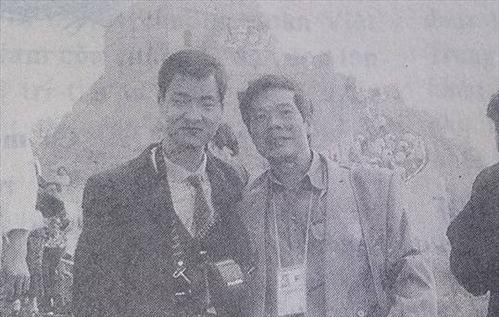
Teacher Tran Trong Cao (on the right) at the Great Wall of China.
He took another sip of water, then slowly said, "Teacher, you guessed my intention correctly. We should handle it within the Party branch first, but what you said makes sense and is reasonable. Let me think about it a bit first." I lit another cigarette, waiting for him to speak. At this point, I thought he wasn't moved by anything, but rather felt insulted, so he considered the matter more urgent than "a house fire or a dike breaking." Suddenly, I felt deeply moved and affectionate towards him. Having a Head of Organization and Personnel like him is a blessing for our school; elsewhere, this position would be one where you can "breathe fire"...
After a few minutes, he began to speak: "I'll go down to her room, talk to her, give her the envelope openly, and tell her that what she did was 'ruining' me. Is that okay, teacher?"
I chuckled and said, "Okay, sir, but let me raise another point for discussion. Perhaps you could call your wife to meet you privately, not in your office, since there are other officials present. Let's go to the meeting room. I think the content should include something like this: 'Since separating from the University and establishing our own school, no one in my department has ever accepted bribes or sent messages to get envelopes of cash. If you do that, you'll be ruining me. As a Party member, you must work with us to build professional ethics. At the end of the year, you should self-evaluate to set an example for others.' What do you think? Now it's my turn to ask for your opinion, sir!"
He jumped up, laughing, and said, "That's a great idea, actually it's only a little over a million dong, but we have to be strict because this falls under the realm of ethics." I immediately said, "That's not accurate; it should be, 'The Head of Department and the Principal clashing would be excellent,'" to be more objective. He smiled brightly, shook my hand, and said, "Okay, let's do that. I'll go implement it now!" After lunch, he went with me back to my office and I said, "It's good, sir. She was moved, her voice trembling as she apologized and thanked me for not bringing it to the disciplinary committee."
Let me elaborate on why I felt so offended. I'm the one who advocated and emphasized professional ethics, so I started instilling it in my department first. Once, a staff member from the Personnel and Organization Department called me and asked: “Ms. D returned from a business trip abroad and came to the department to handle the enrollment procedures. She gave the department gifts – a box of cookies, lipstick for the female staff, and ballpoint pens for the male staff. We refused, saying we'd take them back to the department for a celebration. She said it was just a small token of appreciation, and asked if we could accept them to make her happy and avoid complaining about the small amount. My department head is very strict, so please give us your opinion, as we're currently caught between Ms. D and the Head of Department.” She then added that a professor who had taught abroad bluntly said: “I'm not bribing anyone, but I teach, and they pay me a high salary. I'd like to give the whole department 50 USD to use as a fund for funeral expenses, to visit staff and their immediate family when needed. If you all are so serious, where would you find the money for that fund?” "I must say, I'm not stingy at all; I could easily give more, but I'm afraid you comrades might misunderstand me if you don't accept it. You ladies are so dedicated, thoughtful, and selfless in your work." She replied, "That's what you taught us, sir. We truly wouldn't dare accept such a large sum."
I replied, on behalf of the school, thank you all. You and the teachers at our school are all wonderful, helping us so much, and knowing how to maintain a humane environment together. You have not let down those who are kind, you appreciate the sharing spirit, you work together to set an example, and your words match your actions. I honestly shared this, and I welcome your trust and "confession."
At the end of the year, when approving the list of emulation titles, Comrade K's name was missing, not even for the title with the lowest reward. When I met Ms. K, I thanked her and congratulated her on not receiving any emulation titles. She was surprised and asked, "You know? Who told you that?" I replied, "I just knew because I was reviewing the emulation titles." She was even more surprised and said, "I don't understand." I said, "No one told me. A few months ago, Mr. Cao confided in me and suggested a way to talk to you about it. I supported and welcomed his approach. It's that simple." She was touched and thanked me, saying, "And yet you remained silent. You see me every day, and you never reminded me. I was so happy thinking you didn't know about it. Turns out you were the one handling it?" I said, "You're happy because I didn't know? If I reminded you, would you be happy, or would you just be worried? Right?" She replied, "Yes, thank you. So that's how you guys are. I promise I won't let you down, or let the school down." I was happy and moved: "Thank you, actually, you promised that first and foremost so you wouldn't let yourself down."
Oh, today, Mr. Tran Trong Cao, a British man, my close friend, our trusted colleague, is no longer with us! The heart of a humble war veteran, a dedicated teacher, an honest and upright administrator of the Hanoi University of Social Sciences and Humanities has stopped beating at the age of 69 and 49 years of Party membership.
We mourn the loss of our beloved teacher, a kind man, a self-respecting war veteran, a dedicated and responsible educator, a simple, ordinary man who lived with extraordinary willpower. In the school, in the school's Veterans Association, everyone knew how cruelly life had dealt him. He lost a leg to an American bomb on Route 20, the Road to Victory in the Truong Son Mountains. Even those who passed through that area, except for a few comrades, knew that it was once stained with the blood of our teacher, Mr. Cao. He persevered, passed the entrance exam to the Department of General Chemistry, trained diligently in the disabled association, and won many medals in national and international competitions for people with disabilities. He even conquered the Great Wall of China and participated in a marathon in the United States. Once, while fishing, he was struck by lightning on his way home, suffering severe burns. Fortunately, he was unharmed by bombs and bullets. His will to live was truly extraordinary! Duy, after falling seriously ill, met Anh, who was also hospitalized at the Viet Xo Hospital. He saw Anh's calm, persistent, and humorous battle against cancer, enduring the harsh pain after numerous colon and rectal surgeries and radiation therapy. Still smiling in the hospital room, Anh even lectured me about the liver – a second heart of the human body – like a true medical professional. His strength failing, he had to leave. Life and death are the natural order; humans move from nothingness to temporary dwelling in the impermanent, cruel world, only to return to nothingness. For Anh, the harshness of this impermanent world challenged and tormented him, but he lived extraordinarily well.full lessonHe was once a human being living among us, as we have witnessed. He was an ordinary man, but he lived and acted in an extraordinary way.
Dear soul of Tran Trong Cao, farewell! May you find peace in the realm of Nirvana, the land of Buddha. With deep sorrow, I bow my head in farewell. My heart is weeping, my eyes are blurred as I write this, my dear friend!
Author:Assoc. Prof. Dr. Pham Xuan Hang (Former Party Secretary and Rector of the University)
Newer news
Older news

