
On June 26th and 27th, 2008, the University of Social Sciences and Humanities (Vietnam National University, Hanoi) collaborated with San Jose State University (USA) to organize the international conference "Research and Training in Social Work in the Process of Integration and Development". The conference was attended by Prof. Dr. Vu Minh Giang - Vice Director of Vietnam National University, Hanoi, and Prof. Dr. Alice M. Hinces - Dean of the School of Social Work, San Jose State University (USA). More than 30 papers from research institutions and universities in Vietnam and the USA were presented, discussing the current state and prospects of social work in Vietnam and globally in the context of integration and development.
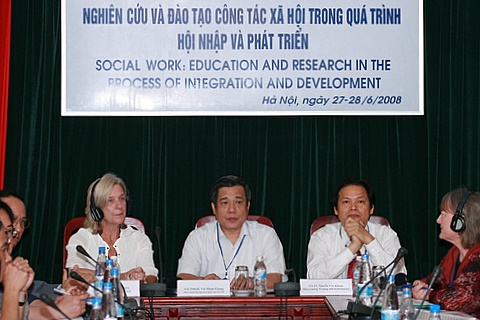
On June 26th and 27th, 2008, the University of Social Sciences and Humanities (Vietnam National University, Hanoi) collaborated with San Jose State University (USA) to organize the international conference "Research and Training in Social Work in the Process of Integration and Development". The conference was attended by Prof. Dr. Vu Minh Giang - Vice Director of Vietnam National University, Hanoi, and Prof. Dr. Alice M. Hinces - Dean of the School of Social Work, San Jose State University (USA). More than 30 papers from research institutions and universities in Vietnam and the USA were presented, discussing the current state and prospects of social work in Vietnam and globally in the context of integration and development.
 The International Federation of Social Workers (IFSF) defines it as: “Professional social work promotes social change, addresses problems in human relationships, and empowers and liberates people to improve their lives. Applying theories of human behavior and social systems, social work intervenes at the points of interaction between people and their environment. Human rights and social justice are fundamental principles of the profession.“(International Federation of Social Workers Associations - IFSW, July 2000, Montreal, Canada). Based on the above definition, the presentations at the conference affirmed that social work is a field that is increasingly playing an important role in the process of achieving social equality and progress. Over more than half a century of formation and development, as a science and a profession, social work has gradually built and perfected theories and approaches, and practiced professional skills to contribute to solving social problems related to the lives of individuals, groups, and vulnerable communities. Social work has been and is contributing to promoting social change towards empowering and liberating people, awakening their potential.”
 In Vietnam, at the beginning of 2001, the Ministry of Education and Training signed a decision to establish an advisory council to develop a framework curriculum for the Social Work major at the university and college levels. In 2004, the Ministry of Education and Training issued the framework curriculum for university-level Social Work programs at the university and college levels. Currently, more than 30 training institutions are enrolling students in Bachelor of Social Work programs. However, Social Work is currently facing many difficulties: the overall demand for Social Work is relatively large, but the labor market for this field remains quite abstract; various levels and sectors have gradually paid attention to this new profession, but not in a coordinated manner; the teaching staff specializing in Social Work is still insufficient and lacks the necessary expertise due to a lack of formal training in Social Work; teaching materials, textbooks, and lectures are lacking and outdated. Cooperation with international organizations and training institutions is still limited and not commensurate with the specific characteristics and position of the profession... These reasons lead to a lack of professionalism among social work staff, who work only on the basis of enthusiasm and personal experience.
 Proposing solutions to overcome these challenges, the reports all affirm that: For Vietnamese social work to integrate and develop, there needs to be coordinated cooperation among schools, agencies, and organizations within the country, as well as active support from international organizations. However, the most important factor remains the enthusiasm and dedication of the lecturers, students, and staff who are currently, and will be, working in social work now and in the future.
In addition to addressing the major challenges facing the social work profession, some reports also analyze and highlight the current state of social work development related to specific fields and target groups, such as: social work in child protection; social work in preventing domestic violence; social work in healthcare and hospitals; group social work with juvenile offenders; social work with young people undergoing drug rehabilitation; social work in community health, etc. Other reports delve deeply into professional ethics and cultural barriers faced by social workers; and lessons learned from the development of social work in the United States.
Author:thanhha
Newer news
Older news

