

This page commemorates the 80th anniversary of the school's tradition and 30 years of development.University of Social Sciences and Humanities

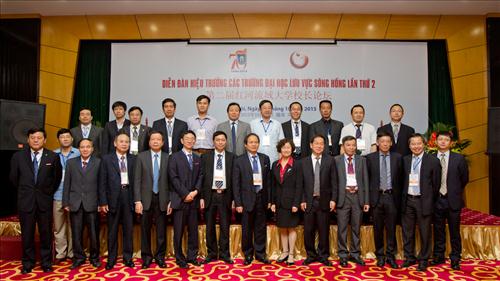

Leaders of universities in the Red River Delta pose for a group photo at the forum.
Attending the forum were Dr. Trinh Ngoc Thach, Vice Chairman of the National Assembly's Committee on Culture, Education, Youth and Children; Dr. Nguyen Xuan Cuong, Vice Director of the Institute of Chinese Studies, Vietnam Academy of Social Sciences; and Prof. Dr. Nguyen Van Khanh, Rector of the University of Social Sciences and Humanities. From China, invited guests included Ms. Liu Xiaoshan, Vice Director of the Education Department of Yunnan Province; Prof. Cam Tuyet Xuan, Rector of Honghe Academy (China); and representatives from 17 participating member universities.
Reality demands cooperation.
From a national perspective, both Vietnam and China are connected by numerous historical, cultural, political, economic, and social ties. However, both regions possess unique characteristics unlike other areas. The geographical proximity and cross-border interactions among the inhabitants of the Red River basin are crucial prerequisites for intergovernmental cooperation and integration.
To develop a comprehensive and sustainable development strategy, governments and communities alike need fundamental, systematic, and interdisciplinary research to propose appropriate policies and solutions. In this process, collaboration among scientists, combining modern theories with local knowledge, is essential. Therefore, communities and experts from universities located in the Red River basin are crucial factors in promoting this development.

Professor, Doctor, People's Teacher Nguyen Van Khanh, Rector of the University of Social Sciences and Humanities, Vietnam National University, Hanoi, delivered the opening remarks at the forum.
In light of this situation, in January 2014, at Honghe University (China), leaders of universities in the Red River Delta (including provinces in southern China and northern Vietnam) discussed and made a historic decision to establish the "Forum of Rectors of Universities in the Red River Delta" with the goal of strengthening cooperation in training and research between universities in the Red River Delta. This is the first and most significant initiative, opening up opportunities to find common ground and contribute more directly and significantly to the rapid and sustainable development of both Vietnam and China, primarily in the northern region of Vietnam and southwestern China.
Key objectives in the development orientation
Currently, for each country to achieve sustainable development, regional and international integration is an inevitable trend. In such a trend, universities in the Red River Delta need to strengthen cooperation and exchange to contribute to promoting socio-economic development between the two Red River sub-regions of the two countries.
The responsibility of higher education institutions is to provide human resources for society. To train high-quality human resources, universities in the Red River Delta need stronger cooperation. High-quality human resources should be those with good professional skills and qualifications, suitable for the socio-economic development needs of the region. Furthermore, this workforce must possess the language skills to work effectively for Vietnam, China, and other neighboring countries.
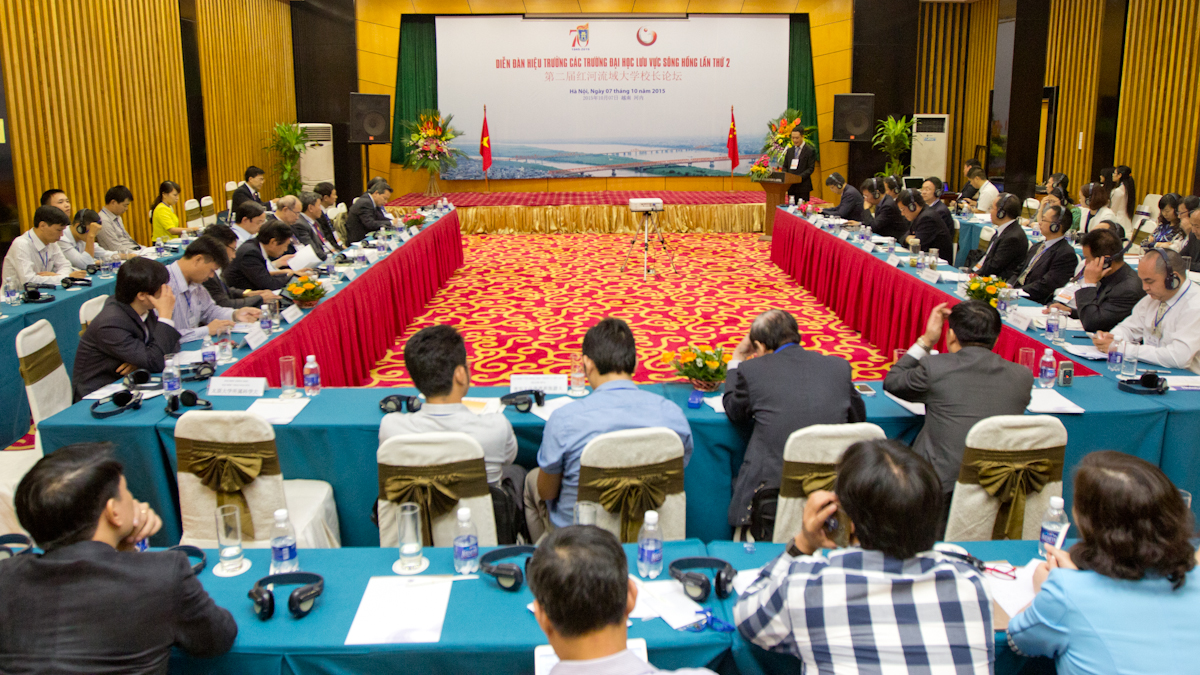
Overview of the forum of university rectors in the Red River Delta
Besides the need for cooperation in training high-quality human resources, universities also need to cooperate in scientific research to address climate change trends and protect the environment to ensure sustainable development in the region.
Currently, due to the impact of climate change, the Earth is warming, sea levels are rising, causing persistent flooding in coastal countries, and freshwater sources in rivers and streams are becoming increasingly scarce. Under these conditions, the Red River, originating in Dali (China), is also at risk of depletion and, in particular, pollution due to the effects of climate change, especially human activities such as wasteful exploitation and use. Furthermore, forest fires, earthquakes, flash floods, and storms are becoming increasingly frequent and unpredictable. This necessitates the two countries to unite and work together to control these severe natural disasters that threaten human safety and socio-economic development every day and every hour. Therefore, scientific cooperation between universities in the Red River basin is extremely urgent and necessary at this time.
Some suggestions for the future.
In his speech, Professor Nguyen Van Khanh, Rector of the University of Social Sciences and Humanities, Vietnam National University, Hanoi, also offered several suggestions for future cooperation between universities in the Red River Delta.
Firstly, universities in the Red River Delta region need to develop common training programs that are suitable to the development requirements of society and the existing capabilities of the universities. These common programs must be consistent with the requirements of "Vietnamese Studies," "Chinese Studies," and "Southeast Asian Studies."
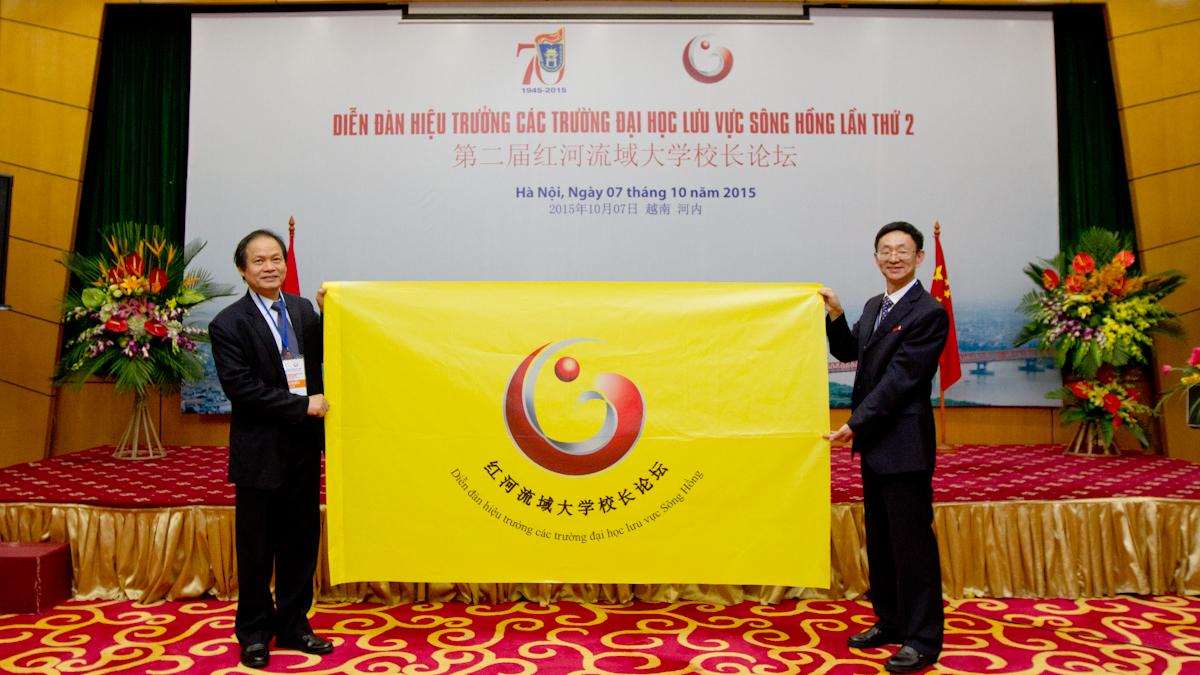
Professor Nguyen Van Khanh (left) hands over the flag for hosting the 3rd Presidents' Forum to Dali University (China).
Secondly, universities in the river basin region may"Establishing joint training facilities"In neighboring countries, universities in the basin can identify their strengths and establish joint training facilities with suitable partner universities. By accurately identifying workforce needs and developing appropriate cooperation programs, universities can find suitable ways to support each other in collaborative training.
Thirdly, there is the need for cooperation among schools in the region. In the Red River Delta, the natural and human geographical location is an invaluable resource for tourism development that is not found everywhere. Schools in the region need to have joint training programs on regional tourism to make a significant contribution to the socio-economic development of Yunnan Province and the northern provinces of Vietnam.
As a leading university in Vietnam, the University of Social Sciences and Humanities, Vietnam National University, Hanoi, can provide universities in the region with training programs in social sciences and humanities, primarily in language (Vietnamese) to supply high-quality human resources for other universities.
|
The Forum of University Presidents of the Red River Basin was founded and first held in January 2014 at Honghe University, China, with 12 members (currently 17 members have joined). This is a regional educational organization aiming to promote the exchange of faculty and students, cooperation in training, collaboration in scientific research, and to enhance mutual understanding and friendship between the two sides. Some of the achievements (2014-2015): - Training cooperation: 1+3 and 3+1 cooperation models are being implemented between schools in the Hong Ha Academy - Thai Nguyen University, Hung Vuong University; Hanoi University of Social Sciences and Humanities - Southwest Forestry University, Yunnan Nationalities University, Yunnan University of Finance and Economics… Linkages between Chinese universities and provinces in Vietnam. Chinese universities sign direct training cooperation agreements with Vietnamese provinces that need human resource training, such as Honghe Academy signing a training cooperation agreement with Lao Cai province in Vietnam; Yunnan University of Economics and Finance training for Lai Chau province in Vietnam… Last year, Honghe Academy (China) also initiated a collaboration between member universities of the Association, raising the level of postgraduate training to a high standard. This model of cooperation between member universities has yielded many positive results and can serve as a model for similar collaborations among member universities in the future. - Regarding scientific research: Scientific research in universities has received much more attention, and research conditions have gradually improved. Many scientific research collaborations have taken place, such as the Hong Ha Academy signing a cooperation agreement to implement a series of research projects related to ethnicity, cross-border issues, border trade economics, etc., with the Institute of Chinese Studies, Vietnam Academy of Social Sciences; the University of Social Sciences and Humanities, Vietnam National University, Hanoi, the Department of Culture, Sports and Tourism of Lao Cai province, and the Hong Ha Academy have collaborated for many years to organize numerous seminars related to the Red River basin… - Cultural and sports exchange: In March 2015, the University of Social Sciences and Humanities, Vietnam National University, Hanoi, Hong Ha Academy, and Lao Cai province jointly organized a cultural and sports exchange in Lao Cai, a biennial event. |
Author:Phuong Chi
Newer news
Older news